 Back
BackPopulation Growth and Ecological Dynamics in Yellowstone Bison
Study Guide - Smart Notes
 Tailored notes based on your materials, expanded with key definitions, examples, and context.
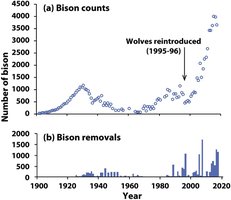
Q18. Panel (a) shows the bison population in Yellowstone National Park’s northern range. What type of population growth has been occurring since 2000?
Background
Topic: Population Ecology
This question is testing your understanding of population growth models, specifically how populations change over time in response to environmental factors and carrying capacity.
Key Terms and Concepts:
Exponential Growth: Rapid population increase when resources are unlimited.
Logistic Growth: Population growth that slows as it approaches carrying capacity due to limited resources.
Density-dependent Growth: Growth rate affected by population density (e.g., competition, predation).
Density-independent Growth: Growth rate affected by factors unrelated to population density (e.g., weather).
Carrying Capacity (K): Maximum population size that the environment can sustain.
Step-by-Step Guidance
Examine the graph in panel (a) to observe the trend in bison population counts since 2000. Notice whether the population is increasing rapidly, leveling off, or fluctuating.
Consider the shape of the curve: Is it a J-shaped curve (exponential) or an S-shaped curve (logistic)? Logistic growth typically shows a rapid increase followed by a plateau as the population nears carrying capacity.
Think about the ecological factors that might influence bison population growth, such as resource availability, predation (wolves were reintroduced), and management actions (see panel b for removals).
Compare the population trend to the definitions of density-dependent and density-independent growth. Density-dependent factors often cause population growth to slow as density increases.
Try solving on your own before revealing the answer!
Final Answer: Logistic growth
The bison population shows a rapid increase followed by a leveling off, which is characteristic of logistic growth. This pattern suggests the population is approaching the carrying capacity of the environment, with density-dependent factors (such as predation and resource limitation) influencing growth.
