 Back
BackPopulation Growth and Ecological State Shifts: Step-by-Step Guidance
Study Guide - Smart Notes
 Tailored notes based on your materials, expanded with key definitions, examples, and context.
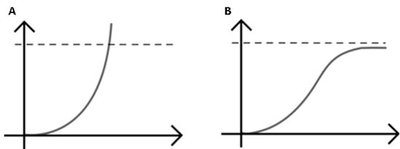
Q18. (a) What are the two different types of population growth shown by the curved lines on A and B below?
Background
Topic: Population Ecology
This question tests your understanding of population growth models, specifically the differences between exponential and logistic growth.
Key Terms:
Exponential Growth: Rapid population increase without environmental limits.
Logistic Growth: Population increase that slows as it approaches a carrying capacity.
Carrying Capacity (): The maximum population size an environment can sustain.
Step-by-Step Guidance
Examine the shape of the curves in plots A and B. Plot A shows a curve that rises steeply without leveling off, while plot B shows a curve that rises and then levels off.
Recall that exponential growth is characterized by a J-shaped curve, while logistic growth is characterized by an S-shaped curve.
Identify which curve corresponds to each type of growth based on their shapes.
Try solving on your own before revealing the answer!
Q18. (b) What does the dashed line on both plots represent?
Background
Topic: Population Ecology
This part tests your understanding of environmental limits on population growth.
Key Terms:
Carrying Capacity (): The dashed line typically represents the maximum population size that the environment can support.
Step-by-Step Guidance
Observe the dashed line in both plots. It is horizontal and above the population curves.
Recall the definition of carrying capacity and its role in limiting population growth.
Connect the dashed line to the concept of carrying capacity.
Try solving on your own before revealing the answer!
Q18. (c) Explain the process behind the type of growth in plot A, and what conditions need to be present for a population to grow like this.
Background
Topic: Population Ecology
This part tests your understanding of the conditions required for exponential population growth.
Key Terms and Formula:
Exponential Growth Equation:
= population size
= intrinsic rate of increase
Step-by-Step Guidance
Recall that exponential growth occurs when resources are unlimited and environmental resistance is minimal.
Understand that the population grows at a constant rate, leading to a rapid increase in numbers.
Consider the mathematical model: , where the rate of change in population size is proportional to the current population.
Think about real-world conditions: abundant food, space, and absence of limiting factors such as disease or predation.
Try solving on your own before revealing the answer!
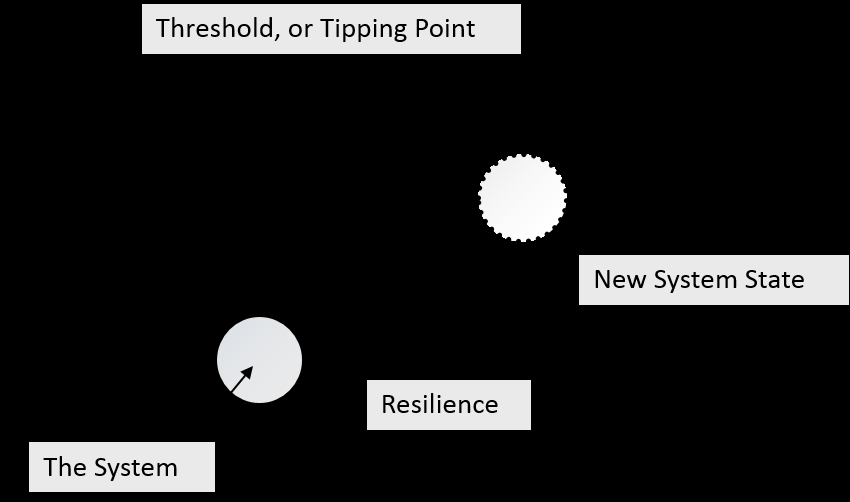
Q21. What ecological theory is the diagram below representing? Provide a definition of this ecological process and how it relates to the concept of ecological state shifts, with an example of an ecological state shift.
Background
Topic: Ecology – State Shifts and Tipping Points
This question tests your understanding of ecological thresholds, resilience, and state shifts in ecosystems.
Key Terms:
Threshold/Tipping Point: A critical point where a small change can push a system into a new state.
Resilience: The ability of a system to absorb disturbances and remain in its current state.
Ecological State Shift: A transition from one stable ecosystem state to another, often triggered by crossing a threshold.
Step-by-Step Guidance
Identify the main elements in the diagram: the system, resilience, threshold/tipping point, and new system state.
Recall the definition of ecological thresholds and tipping points, and how they relate to sudden changes in ecosystem structure or function.
Think about how resilience determines whether a system can recover from disturbances or will shift to a new state.
Consider examples of ecological state shifts, such as a lake shifting from clear to turbid due to nutrient loading.
Try solving on your own before revealing the answer!
