 Back
BackPopulation Growth and Regulation: Key Concepts and Applications
Study Guide - Smart Notes
 Tailored notes based on your materials, expanded with key definitions, examples, and context.
Population Growth and Regulation
Introduction to Population Ecology
Population ecology examines how and why populations of organisms change over time and space. It is fundamental for understanding species survival, resource management, and conservation biology. Key concepts include population size, density, growth patterns, and regulatory mechanisms.
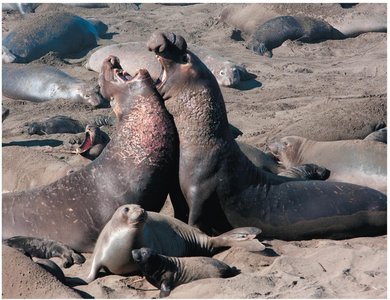
Case Study: The Return of the Elephant Seals
The recovery of elephant seal populations after near-extinction demonstrates the principles of population growth and regulation. Conservation efforts and legal protection allowed their numbers to rebound, illustrating how populations can recover under favorable conditions.
Exponential Population Growth
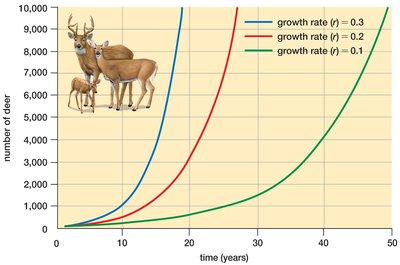
Exponential growth occurs when a population increases by a constant proportion over successive time intervals, under ideal, unlimited environmental conditions. This type of growth is rare in nature but can occur when populations are introduced to new environments or recover from drastic reductions.
Exponential Growth Equation: , where is the population size at time , is the initial population size, is the intrinsic rate of increase, and is the base of the natural logarithm.
Key Features: J-shaped curve, rapid increase, unsustainable in the long term due to resource limitations.
Boom-and-Bust Population Cycles
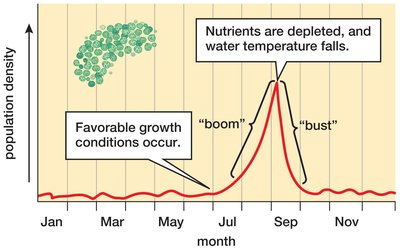
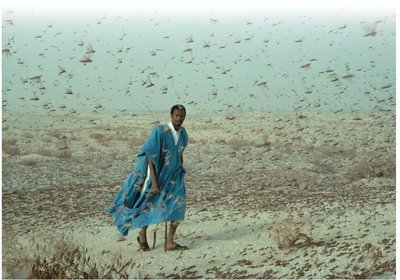
Some populations experience rapid increases (booms) followed by sudden declines (busts), often in response to environmental changes such as nutrient availability or predation pressure.
Example: Photosynthetic bacteria may rapidly multiply when conditions are favorable, then crash when resources are depleted.
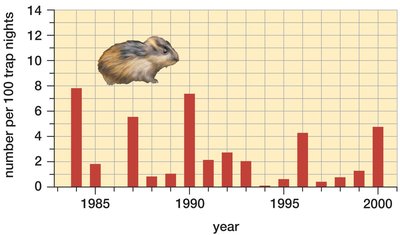
Example: Lemming populations in the Arctic show dramatic fluctuations due to resource availability and predation.
Exponential Growth in Nature
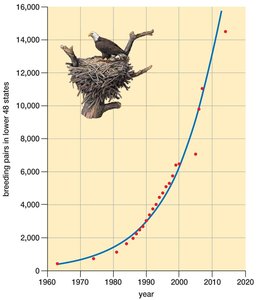
Exponential growth can be observed in recovering or newly established populations, such as the bald eagle population in the United States after conservation measures were implemented.
Logistic Population Growth
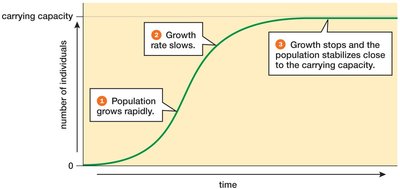
Logistic growth describes how a population's growth rate slows and eventually stabilizes as it approaches the carrying capacity of its environment. The carrying capacity (K) is the maximum population size that the environment can sustain indefinitely.
Logistic Growth Equation:
Key Features: S-shaped (sigmoidal) curve, initial rapid growth, slowing as resources become limited, stabilization at carrying capacity.
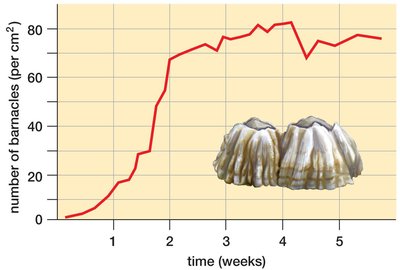
Example: Barnacle populations in nature often follow a logistic growth pattern as they fill available space.
Consequences of Exceeding Carrying Capacity
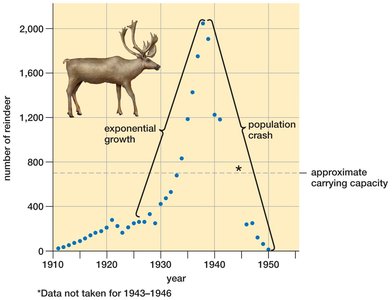
When populations exceed the carrying capacity, environmental degradation can occur, leading to population crashes or long-term reductions in carrying capacity.
Overshoot: Population temporarily exceeds carrying capacity, causing resource depletion.
Crash: Population declines rapidly due to insufficient resources.
Long-term Effects: Carrying capacity may be permanently reduced if the environment is severely damaged.
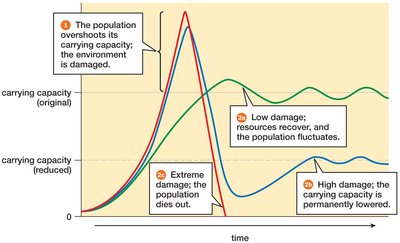
Example: Reindeer populations on islands have shown exponential growth followed by dramatic crashes when resources are exhausted.
Population Regulation: Biotic and Abiotic Factors
Population size is regulated by a combination of biotic (living) and abiotic (non-living) factors. Predation, competition, disease, and resource availability are key regulatory mechanisms.
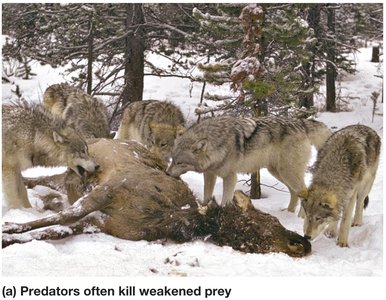
Predation: Predators help control prey populations, often targeting the weak or sick individuals.
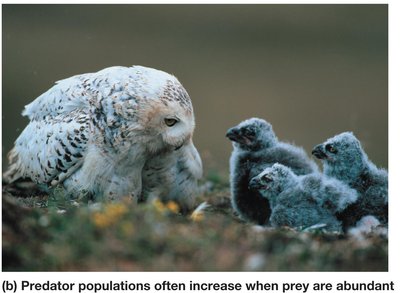
Predator-Prey Dynamics: Predator populations may increase when prey are abundant, leading to cyclical population changes.
Emigration and Immigration
Population size is also influenced by the movement of individuals into (immigration) or out of (emigration) a population. These processes can stabilize or destabilize population sizes, especially in fragmented habitats.
r-Selected and K-Selected Species
Species can be classified based on their reproductive strategies:
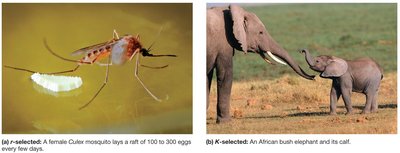
r-Selected Species: High reproductive rates, short lifespans, little parental care (e.g., mosquitoes).
K-Selected Species: Low reproductive rates, long lifespans, extensive parental care (e.g., elephants).
Survivorship Curves
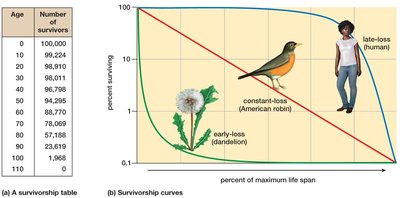
Survivorship curves graphically represent the number of individuals surviving at each age. There are three main types:
Type I: High survivorship until old age (e.g., humans).
Type II: Constant survivorship throughout life (e.g., some birds).
Type III: Low survivorship early in life (e.g., dandelions).
Spatial Distribution of Populations
Populations can exhibit different spatial patterns:
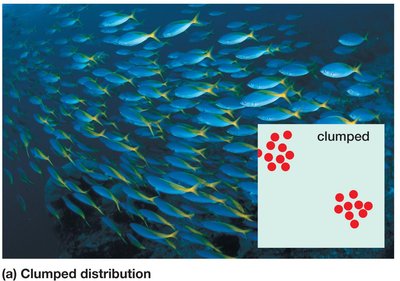
Clumped Distribution: Individuals aggregate in patches, often due to resource availability or social behavior.
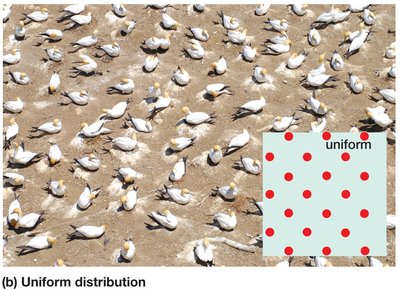
Uniform Distribution: Individuals are evenly spaced, often due to territoriality or competition.
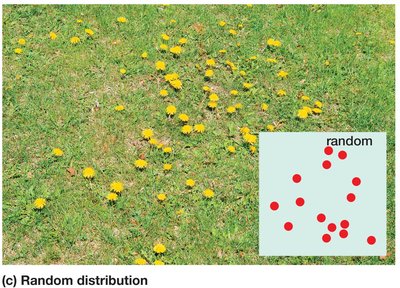
Random Distribution: Individuals are spread unpredictably, often in homogeneous environments.
Human Population Growth
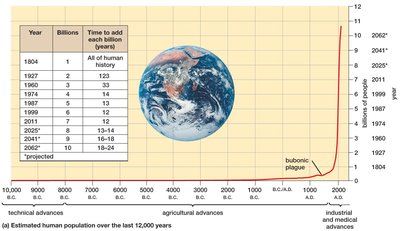
Human populations have experienced exponential growth, especially in the last few centuries due to advances in agriculture, technology, and medicine. This rapid growth poses challenges for resource use and environmental sustainability.
Historical Trends: Human population growth was slow for most of history, accelerating dramatically in the modern era.
Summary Table: Population Statistics by World Region (2018)
This table compares average population statistics across different world regions, including population size, growth rates, and demographic characteristics.
Region | Population (millions) | Growth Rate (%) | Doubling Time (years) |
|---|---|---|---|
World | 7,632 | 1.1 | 63 |
More-developed | 1,263 | 0.2 | 350 |
Less-developed | 6,369 | 1.3 | 54 |
Least-developed | 1,019 | 2.4 | 29 |
Sub-Saharan Africa | 1,078 | 2.7 | 26 |
Asia | 4,545 | 1.0 | 70 |
Europe | 742 | 0.0 | — |
Latin America & Caribbean | 646 | 1.0 | 70 |
Northern America | 361 | 0.7 | 100 |
Oceania | 41 | 1.3 | 54 |
Additional info: Table values inferred from standard demographic sources for 2018.
Conclusion
Understanding population growth and regulation is essential for managing wildlife, conserving endangered species, and addressing human impacts on the environment. Population ecology provides the tools to predict changes, identify threats, and develop sustainable solutions for the future.
