 Back
Porifera and Cnidaria: Structure, Function, and Life Cycles
Study Guide - Smart Notes
 Tailored notes based on your materials, expanded with key definitions, examples, and context.
Overview of Invertebrate Animals: Porifera and Cnidaria
This section covers the basic biology of two major invertebrate phyla: Porifera (sponges) and Cnidaria (jellyfish, hydra, corals, and related forms). These groups illustrate the diversity of animal body plans, tissue organization, and life cycles at the base of the animal kingdom.
Porifera (Sponges)
Structure and Function
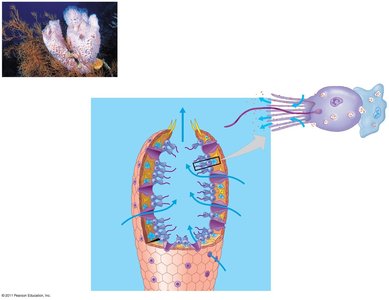
Sponges are simple, multicellular animals that lack true tissues and organs. They are primarily aquatic and filter feeders, drawing water through their porous bodies to capture food particles.
Spongocoel: The central cavity inside the sponge where water flows.
Pores (Ostia): Small openings in the sponge body wall through which water enters.
Osculum: A large opening at the top where water exits.
Choanocytes (Collar Cells): Specialized cells with flagella that create water currents and trap food particles.
Amoebocytes: Mobile cells involved in digestion, nutrient transport, and spicule formation.
Spicules: Structural elements that provide support and deter predators.
Example: Sponges filter large volumes of water daily, removing bacteria and organic particles from their environment.
Cnidaria
Body Plans: Polyp and Medusa
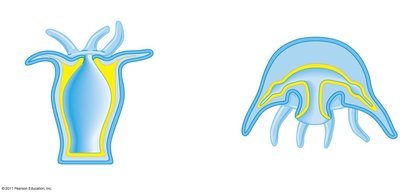
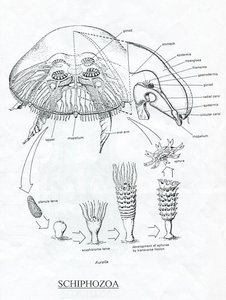
Cnidarians are radially symmetrical animals with two main body forms: the sessile polyp and the free-swimming medusa. They possess true tissues, including an outer epidermis and an inner gastrodermis, separated by a gelatinous mesoglea.
Polyp: Cylindrical, usually attached to a substrate, with the mouth/anus facing upward (e.g., hydra, sea anemones).
Medusa: Bell-shaped, free-swimming form with the mouth/anus facing downward (e.g., jellyfish).
Gastrovascular Cavity: Central digestive compartment with a single opening serving as both mouth and anus.
Tentacles: Used for capturing prey and defense, often equipped with specialized stinging cells.
Specialized Cells: Cnidocytes and Nematocysts
Cnidarians possess unique stinging cells called cnidocytes, which contain organelles known as nematocysts. These structures are used for prey capture and defense.
Cnidocyte: Specialized cell in the epidermis containing a nematocyst.
Nematocyst: Capsule with a coiled, barbed thread that can rapidly discharge to inject toxins into prey or predators.
Trigger Mechanism: Physical or chemical stimulation causes the nematocyst to fire.
Example: Jellyfish tentacles can paralyze small fish using nematocysts.
Life Cycles of Cnidarians
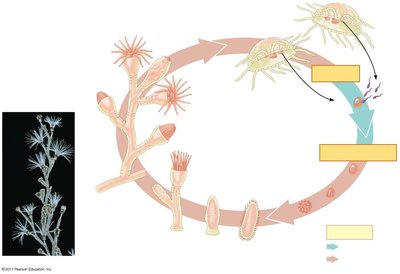
Cnidarians often alternate between polyp and medusa forms during their life cycle. Reproduction can be sexual or asexual (budding).
Asexual Reproduction: Budding produces genetically identical polyps.
Sexual Reproduction: Medusae produce gametes; fertilization results in a motile larva (planula) that settles and develops into a new polyp.
Alternation of Generations: Many cnidarians, such as hydrozoans, alternate between polyp (asexual) and medusa (sexual) stages.
Classification and Examples
Cnidaria is divided into several classes, including:
Hydrozoa: Mostly colonial polyps, some with medusa stages (e.g., Hydra).
Scyphozoa: True jellyfish, dominant medusa stage (e.g., Aurelia).
Anthozoa: Only polyp stage, includes sea anemones and corals.
Example: The moon jelly (Aurelia) is a common scyphozoan with a complex life cycle involving both polyp and medusa forms.
Movement and Behavior
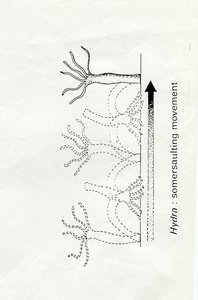
Some cnidarians, such as Hydra, exhibit simple movements like somersaulting, while medusae swim by contracting their bell-shaped bodies.
Somersaulting: Hydra can move by bending and flipping over, attaching to new surfaces.
Jet Propulsion: Medusae expel water from their gastrovascular cavity to move.
Summary Table: Key Differences Between Porifera and Cnidaria
Feature | Porifera (Sponges) | Cnidaria |
|---|---|---|
Body Symmetry | Asymmetrical | Radial |
Tissues | No true tissues | Diploblastic (epidermis & gastrodermis) |
Body Cavity | Spongocoel | Gastrovascular cavity |
Specialized Cells | Choanocytes, amoebocytes | Cnidocytes with nematocysts |
Reproduction | Asexual (budding), sexual | Asexual (budding), sexual, alternation of generations |
Additional info: This guide covers the basic biology, structure, and life cycles of Porifera and Cnidaria, foundational phyla for understanding animal diversity and evolution.
