 Back
Practice Exam 1 – General Biology Study Guidance
Study Guide - Smart Notes
 Tailored notes based on your materials, expanded with key definitions, examples, and context.
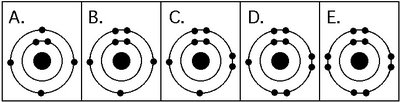
Q2. Using the diagram above: _____ has the greatest number of valence electrons; _____ has the greatest valence.
Background
Topic: Atomic Structure and Valence Electrons
This question tests your understanding of how to interpret electron shell diagrams to determine the number of valence electrons and the concept of valence (the ability of an atom to bond with others).
Key Terms:
Valence electrons: Electrons in the outermost shell of an atom, important for chemical bonding.
Valence: The number of bonds an atom can form, often determined by the number of unpaired electrons in the outer shell.
Step-by-Step Guidance
Examine each diagram (A–E) and count the electrons in the outermost shell for each atom. These are the valence electrons.
Compare the number of valence electrons for all five atoms to identify which has the greatest number.
Recall that valence is often highest when there are more unpaired electrons in the outer shell, which increases the atom's bonding capacity.
For each atom, determine how many electrons are unpaired in the outer shell to assess their valence.
Set up your answer by matching the atom with the most valence electrons and the atom with the greatest valence based on your counts.
Try solving on your own before revealing the answer!
Final Answer: E, A
Atom E has the greatest number of valence electrons (7), and atom A has the greatest valence (1 unpaired electron, so it can form one bond).
Counting the outermost electrons and identifying unpaired electrons helps you determine both valence electrons and valence.
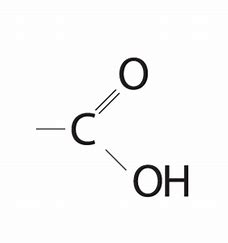
Q6. Identify the following functional group
Background
Topic: Functional Groups in Organic Molecules
This question tests your ability to recognize and name common functional groups found in biological molecules.
Key Terms:
Functional group: A specific group of atoms within a molecule responsible for characteristic chemical reactions.
Carboxyl group: Consists of a carbon atom double-bonded to an oxygen atom and single-bonded to a hydroxyl group (–COOH).
Step-by-Step Guidance
Observe the structure: a carbon atom is double-bonded to an oxygen atom and single-bonded to an OH group.
Recall the common functional groups: amino (–NH2), carboxyl (–COOH), carbonyl (C=O), phosphate, thiol (–SH).
Compare the structure to the definitions of these groups, focusing on the arrangement of atoms.
Identify which functional group matches the structure shown.
Try solving on your own before revealing the answer!
Final Answer: Carboxyl group
The structure shown is a carboxyl group (–COOH), which is common in amino acids and fatty acids.
It is characterized by a carbon double-bonded to oxygen and single-bonded to a hydroxyl group.
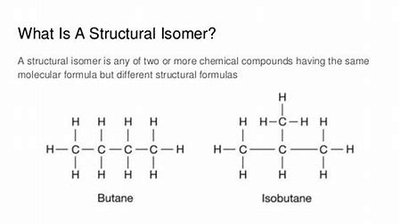
Q25. The two molecules above are what type of isomers?
Background
Topic: Isomerism in Organic Chemistry
This question tests your understanding of structural isomers, which are molecules with the same molecular formula but different connectivity of atoms.
Key Terms:
Isomers: Compounds with the same molecular formula but different structures.
Structural isomers: Isomers that differ in the connectivity of their atoms.
Step-by-Step Guidance
Examine the two molecules: both have the same number of carbon and hydrogen atoms.
Compare the arrangement of atoms in each molecule. Are the atoms connected differently?
Recall the types of isomers: structural, cis-trans, enantiomers, diastereomers.
Determine which type of isomerism is present based on the connectivity of atoms.
Try solving on your own before revealing the answer!
Final Answer: Structural isomers
Butane and isobutane are structural isomers because they have the same molecular formula but different connectivity of their atoms.
This difference in structure leads to different physical and chemical properties.
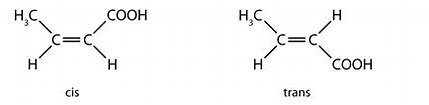
Q26. The two molecules above are what type of isomers?
Background
Topic: Cis-Trans Isomerism
This question tests your ability to recognize cis-trans (geometric) isomers, which differ in the arrangement of groups around a double bond.
Key Terms:
Cis-trans isomers: Isomers with the same molecular formula and connectivity, but different spatial arrangement around a double bond.
Cis: Groups are on the same side of the double bond.
Trans: Groups are on opposite sides of the double bond.
Step-by-Step Guidance
Observe the double bond in both molecules and the position of the groups attached to the carbons.
Compare the arrangement: are the similar groups on the same side (cis) or opposite sides (trans)?
Recall that cis-trans isomerism occurs due to restricted rotation around the double bond.
Identify which type of isomerism is present based on the spatial arrangement.
Try solving on your own before revealing the answer!
Final Answer: Cis-trans isomers
The molecules are cis-trans isomers because they differ in the arrangement of groups around the double bond.
This affects their physical properties and biological activity.
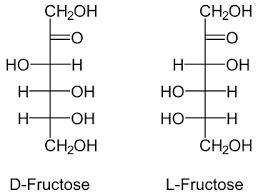
Q27. What type of macromolecule is the above molecule?
Background
Topic: Macromolecules in Biology
This question tests your ability to identify the type of macromolecule based on its structure.
Key Terms:
Macromolecule: Large biological molecules such as carbohydrates, proteins, lipids, and nucleic acids.
Monosaccharide: A simple sugar, the basic unit of carbohydrates.
Step-by-Step Guidance
Examine the structure: look for repeating units, functional groups, and overall shape.
Identify the presence of multiple hydroxyl groups and a carbonyl group, which are typical of sugars.
Recall the four main types of macromolecules: carbohydrates, proteins, lipids, nucleic acids.
Determine which category the molecule fits based on its structure and functional groups.
Try solving on your own before revealing the answer!
Final Answer: Carbohydrate (Monosaccharide)
The molecules shown are D-Fructose and L-Fructose, which are monosaccharides (simple sugars) and belong to the carbohydrate macromolecule group.
They are important for energy storage and metabolism in living organisms.
