 Back
Practice Exam Guidance: DNA Mapping, Promoter Analysis, and Probability in Genomics
Study Guide - Smart Notes
 Tailored notes based on your materials, expanded with key definitions, examples, and context.
Q1. Mapping restriction sites on a piece of DNA
Background
Topic: Restriction Mapping and Gel Electrophoresis
This question tests your understanding of how to interpret restriction enzyme digestion patterns and map the locations of restriction sites on a linear DNA molecule using gel electrophoresis results.
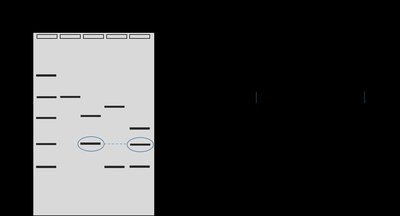
Key Terms and Concepts:
Restriction enzyme: A protein that cuts DNA at a specific sequence.
EcoRI and BamHI: Two different restriction enzymes, each recognizing a unique DNA sequence.
Gel electrophoresis: A technique to separate DNA fragments by size.
Fragment size: The length of DNA pieces produced after cutting with restriction enzymes, measured in base pairs (bp).
Step-by-Step Guidance
Review the gel image and note the fragment sizes produced by each enzyme alone and in combination. Pay attention to the bands in lanes for EcoRI only, BamHI only, and both enzymes together.
Recall that a fragment of about 100 bp is released by BamHI, indicating a BamHI site approximately 100 bp from one end of the DNA.
Consider the EcoRI cut: it produces two fragments, one smaller and one larger. The location of EcoRI is already mapped at 200 bp from one end.
When both enzymes are used, observe which fragments change and which remain the same. This helps you deduce which fragment contains the BamHI site.
Use the information that the BamHI site does not cut the smaller EcoRI fragment to determine its position relative to the ends of the DNA.
Try solving on your own before revealing the answer!
Q2. Mapping functional sequence elements on a promoter
Background
Topic: Promoter Analysis and Reporter Gene Assays
This question examines your ability to interpret experimental data from promoter deletion analysis to identify functional elements that regulate gene expression.
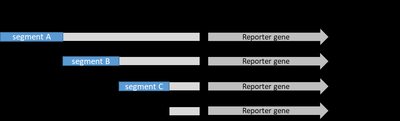
Key Terms and Concepts:
Promoter: A DNA sequence that initiates transcription of a gene.
Reporter gene: A gene whose expression is easily measured, used to study promoter activity.
Functional element: A DNA region within the promoter that affects gene expression (positively or negatively).
Deletion analysis: Removing segments of DNA to test their effect on gene expression.
Step-by-Step Guidance
Examine the experimental results for each segment (A, B, C) removed and note the changes in reporter gene activity.
For segment A: Compare gene expression before and after its removal. Does the activity change?
For segment B: Observe the effect of removing this segment on gene expression. Is there an increase or decrease?
For segment C: Analyze the change in gene expression when this segment is deleted. What does this suggest about its function?
Summarize your findings by mapping which segments contain positive or negative regulatory elements based on the observed effects.

Try solving on your own before revealing the answer!
Q3. Calculating the probability of a specific sequence in a genome
Background
Topic: Probability in Genomics
This question tests your understanding of how to calculate the probability of a specific nucleotide sequence occurring in a genome, and how sequence length affects this probability.
Key Terms and Formulas:
Probability of a nucleotide: The chance of a specific base (A, C, G, or T) at a given position (here, 0.25).
Probability of a sequence: Multiply the probabilities for each position in the sequence.
Expected occurrences: Multiply the probability of the sequence by the total number of possible sites in the genome.
Step-by-Step Guidance
For a sequence like "ACGT" (4 bases), calculate the probability at a single site: .
Express this as and compute the value (but do not finish the calculation yet).
To find the expected number of occurrences in a genome of 48,500 bp, multiply the probability by the number of possible sites: .
For longer sequences, recognize that each additional nucleotide multiplies the probability by 0.25, making the sequence less likely to occur.
Try solving on your own before revealing the answer!
