Back
Practice Questions: Lipids and Triglyceride Structure
Study Guide - Smart Notes
 Tailored notes based on your materials, expanded with key definitions, examples, and context.
Q1. What is one chemical property that all lipids have in common?
Background
Topic: Lipid Chemistry
This question tests your understanding of the basic chemical properties shared by all lipids, which are a major class of biological macromolecules.
Key Terms:
Lipid: A diverse group of hydrophobic or amphipathic molecules, including fats, oils, and steroids.
Hydrophobic: Repels water; does not dissolve in water.
Step-by-Step Guidance
Recall that lipids are generally insoluble in water due to their molecular structure.
Think about the types of bonds and atoms present in lipids (lots of nonpolar C-H bonds).
Consider how this property affects their biological function, such as forming cell membranes.
Try solving on your own before revealing the answer!
Final Answer:
All lipids are hydrophobic, meaning they do not dissolve in water. This is due to their high proportion of nonpolar hydrocarbon chains, which repel water molecules.
Q2. A triglyceride molecule is formed by condensation reactions. From how many molecules is this triglyceride formed?
Background
Topic: Macromolecule Synthesis
This question is about the process of forming triglycerides, a type of lipid, through condensation (dehydration synthesis) reactions.
Key Terms and Formula:
Triglyceride: A lipid molecule made from one glycerol and three fatty acids.
Condensation Reaction: A chemical reaction where two molecules combine, releasing water.
Step-by-Step Guidance
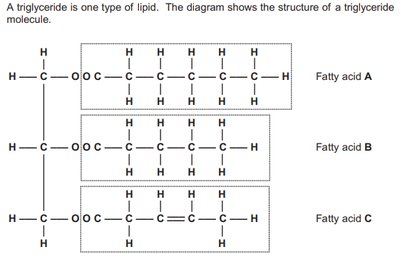
Examine the diagram: Notice the glycerol backbone and three attached fatty acids.
Recall that each fatty acid is attached to glycerol via a condensation reaction, forming an ester bond and releasing water.
Count the total number of molecules involved in the formation: one glycerol and three fatty acids.
Try solving on your own before revealing the answer!
Final Answer:
A triglyceride is formed from four molecules: one glycerol and three fatty acids. Each fatty acid is joined to glycerol by a condensation reaction.
Q3. The structure of a phospholipid molecule is different from that of a triglyceride. Describe how a phospholipid is different.
Background
Topic: Lipid Structure and Function
This question asks you to compare the structure of triglycerides and phospholipids, two important types of lipids in biology.
Key Terms:
Phospholipid: A lipid with a glycerol backbone, two fatty acids, and a phosphate group.
Triglyceride: A lipid with a glycerol backbone and three fatty acids.
Hydrophilic: Attracted to water.
Hydrophobic: Repels water.
Step-by-Step Guidance
Recall the structure of a triglyceride: one glycerol and three fatty acids.
Think about the structure of a phospholipid: one glycerol, two fatty acids, and a phosphate group.
Consider how the presence of the phosphate group changes the molecule's properties (hydrophilic head, hydrophobic tails).
Reflect on the biological significance: phospholipids form cell membranes due to their amphipathic nature.
Try solving on your own before revealing the answer!
Final Answer:
A phospholipid differs from a triglyceride in that it has two fatty acids and a phosphate group attached to glycerol, instead of three fatty acids. The phosphate group makes one end of the molecule hydrophilic, while the fatty acid tails remain hydrophobic. This amphipathic structure allows phospholipids to form cell membranes.