 Back
BackL5:Primary Growth and Meristems in Plants: Structure, Function, and Anatomy
Study Guide - Smart Notes
 Tailored notes based on your materials, expanded with key definitions, examples, and context.
L5: Primary Growth and Meristems in Plants
Introduction to Plant Growth and Meristems
Plant growth is characterized by its indeterminate nature, meaning that plants can continue to grow new organs throughout their life as long as conditions and meristems permit. This continuous growth is supported by specialized regions called meristems, which are responsible for producing new cells and tissues.
Indeterminate Growth: Unlike animals, most plants do not have a genetically predetermined size or shape. Growth continues as long as meristems remain active.
Meristems: Populations of small, undifferentiated cells with embryonic characteristics that can divide and differentiate into various cell types.
Types of Meristems: Apical meristems (at root and shoot tips) drive primary growth, while lateral meristems (vascular cambium and cork cambium) are responsible for secondary growth.
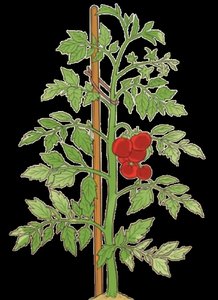
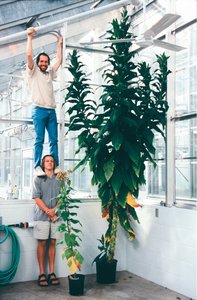
Primary vs. Secondary Growth
Plant growth can be divided into two main types: primary growth and secondary growth. Primary growth increases the length of roots and shoots, while secondary growth increases the thickness or girth of stems and roots, mainly in woody plants.
Primary Growth: Occurs in all plants and is responsible for elongation. Driven by apical meristems.
Secondary Growth: Occurs mainly in woody plants and is responsible for thickening. Driven by lateral meristems.
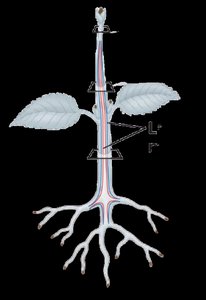
Types and Locations of Meristems
Meristems are classified based on their location and function:
Apical Meristems: Located at the tips of roots and shoots; responsible for primary growth.
Lateral Meristems: Include the vascular cambium and cork cambium; responsible for secondary growth.
Axillary Bud Meristems: Found in the angle between the stem and leaf; can give rise to branches or flowers.
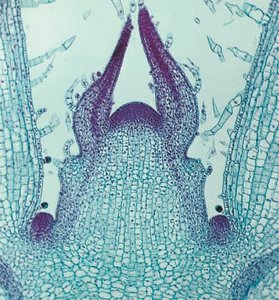

Structure and Organization of the Shoot Apical Meristem (SAM)
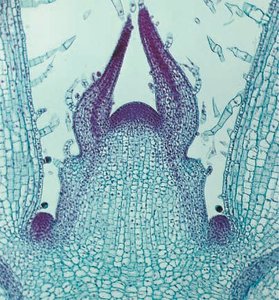
The shoot apical meristem (SAM) is a dome-shaped region at the tip of the shoot, protected by young leaves called leaf primordia. It is organized into zones and layers, each with specific roles in growth and tissue formation.
Zones:
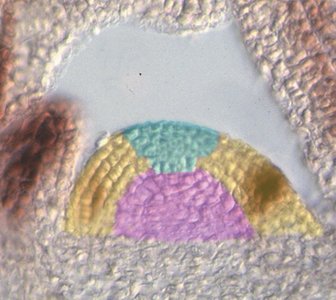
Central Zone (CZ): Slowly dividing initial cells that maintain the meristem.
Peripheral Zone (PZ): Rapidly dividing cells that generate leaves and stem tissues.
Rib Zone (RZ): Cells that contribute to central stem tissues.
Layers:
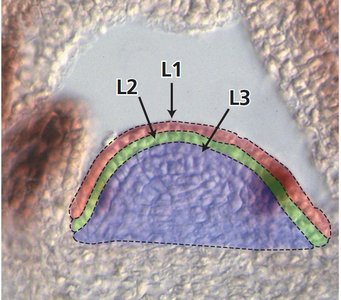
L1: Outer epidermal cell layer (forms the epidermis).
L2: Subepidermal layer (forms much of the ground tissue and some vascular tissue).
L3: Inner layer (forms most internal stem tissues).
Meristem Cell Fate and Function
Cells in the shoot apical meristem have different fates depending on their position in zones and layers. The combination of zone and layer determines both the current function and the long-term fate of a cell.
Central Zone (CZ): Maintains a pool of stem cells.
Peripheral Zone (PZ): Generates new organs and outer tissues.
Rib Zone (RZ): Builds the central stem core.
L1 Layer: Forms the shoot epidermis.
L2 Layer: Forms leaf mesophyll, cortex, and some vascular tissues.
L3 Layer: Forms internal stem tissues and vasculature.
Primary Growth in Roots
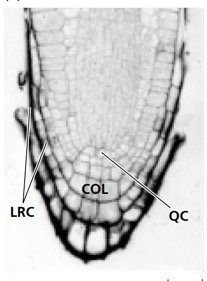
Primary growth in roots is driven by the root apical meristem (RAM), which produces new cells that elongate and differentiate into various root tissues. The root tip is organized into distinct zones:
Zone of Cell Division: Contains the RAM and is the site of active cell division.
Zone of Elongation: Cells elongate, pushing the root tip further into the soil.
Zone of Differentiation: Cells mature into specialized root tissues (epidermis, cortex, vascular tissue).
Root and Stem Anatomy: Eudicots vs. Monocots
The internal structure of roots and stems differs between eudicots and monocots, reflecting their evolutionary adaptations.
Eudicot Root: Xylem forms a star shape at the center, with phloem between the arms; no central pith.
Monocot Root: Central region of parenchyma (pith) surrounded by a ring of xylem and phloem.
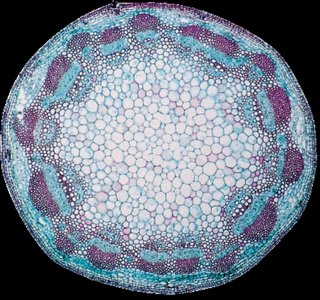
Eudicot Stem: Vascular bundles arranged in a ring; ground tissue divided into cortex (outside) and pith (inside).
Monocot Stem: Vascular bundles scattered throughout the ground tissue; no clear cortex–pith distinction.
Leaf Anatomy: Dicot vs. Monocot
Leaves are specialized for photosynthesis and gas exchange, with distinct tissue organization in dicots and monocots.
Dicot Leaf: Has both palisade and spongy mesophyll; stomata mainly on the lower side; central vein prominent.
Monocot Leaf: Uniform mesophyll; stomata on both surfaces; parallel veins.
Common Features: Both have upper and lower epidermis, guard cells, stomata, and vascular bundles (veins).
Summary Table: Comparison of Eudicot and Monocot Anatomy
Feature | Eudicot | Monocot |
|---|---|---|
Root Cross Section | Xylem star at center, no pith | Central pith, ring of xylem/phloem |
Stem Cross Section | Vascular bundles in a ring, cortex & pith | Vascular bundles scattered, no clear cortex/pith |
Leaf Mesophyll | Palisade + spongy | Uniform |
Stomata | Mainly lower side | Both surfaces |
Veins | Central, branching | Parallel, longitudinal |
Key Terms and Definitions
Meristem: Region of undifferentiated plant cells capable of division and growth.
Apical Meristem: Meristem at the tip of a plant root or shoot, responsible for primary growth.
Lateral Meristem: Meristem that causes growth in thickness (secondary growth).
Primary Growth: Growth that increases the length of stems and roots.
Secondary Growth: Growth that increases the girth of stems and roots.
Protoderm, Ground Meristem, Procambium: Primary meristems that give rise to dermal, ground, and vascular tissues, respectively.
