 Back
Principles of Biology I: Introduction to Life and Biological Organization
Study Guide - Smart Notes
 Tailored notes based on your materials, expanded with key definitions, examples, and context.
Introduction to Biology
What Makes Something Alive?
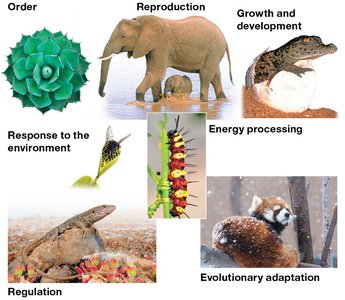
Biology is the scientific study of life. To understand what makes something alive, biologists identify a set of properties shared by all living organisms. These properties distinguish living things from non-living matter and are foundational to the study of biology.
Order: Living things exhibit complex but ordered organization, from molecules to cells to tissues.
Reproduction: Organisms reproduce, passing genetic information to offspring.
Growth and Development: Organisms grow and develop according to instructions coded in their DNA.
Energy Processing: Living things obtain and use energy for metabolic processes.
Response to the Environment: Organisms respond to environmental stimuli.
Regulation: Internal conditions are regulated to maintain homeostasis.
Evolutionary Adaptation: Populations evolve over generations through adaptation.
Characteristics of Cells
Functions of Life at the Cellular Level
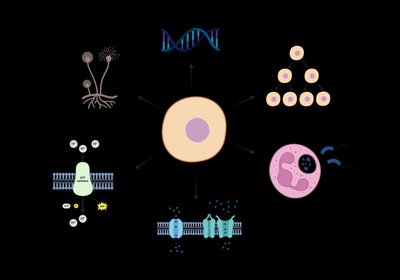
Cells are the fundamental unit of life, capable of performing all essential functions. Every cell, whether prokaryotic or eukaryotic, exhibits the following characteristics:
Transport: Movement of substances into and out of the cell.
Responsiveness: Ability to sense and respond to changes in the environment.
Growth: Increase in size and number.
Heredity: Transmission of genetic information.
Reproduction: Production of new cells or organisms.
Metabolism: Chemical reactions that provide energy and build cellular structures.
Viruses: Alive or Not?
Are Viruses Living?
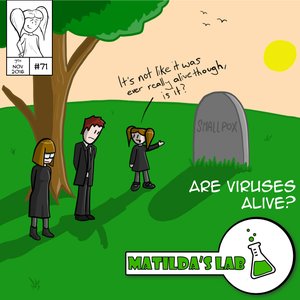
Viruses are unique biological entities that challenge the definition of life. They possess genetic material and can evolve, but they lack the ability to carry out life functions independently. Viruses must reside inside a host cell to reproduce and perform metabolic activities, making them obligate intracellular parasites.
Dependence on Host: Viruses require a living cell to replicate.
Do Not Fulfill All Characteristics of Life: Viruses cannot independently grow, metabolize, or respond to the environment.
Scientific Debate: The status of viruses as living or non-living is debated in biology.
Levels of Biological Organization
Hierarchy of Life
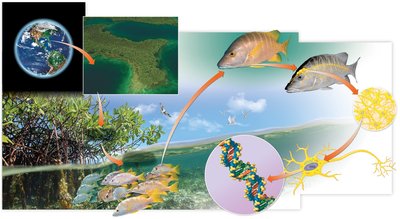
Biologists study life at many levels, from the smallest molecules to the entire biosphere. Each level represents a higher degree of complexity and organization.
Biosphere: All life on Earth and the environments they inhabit.
Ecosystem: Communities of organisms and their physical environment.
Community: All organisms living in a particular area.
Population: Individuals of the same species in a given area.
Organism: Individual living entity.
Organs & Organ Systems: Structures with specific functions.
Tissue: Groups of cells with a common function.
Cell & Organelles: Basic unit of life and its internal structures.
Molecules & Atoms: Chemical building blocks of life.
Classification of Organisms
Domains and Kingdoms of Life
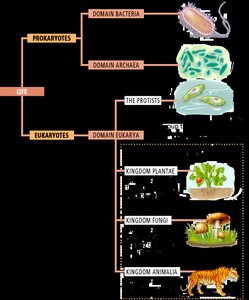
Organisms are classified based on shared characteristics and evolutionary relationships. The broadest classification divides life into three domains: Bacteria, Archaea, and Eukarya. Eukarya is further divided into kingdoms such as Plantae, Fungi, and Animalia.
Domain Bacteria: Prokaryotic, unicellular organisms.
Domain Archaea: Prokaryotic, often found in extreme environments.
Domain Eukarya: Eukaryotic organisms, including protists, plants, fungi, and animals.
Taxonomic Hierarchy
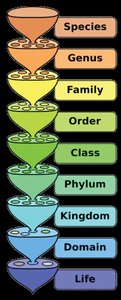
The classification of organisms follows a hierarchical system, from broad to specific categories:
Level | Description |
|---|---|
Domain | Largest grouping; Bacteria, Archaea, Eukarya |
Kingdom | Major groups within domains |
Phylum | Groups of related classes |
Class | Groups of related orders |
Order | Groups of related families |
Family | Groups of related genera |
Genus | Groups of related species |
Species | Smallest unit; individual organisms |
Example: The scientific name Homo sapiens refers to the genus Homo and the species sapiens.
----------------------------------------
