 Back
Study guide 1
Study Guide - Smart Notes
 Tailored notes based on your materials, expanded with key definitions, examples, and context.
Introduction to Biology and the Study of Life
Defining Life
Biology is the scientific study of life and living organisms. To understand what it means to be alive, biologists identify several key characteristics shared by all living things:
Cells: All organisms are composed of one or more membrane-bound cells.
Replication: All organisms are capable of reproduction, producing offspring similar to themselves.
Information: All organisms process hereditary information (genetic material) and respond to environmental information.
Energy: All organisms acquire and utilize energy to maintain order and support life processes.
Evolution: Populations of organisms change over time through evolutionary processes.
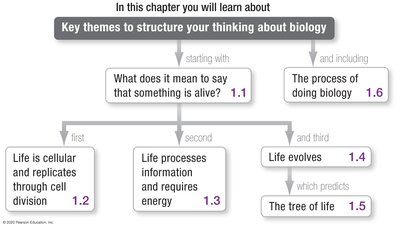
The Scientific Method and Doing Biology
The Nature of Science
Science is a systematic approach to understanding the natural world through observation, measurement, and experimentation. Scientists use the scientific method to answer questions and test ideas about biological phenomena.
Formulating Hypotheses: Scientists develop testable statements (hypotheses) to explain observations.
Collecting Data: Evidence is gathered through observation or experimentation to support or refute hypotheses.
Testing Predictions: Hypotheses lead to predictions, which are measurable or observable outcomes that must be correct if the hypothesis is valid.
Key Terminology
Theory: A broad explanation for a wide range of phenomena, supported by extensive evidence.
Hypothesis: A specific, testable statement explaining an observation.
Experiment: A controlled procedure to test a hypothesis.
Prediction: The expected outcome if the hypothesis is correct.
Hypothesis Testing
Hypothesis testing is a two-step process:
State the hypothesis as precisely as possible and list the predictions it makes.
Design an observational or experimental study capable of testing those predictions.
Example: Why Do Giraffes Have Long Necks?
Food Competition Hypothesis: Suggests that long necks evolved to allow giraffes to reach food unavailable to other mammals. Predictions include heritable variation in neck length and feeding high in trees.
Sexual Competition Hypothesis: Proposes that long necks evolved because longer-necked males win more fights and father more offspring. Data support this hypothesis more strongly than the food competition hypothesis.

Additional info: Good experimental design includes control groups, constant conditions, repetition, and large sample sizes to ensure reliable results.
The Cell Theory
Historical Development
The cell theory is a fundamental concept in biology, developed in the 1800s after the invention of the microscope by Robert Hooke and Anton van Leeuwenhoek. It states:
All organisms are made of cells.
All cells come from preexisting cells.
Testing the Cell Theory: Spontaneous Generation
Historically, two hypotheses were debated:
All-cells-from-cells hypothesis: All cells derive from pre-existing cells.
Spontaneous generation hypothesis: Living organisms can arise spontaneously under certain conditions.
Louis Pasteur's experiments with nutrient broth in swan-necked flasks demonstrated that cells do not arise spontaneously, but only from other cells, supporting the cell theory.
Implication: All cells and organisms share a common ancestry.
Theory of Evolution by Natural Selection
Darwin, Wallace, and the Modern Synthesis
Charles Darwin and Alfred Russel Wallace proposed that:
All species are related by common ancestry.
Species change over time through the process of descent with modification.
Natural Selection
Natural selection is the mechanism by which evolution occurs. It requires:
Variation in heritable characteristics among individuals in a population.
Certain heritable traits confer a survival or reproductive advantage in a particular environment.
Over time, beneficial traits become more common in the population, leading to evolutionary change. Natural selection acts on individuals, but the effects are seen in populations.
Examples of Evolutionary Change
Lactase Persistence in Humans: The ability to digest lactose into adulthood has increased in frequency in certain human populations due to genetic changes over time.

SARS-CoV-2 Variants: The emergence and spread of new viral variants (such as B.1.1.7/Alpha and B.1.617.2/Delta) illustrate ongoing natural selection in response to environmental pressures.



Summary Table: Characteristics of Life
Characteristic | Description |
|---|---|
Cellular Organization | All living things are composed of one or more cells. |
Reproduction | Ability to produce new individuals. |
Information Processing | Ability to store, process, and transmit genetic information. |
Energy Utilization | Acquisition and use of energy for metabolism and maintenance. |
Evolution | Populations change over time through natural selection and other processes. |
Best Practices for Success in Biology
Take careful notes and review them regularly.
Study consistently, a little each day.
Read the textbook in small sections.
Ask questions and attend office hours for clarification.
