 Back
BackPrinciples of Biology: Scientific Method and Experimental Design
Study Guide - Smart Notes
 Tailored notes based on your materials, expanded with key definitions, examples, and context.
Introduction to Biology
What is Science?
Science is a systematic approach to understanding the natural world through observation, experimentation, and analysis. It relies on evidence and logical reasoning to answer questions and solve problems related to living organisms and their environments.
Science is based on empirical evidence and repeatable experiments.
Biology is the study of life, encompassing diverse organisms and systems.
Scientific knowledge evolves as new discoveries are made and old ideas are tested.

Scientific Method
Steps of the Scientific Method
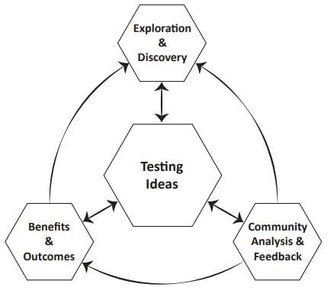
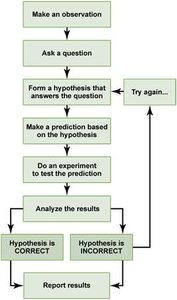
The scientific method is a structured process used to investigate questions and test hypotheses. It ensures objectivity and reliability in scientific research.
Observation: Noticing phenomena or problems in the natural world.
Question: Formulating a question based on the observation.
Hypothesis: Proposing a testable explanation or answer.
Prediction: Making a logical prediction based on the hypothesis.
Experiment: Designing and conducting tests to evaluate the prediction.
Result: Collecting and analyzing data from the experiment.
Conclusion: Interpreting results to accept, reject, or revise the hypothesis.
Example: Simple Experiment
Consider the scenario: "Charlie is sick." The scientific method can be applied as follows:
Observation: Charlie is sick.
Question: Does Charlie have an infection?
Hypothesis: Charlie has an infection.
Prediction: If Charlie receives medicine, he will recover.
Experiment: Administer medicine and observe recovery.
Result: Charlie recovers.
Conclusion: The medicine cured Charlie’s infection.

Experimental Design
Key Vocabulary
Understanding experimental design is crucial for conducting valid scientific investigations.
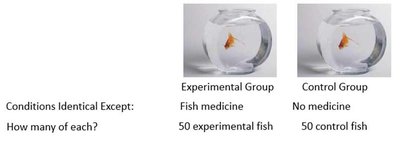
Experimental Variable (Independent Variable): The one factor that is changed between groups.
Dependent Variable: The outcome measured in the experiment.
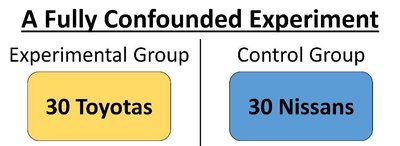
Control Group: The group that does not receive the experimental treatment, used for comparison.
Experimental Group: The group that receives the treatment or variable being tested.
Avoiding Bias and Confounds
Bias and confounding variables can distort experimental results and lead to incorrect conclusions.
Bias: Systematic errors in design, data collection, or analysis. Examples include selection bias (e.g., only testing on male mice) and information bias (e.g., omitting inconvenient data).
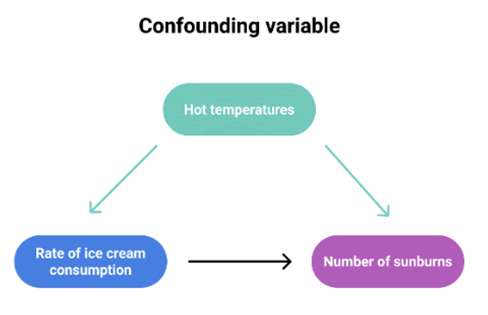
Confounding Variables: External factors that influence both the independent and dependent variables, making it difficult to determine causality.
Strategies to reduce bias and confounds include randomization, blinding, and careful control of variables.
Correlation vs. Causation
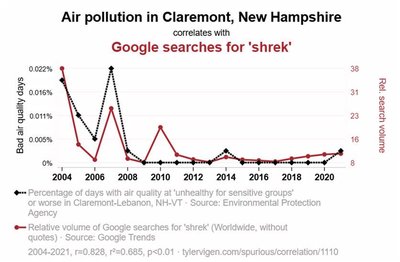
Correlation is a statistical relationship between two variables, but it does not imply that one causes the other. Causation means that one variable directly affects another.
Spurious correlations can arise when unrelated variables appear to be linked due to confounding factors.
Careful experimental design is needed to establish causation.
Application: Testing the Five Second Rule
Experimental Design Example
The "five second rule" suggests food is safe to eat if picked up within five seconds. This hypothesis can be tested scientifically.
Question: Is food safe to eat if picked up within five seconds?
Hypothesis: Food dropped on the ground is safe to eat within five seconds.
Prediction: Food picked up within five seconds will show reduced microbial contamination.
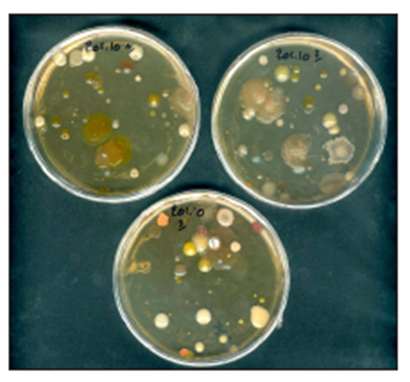
Experiment: Expose apple pieces to contaminated surfaces for varying times, then measure microbial growth on Petri dishes.
Counting Colonies
Microbes such as bacteria and fungi are ubiquitous and grow rapidly on nutrient-rich media like Petri dishes. Colony counting is a method to quantify microbial contamination.
Each colony originates from a single cell or spore.
Colony counts provide a measure of contamination.
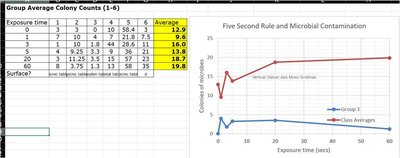
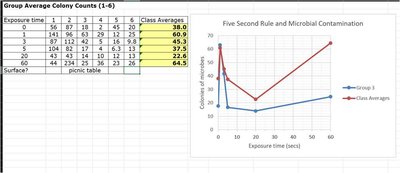
Data Analysis: Five Second Rule Results
Experimental results are analyzed by counting colonies and graphing data to compare contamination levels at different exposure times.
Group averages and class averages are calculated for each exposure time.
Graphs illustrate the relationship between exposure time and microbial contamination.
Exposure Time (sec) | Group Average Colony Count | Class Average Colony Count |
|---|---|---|
0 | 12.4 | 38.0 |
5 | 16.0 | 60.9 |
10 | 16.8 | 45.3 |
30 | 18.2 | 37.5 |
60 | 19.4 | 64.5 |
Historical Example: Ignaz Semmelweis
Semmelweis and the Fight to Save Mothers
Ignaz Semmelweis was a pioneer in medical hygiene, demonstrating that handwashing could drastically reduce maternal mortality in hospitals. His work exemplifies the application of scientific method to solve real-world problems.
Semmelweis observed high mortality rates in maternity wards.
He hypothesized that handwashing would reduce infections.
His experiments confirmed the hypothesis, leading to improved medical practices.

Additional info: The notes above expand brief points into full academic explanations, add context for experimental design, and clarify the importance of avoiding bias and confounds in scientific research. Tables and graphs are recreated for clarity and completeness.
