 Back
BackProbability and Patterns of Inheritance in Genetics
Study Guide - Smart Notes
 Tailored notes based on your materials, expanded with key definitions, examples, and context.
Probability in Genetics
Basic Probability Concepts
Probability is a fundamental concept in genetics, used to predict the likelihood of specific genetic outcomes. The probability of an event (P) ranges from 0 (impossible) to 1 (certain).
Certain event: Probability = 1
Impossible event: Probability = 0
Example: The probability of a child being a girl (P(girl)) = 0.5
Probability of either a girl or boy: P(girl or boy) = 1.0
Probability of neither a girl nor a boy: P(neither) = 0
Rules of Probability
Product Rule: The probability of two independent events both occurring is the product of their individual probabilities. Example: Probability of two girls: P(2 girls) = P(girl) × P(girl) = 0.5 × 0.5 = 0.25
Addition Rule: The probability of an event that can occur in two or more different ways is the sum of their individual probabilities. Example: Probability that exactly one of two children is a girl: P(girl then boy) = 0.5 × 0.5 = 0.25 P(boy then girl) = 0.5 × 0.5 = 0.25 Total = 0.25 + 0.25 = 0.5
Calculating Genotype Probabilities
Punnett Squares and Phenotypic Ratios
Punnett squares are used to predict the genotypic and phenotypic ratios of offspring from genetic crosses. For example, in a dihybrid cross involving two traits (such as seed color and shape in peas), the following probabilities can be calculated:
Yellow (Y) is dominant to green (y)
Round (R) is dominant to wrinkled (r)
Phenotype | Probability |
|---|---|
Yellow and round | 3/4 × 3/4 = 9/16 |
Yellow and wrinkled | 3/4 × 1/4 = 3/16 |
Green and round | 1/4 × 3/4 = 3/16 |
Green and wrinkled | 1/4 × 1/4 = 1/16 |
Testcross: Determining Genotype
Principle of the Testcross
A testcross is used to determine the genotype of an individual with a dominant phenotype. This is done by crossing the individual with a homozygous recessive (pp) individual. The resulting offspring phenotypes reveal the unknown genotype.
Dominant phenotype (PP or Pp) × Recessive phenotype (pp)
If all offspring show the dominant trait, the unknown is likely homozygous dominant (PP).
If offspring show a 1:1 ratio of dominant to recessive, the unknown is heterozygous (Pp).
Patterns of Inheritance
Complete Dominance
In complete dominance, the phenotype of the heterozygote is identical to that of the homozygous dominant individual. For example, in pea plants, purple flower color (P) is dominant to white (p).
PP × pp: All offspring are Pp (purple)
Pp × pp: 1:1 ratio of purple (Pp) to white (pp)
Incomplete Dominance
Incomplete dominance occurs when the phenotype of the heterozygote is intermediate between the phenotypes of the two homozygotes. For example, crossing red (RR) and white (rr) snapdragons produces pink (Rr) offspring.
F1 cross (RR × rr): 100% pink (Rr)
F2 cross (Rr × Rr): Genotypic ratio 1:2:1 (RR:Rr:rr), Phenotypic ratio 1:2:1 (red:pink:white)



Example: Familial Hypercholesterolemia (FH)
Familial Hypercholesterolemia is a human genetic disease that demonstrates incomplete dominance. The severity of the disease depends on the number of mutant alleles:
Genotype | Cholesterol Level | Heart Disease Onset |
|---|---|---|
+/+ | Normal (1x) | Late in life (60-80) |
+/fh | 2x normal | Mid adult (30-50) |
fh/fh | 6x normal | Early life (<10) |
Codominance and ABO Blood Groups
Codominance occurs when both alleles in a heterozygote are fully expressed. The ABO blood group system in humans is a classic example:
Gene I controls blood type
Alleles: IA, IB (both dominant); i (recessive)
Genotypes and Phenotypes:
Genotype | Blood Type |
|---|---|
IAIA or IAi | A |
IBIB or IBi | B |
IAIB | AB (codominant) |
ii | O |
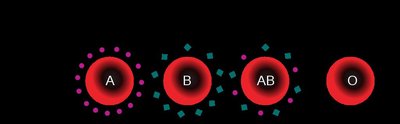
Additional info: Codominance is distinct from incomplete dominance because both traits are fully and simultaneously expressed, rather than blending into an intermediate phenotype.
