 Back
BackProkaryotes, Protists, and the Evolution of Eukaryotes: Structure, Function, and Diversity
Study Guide - Smart Notes
 Tailored notes based on your materials, expanded with key definitions, examples, and context.
Introduction to Prokaryotes
Prokaryotic and Eukaryotic Cells
All living organisms are classified into two broad cell types: prokaryotic and eukaryotic cells. These categories represent the most fundamental division in cellular life.
Prokaryotic Cells: Lack a membrane-bound nucleus and other membrane-bound organelles. Includes both Bacteria and Archaea.
Eukaryotic Cells: Possess a true nucleus and various membrane-bound organelles. Includes Protists, Fungi, Plants, and Animals.
Example: Bacteria and Archaea are prokaryotes, while plants and animals are eukaryotes.
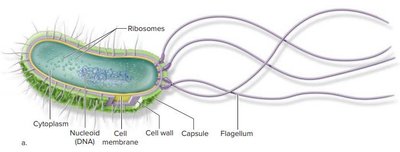
Features of Bacterial Cells
Bacteria are the most abundant and diverse organisms on Earth. Their cellular structure is distinct from eukaryotes in several ways:
DNA: Circular DNA located in a region called the nucleoid.
Ribosomes: Small (70S) ribosomes for protein synthesis.
Cell Division: Divide by binary fission, a simple form of asexual reproduction.
Cell Wall: Most have a cell wall composed of peptidoglycan (in Bacteria).
Motility: Many possess flagella for movement.
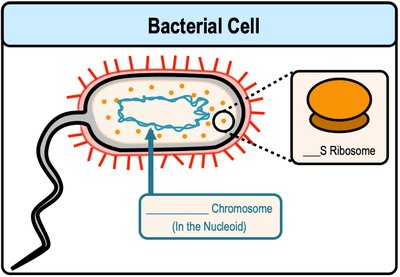
Comparison of Prokaryotic and Eukaryotic Cells
Key differences between prokaryotic and eukaryotic cells include:
Cell Size: Prokaryotes are generally smaller (1–10 μm) than eukaryotes (10–100 μm).
Nucleus: Prokaryotes lack a nucleus; eukaryotes have a true nucleus.
Organelles: Prokaryotes lack membrane-bound organelles; eukaryotes possess them.
Ribosome Size: Prokaryotes have 70S ribosomes; eukaryotes have 80S ribosomes.
Genetic Material: Prokaryotes have circular DNA; eukaryotes have linear DNA.
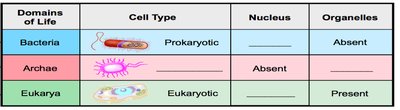
Introduction to Archaea
Characteristics of Archaea
Archaea (singular: archaeon) are one of the three domains of life. Like bacteria, they have a prokaryotic cell structure but differ in several key aspects:
Cell Structure: Prokaryotic, but with unique ribosomal RNA (rRNA) sequences.
Cell Wall: Lack peptidoglycan (unlike bacteria).
Habitats: Many are extremophiles, thriving in extreme environments (e.g., high temperature, salinity, or acidity), but some live in moderate environments.
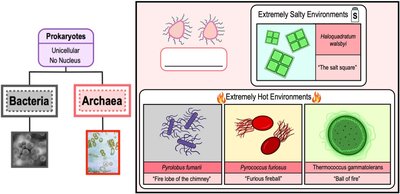
Prokaryotic Metabolism
Nutritional Factors of Microbial Growth
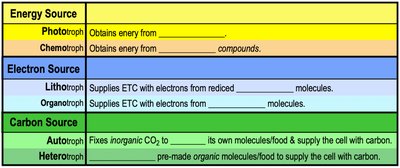
Microbes are classified based on three key nutritional factors:
Energy Source: Where the organism gets its energy (light or chemicals).
Electron Source: The original molecule supplying electrons to the electron transport chain (ETC).
Carbon Source: The original carbon-based molecule used to build cell components.
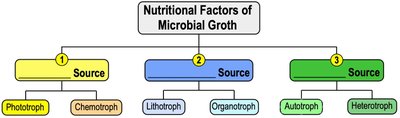
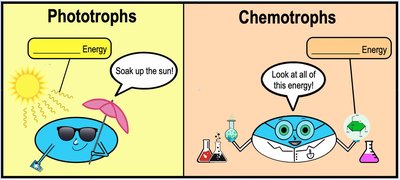
Energy Source: Phototrophs vs. Chemotrophs
Phototrophs: Obtain energy from sunlight.
Chemotrophs: Obtain energy from chemical compounds (organic or inorganic).
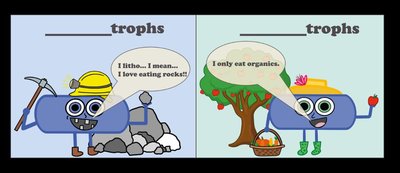
Electron Source: Lithotrophs vs. Organotrophs
Lithotrophs: Use electrons from reduced inorganic molecules (e.g., H2O, Fe2+).
Organotrophs: Use electrons from organic molecules (e.g., glucose).
Carbon Source: Autotrophs vs. Heterotrophs
Autotrophs: Use carbon fixation (e.g., from CO2) to make their own food and cell components.
Heterotrophs: Obtain carbon by consuming organic molecules.
Nutritional Diversity Among Microbes
Microbes can be classified by combinations of their energy, electron, and carbon sources. For example:
Photoautotrophs: Use light for energy and CO2 for carbon (e.g., cyanobacteria).
Chemoheterotrophs: Use chemicals for energy and organic molecules for carbon (e.g., humans).
Photoheterotrophs: Use light for energy and organic molecules for carbon.
Chemoautotrophs: Use chemicals for energy and CO2 for carbon.
Introduction to Protists
What is a Protist?
Protists are a diverse, paraphyletic group of eukaryotic organisms that are not classified as plants, animals, or fungi. Most eukaryotes are protists, and they likely represent the first eukaryotic lineages.
Protists are not a true monophyletic group but are grouped for convenience.
All protists have a membrane-bound nucleus and other eukaryotic organelles.
They can be unicellular or multicellular, and exhibit a wide range of morphologies and lifestyles.
Diversity of Protist Structure & Function
Protists are highly diverse in structure and function:
Most are unicellular and live in moist or aquatic environments.
They may be heterotrophic, photosynthetic, or mixotrophic (combining both modes).
Some can engulf nutrients via phagocytosis.
Evolution of Protists
Primary and Secondary Endosymbiosis
Endosymbiosis is a symbiotic relationship where one organism lives inside another. This process played a key role in the evolution of eukaryotes:
Primary Endosymbiosis: A host cell engulfs a prokaryotic cell (e.g., origin of mitochondria from an aerobic bacterium).
Secondary Endosymbiosis: A host cell engulfs a eukaryotic cell (e.g., red or green algae), leading to organelles with multiple membranes.
Advantage: The engulfed cell provided the host with ATP or photosynthetic capability, increasing survival and energy efficiency.
Protist Life Cycles
General Features
Protists exhibit a wide variety of life cycles, which may be sexual, asexual, or both. Some involve alternation between haploid and diploid forms, and may require multiple hosts.
Plasmodium Life Cycle (Malaria)
Plasmodium is a protist that causes malaria. Its life cycle involves both humans and mosquitoes, with sexual and asexual stages:
Infected mosquito injects sporozoites into human blood.
Sporozoites infect liver cells, become merozoites, and reproduce asexually.
Merozoites infect red blood cells, causing symptoms.
Some merozoites become gametocytes, which are taken up by another mosquito.
Sexual reproduction occurs in the mosquito, completing the cycle.
Laminaria Life Cycle: Alternation of Generations
Some protists, like Laminaria (a brown alga), exhibit alternation of generations:
Sporophyte (2n): Multicellular diploid form produces haploid spores by meiosis.
Gametophyte (n): Multicellular haploid form produces gametes by mitosis.
Fertilization produces a diploid zygote, which grows into a new sporophyte.
Paramecium Life Cycle: Conjugation & Asexual Reproduction
Paramecium exchanges DNA sexually via conjugation and reproduces asexually by binary fission:
Conjugation involves exchange and fusion of micronuclei, resulting in genetic recombination.
Binary fission increases population size.
Land Plants: Evolution and Adaptations
Origin and Major Groups
Land plants evolved from freshwater green algae and developed adaptations for terrestrial life:
Nonvascular plants (Bryophytes): Gametophyte-dominant, lack lignified vascular tissue.
Seedless vascular plants: Sporophyte-dominant, possess vascular tissue (xylem and phloem).
Seed plants: Include gymnosperms (naked seeds) and angiosperms (seeds in fruits/flowers).
Adaptations for Terrestrial Life
Cuticle: Waxy covering to prevent water loss.
Stomata: Pores for gas exchange, regulated by guard cells.
Vascular Tissue: Xylem (water/mineral transport) and phloem (nutrient transport).
Lignin: Provides structural support for vertical growth.
Alternation of Generations in Plants
Gametophyte: Haploid, produces gametes by mitosis.
Sporophyte: Diploid, produces spores by meiosis.
Homospory: One type of spore.
Heterospory: Microspores (male) and megaspores (female).
Animals: Structure, Development, and Diversity
General Features of Animals
Multicellular, heterotrophic eukaryotes.
Lack cell walls; have extracellular matrix for support.
Motile at some stage; most reproduce sexually.
Development involves cleavage, blastula, and gastrulation.
Animal Development and Body Plans
Cleavage: Rapid mitotic divisions of the zygote.
Blastula: Hollow ball of cells.
Gastrulation: Formation of germ layers (ectoderm, mesoderm, endoderm).
Protostomes: Mouth develops from blastopore.
Deuterostomes: Anus develops from blastopore.
Coelom: Body cavity derived from mesoderm.
Major Animal Groups
Lophotrochozoans: Includes flatworms, mollusks, annelids.
Ecdysozoans: Includes arthropods (insects, crustaceans) and nematodes; characterized by molting (ecdysis).
Echinoderms: Deuterostomes with water vascular system (e.g., starfish).
Chordates: Defined by notochord, dorsal hollow nerve cord, pharyngeal slits, and post-anal tail.
Vertebrate Evolution
Jawless fish: Hagfish, lampreys.
Gnathostomes: Jawed vertebrates (fish, amphibians, reptiles, mammals).
Tetrapods: Four-limbed vertebrates (amphibians, reptiles, mammals).
Amniotes: Tetrapods with amniotic eggs (reptiles, birds, mammals).
Primates and Human Evolution
Primates: Mammals with large brains, opposable thumbs.
Hominids: Great apes, including humans.
Homo: Genus including modern humans and extinct relatives.
