 Back
BackProperties of Water: Biological Importance and Mechanisms
Study Guide - Smart Notes
 Tailored notes based on your materials, expanded with key definitions, examples, and context.
Properties of Water
Overview
Water is essential for life due to its unique physical and chemical properties. These properties arise from its molecular structure and interactions, making water indispensable for biological systems. The main properties include polarity, cohesion, adhesion, capillary action, temperature control, high specific heat, high heat of vaporization, density, solvent capabilities, and pH buffering.
Polarity
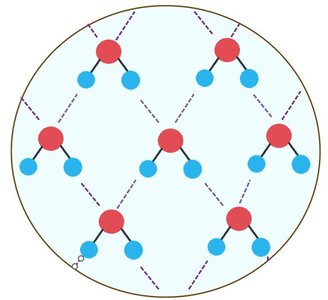
Water molecules are polar because of the unequal sharing of electrons between oxygen and hydrogen atoms, resulting in partial positive and negative charges. This polarity enables water to form hydrogen bonds, which are critical for its other properties.
Polar covalent bonds: Oxygen is more electronegative than hydrogen, creating a dipole.
Hydrogen bonding: The partial charges allow water molecules to attract each other.
Example: Water's polarity allows it to dissolve many substances, making it a universal solvent.
Cohesion
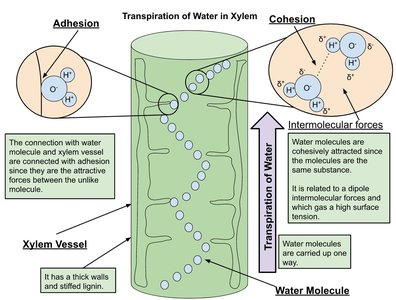
Cohesion refers to the attraction between water molecules due to hydrogen bonding. This property allows water to resist external forces and is responsible for surface tension.
Hydrogen bonds: Hold water molecules together.
Surface tension: Water molecules at the surface experience a greater inward pull.
Biological importance: Enables transport of water and nutrients against gravity in plants.
Adhesion
Adhesion is the attraction of water molecules to other polar or charged substances. This property is crucial for water's interaction with cell walls in plants, helping resist the downward pull of gravity.
Polarity: Water's polarity allows it to stick to other surfaces.
Example: Water clings to the xylem walls in plants.
Capillary Action
Capillary action is the upward movement of water through narrow spaces, resulting from the combined forces of cohesion, adhesion, and surface tension. It is vital for the transport of water and nutrients in plants.
Occurs when adhesion > cohesion: Water moves up against gravity.
Example: Water travels from roots to leaves in plants.
Temperature Control
Water has a high specific heat, meaning it can absorb or release large amounts of heat with minimal temperature change. This property is due to hydrogen bonding, which requires energy to break and releases energy when formed.
High specific heat: Moderates air and ocean temperatures.
Biological importance: Helps organisms maintain stable internal temperatures.
High Heat of Vaporization & Evaporative Cooling
Water requires significant energy to evaporate, which is important for cooling surfaces and regulating climate.
Evaporative cooling: As water evaporates, it cools the surface.
Example: Sweating in humans, cooling leaves in plants.
Density (Floating Ice)
As water freezes, it forms a crystalline structure due to hydrogen bonds, making ice less dense than liquid water. This allows ice to float, providing insulation for aquatic life.
Hydrogen bonds: Cause expansion and lower density in ice.
Biological importance: Marine life survives under ice sheets.
Solvent Properties
Water is a versatile solvent due to its polarity, enabling it to dissolve ionic and polar substances. This is essential for biochemical reactions and transport of nutrients.
Solution: Homogeneous mixture of two or more substances.
Solvent: The dissolving agent (water).
Solute: The substance dissolved.
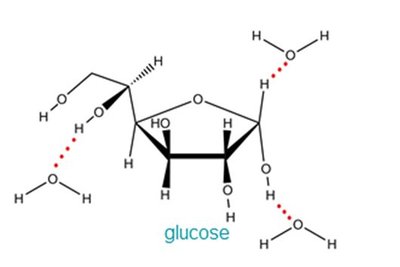
"Like dissolves like": Water dissolves sugars and proteins by forming hydrogen bonds.
Ionic Compounds
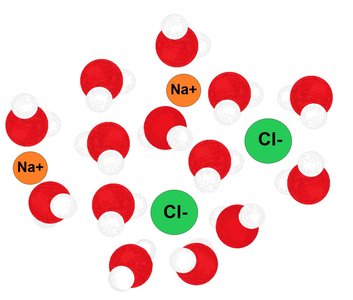
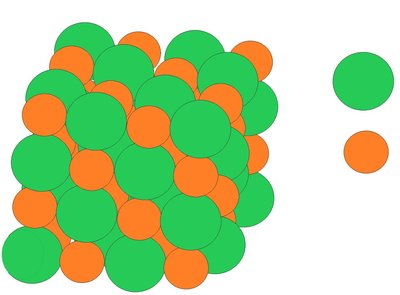
Water dissolves ionic compounds by surrounding ions with its polar molecules. The partially negative oxygen interacts with positive ions, and the partially positive hydrogen interacts with negative ions.
Example: Dissolving sodium chloride (NaCl) in water.
pH and Buffering
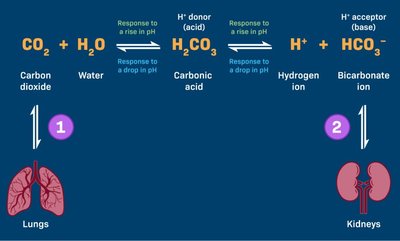
pH measures the acidity or alkalinity of a solution. Water can dissociate into hydrogen (H+) and hydroxide (OH-) ions. Buffers are solutions that resist changes in pH, maintaining stability in biological systems.
Acid: Releases H+ ions in water.
Base: Accepts H+ or releases OH- ions.
Buffer: Maintains pH stability by neutralizing added acids or bases.
Key equation (carbonic acid buffer system):
Concept Check
Mixing potassium chloride (KCl) with water: KCl dissociates into K+ and Cl- ions, which are surrounded by water molecules due to their polarity. Water's oxygen atoms surround K+, and hydrogen atoms surround Cl-.
Property contributing to marine life: The lower density of ice allows it to float, insulating aquatic environments and supporting life beneath.
If ice were more dense than water: Ice would sink, disrupting aquatic ecosystems by eliminating insulation and potentially freezing entire bodies of water.
