 Back
Protein Structure and Function: A Comprehensive Study Guide
Study Guide - Smart Notes
 Tailored notes based on your materials, expanded with key definitions, examples, and context.
Protein Structure and Function
Introduction
Proteins are essential macromolecules that perform a vast array of functions in biological systems. Their structure, determined by the sequence and properties of amino acids, is directly related to their function. Understanding protein structure and function is fundamental to the study of biology.
Protein Functions
Major Roles of Proteins
Catalysis: Proteins called enzymes accelerate chemical reactions necessary for life.
Defense: Antibodies are proteins that recognize and neutralize pathogens.
Movement: Motor proteins move cells or transport molecules within cells.
Signaling: Proteins transmit signals between cells, coordinating biological processes.
Structure: Structural proteins provide support and shape to cells and tissues.
Transport: Transport proteins move substances across cell membranes or throughout the body.
Amino Acids: The Building Blocks of Proteins
Basic Structure of Amino Acids
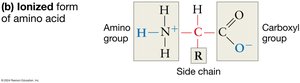
All amino acids share a common structure consisting of a central carbon atom (the alpha carbon) bonded to an amino group, a carboxyl group, a hydrogen atom, and a variable side chain (R-group). In aqueous solutions, the amino group is typically protonated and the carboxyl group is deprotonated, resulting in a zwitterion.
Classification of Amino Acids
Amino acids are classified based on the properties of their R-groups:
Nonpolar (hydrophobic): Side chains are mostly hydrocarbons.
Polar (hydrophilic): Side chains contain electronegative atoms, making them soluble in water.
Acidic: Side chains contain a carboxyl group and are negatively charged at physiological pH.
Basic: Side chains contain an amino group and are positively charged at physiological pH.
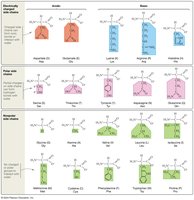
There are 20 standard amino acids, 9 of which are essential (must be obtained from the diet), and 11 are non-essential (can be synthesized by the body).
Properties of R-Groups
The R-group, or side chain, is what makes each amino acid unique and determines its chemical behavior. R-groups can participate in various chemical reactions and bonding, influencing protein structure and function.
Peptide Bonds and Polypeptides
Formation of Peptide Bonds
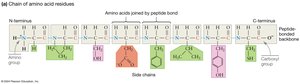
Proteins are formed by linking amino acids together via peptide bonds. This occurs through a condensation reaction, where the carboxyl group of one amino acid reacts with the amino group of another, releasing water.
Properties of Polypeptides
Directionality: Polypeptides have an N-terminus (amino end) and a C-terminus (carboxyl end). Proteins are synthesized from N- to C-terminus.
R-groups: Extend outward from the backbone, allowing for diverse interactions.
Flexibility: The polypeptide backbone can rotate around the bonds flanking the alpha carbon, enabling folding.

Levels of Protein Structure
Primary Structure
The primary structure is the unique sequence of amino acids in a protein, often described as "beads on a string." This sequence determines all higher levels of structure.

Secondary Structure
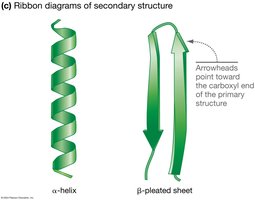
Secondary structure refers to regular, repeated patterns in regions of the polypeptide chain, stabilized by hydrogen bonds between backbone atoms. The two most common types are the alpha-helix and beta-pleated sheet.
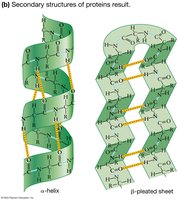
Alpha-helix: A right-handed coil stabilized by hydrogen bonds.
Beta-pleated sheet: Sheet-like arrangement formed by hydrogen bonds between parallel or antiparallel strands.
Tertiary Structure
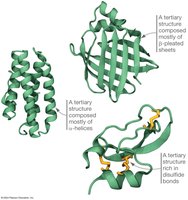
The tertiary structure is the overall three-dimensional shape of a single polypeptide chain, resulting from interactions between R-groups (side chains) that are often distant from each other in the primary sequence. These interactions include hydrogen bonds, ionic bonds, hydrophobic interactions, and disulfide bridges.
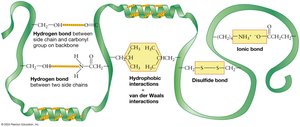
Hydrogen bonds: Between polar side chains or between side chains and backbone atoms.
Ionic bonds (salt bridges): Between oppositely charged side chains.
Hydrophobic interactions: Nonpolar side chains cluster away from water.
Disulfide bonds: Covalent bonds between cysteine residues.
Quaternary Structure
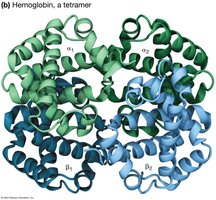
Quaternary structure arises when two or more polypeptide chains (subunits), each with their own tertiary structure, associate to form a functional protein complex. Not all proteins have quaternary structure.
Protein Folding and Function
Relationship Between Structure and Function
The specific sequence of amino acids (primary structure) determines how a protein folds into its functional three-dimensional shape. Protein function is directly dependent on its structure; even a single amino acid change can have dramatic effects.

Example: In sickle cell anemia, a single amino acid substitution (glutamate to valine) in hemoglobin leads to abnormal red blood cell shape and impaired function.
Protein Denaturation
Denaturation is the loss of a protein's native structure (and function) due to disruption of non-covalent interactions. Common denaturants include:
Heat
pH extremes
High salt concentrations
Reducing agents (break disulfide bonds)
Summary Table: Types of Protein Structure and Bonds
Level of Structure | Description | Main Bonds/Interactions |
|---|---|---|
Primary | Sequence of amino acids | Peptide bonds (covalent) |
Secondary | Alpha-helices and beta-sheets | Hydrogen bonds (backbone) |
Tertiary | 3D folding of a single polypeptide | Hydrogen bonds, ionic bonds, hydrophobic interactions, disulfide bonds |
Quaternary | Association of multiple polypeptides | Same as tertiary (between subunits) |
Practice and Application
Draw the basic structure of an amino acid, labeling the amino group, carboxyl group, alpha carbon, hydrogen, and R-group.
Classify amino acids as acidic, basic, polar, or nonpolar based on their side chains.
Draw two amino acids before and after peptide bond formation, indicating the atoms lost during condensation.
List and describe the types of bonds and interactions present at each level of protein structure.
Additional info: Understanding protein structure is foundational for topics such as enzyme catalysis, genetic diseases, and biotechnology applications.
