 Back
Protein Structure and Function: A Comprehensive Study Guide
Study Guide - Smart Notes
 Tailored notes based on your materials, expanded with key definitions, examples, and context.
Protein Structure and Function
Introduction to Proteins
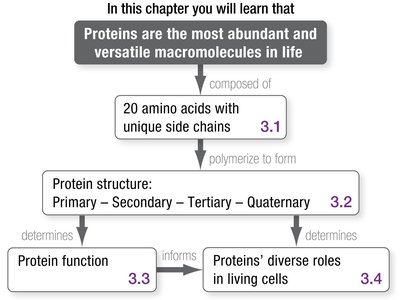
Proteins are the most abundant and versatile macromolecules in living organisms. They are composed of 20 different amino acids, each with a unique side chain, and their structure determines their diverse functions in cells.
Amino Acids: Structure and Properties
General Structure of Amino Acids
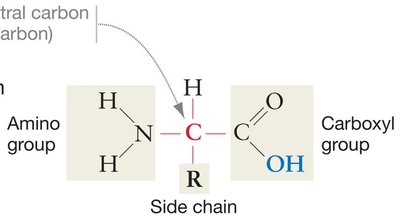
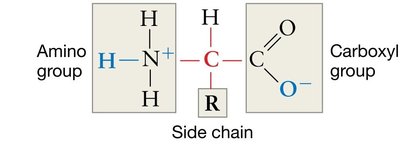
All amino acids share a common structure consisting of a central (alpha) carbon atom bonded to four different groups: a hydrogen atom, an amino group (–NH2), a carboxyl group (–COOH), and a variable side chain (R group). The R group determines the identity and properties of each amino acid.
Ionization of Amino Acids
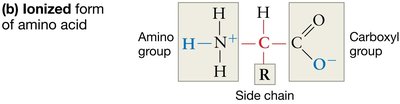
In aqueous solutions, amino acids can ionize. The amino group can accept a proton, becoming positively charged, while the carboxyl group can lose a proton, becoming negatively charged. This ionization helps amino acids stay in solution and affects their chemical reactivity.
Classification of Amino Acid Side Chains
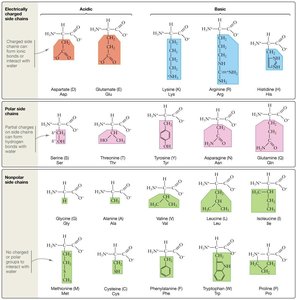
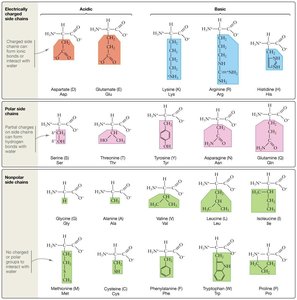
The side chains (R groups) of amino acids can be classified into three main types based on their chemical properties:
Charged (acidic or basic): Side chains carry a full positive or negative charge.
Uncharged polar: Side chains contain polar groups (often oxygen) but are not charged.
Nonpolar: Side chains are primarily hydrocarbons and do not interact well with water.
To classify an amino acid, ask:
Does the side chain have a negative charge? (If yes, it is acidic.)
Does the side chain have a positive charge? (If yes, it is basic.)
If uncharged, does it have an oxygen atom? (If yes, it is uncharged polar.)
If none of the above, it is nonpolar.
Polymerization of Amino Acids: Peptide Bonds
Formation of Peptide Bonds
Amino acids are linked together by peptide bonds, which form between the carboxyl group of one amino acid and the amino group of another through a condensation reaction (releasing water). The resulting chain is called a polypeptide.

Properties of the Polypeptide Backbone
R-group orientation: Side chains extend from the backbone, allowing interactions.
Directionality: Polypeptides have an N-terminus (amino end) and a C-terminus (carboxyl end).
Flexibility: The peptide bond itself is rigid, but single bonds on either side can rotate, allowing the chain to fold.
Levels of Protein Structure
Primary Structure
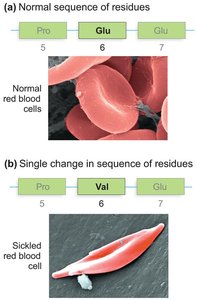
The primary structure is the unique sequence of amino acids in a protein. This sequence determines all higher levels of structure and ultimately the protein's function. Even a single amino acid change can have dramatic effects (e.g., sickle cell anemia).

Secondary Structure
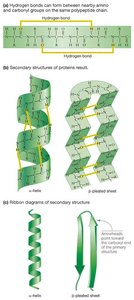
Secondary structure refers to regular folding patterns stabilized by hydrogen bonds between the backbone atoms. The two main types are:
Alpha helix (α-helix): A coiled structure stabilized by hydrogen bonds.
Beta pleated sheet (β-sheet): Sheet-like structures formed by hydrogen bonds between parallel segments.
Tertiary Structure
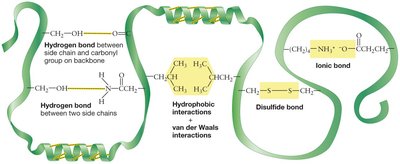
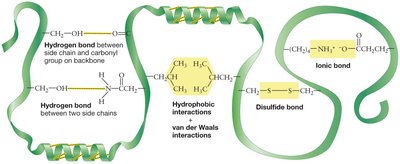
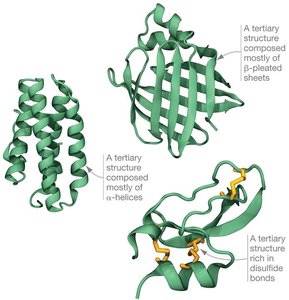
Tertiary structure is the overall three-dimensional shape of a polypeptide, resulting from interactions between R groups. These include:
Hydrogen bonds
Hydrophobic interactions
van der Waals interactions
Covalent bonds (e.g., disulfide bridges)
Ionic bonds
Quaternary Structure
Quaternary structure arises when two or more polypeptide chains (subunits) interact to form a functional protein complex. Subunits can be identical (homodimers) or different (heterodimers).
Summary Table: Levels of Protein Structure
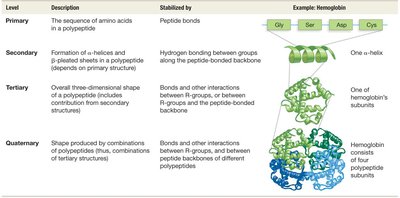
Level | Description | Stabilized by | Example |
|---|---|---|---|
Primary | Sequence of amino acids in a polypeptide | Peptide bonds | Gly-Ser-Asp-Cys |
Secondary | Formation of α-helices and β-sheets | Hydrogen bonds | α-helix in hemoglobin |
Tertiary | Three-dimensional shape of polypeptide | Bonds/interactions between R-groups | One hemoglobin subunit |
Quaternary | Shape from combinations of polypeptides | Bonds/interactions between subunits | Hemoglobin (4 subunits) |
Protein Folding and Function
Folding and Stability
Protein folding is crucial for function and is often spontaneous due to chemical interactions. The folded state is more stable (lower potential energy). Denatured (unfolded) proteins lose their function but can sometimes refold if conditions return to normal.
Molecular Chaperones
Cells contain molecular chaperones, such as heat shock proteins, that assist in proper protein folding and prevent aggregation of misfolded proteins.
Misfolding and Disease
Misfolded proteins can cause diseases. For example, prions are infectious proteins that induce normal proteins to misfold, leading to diseases like mad cow disease.
Functions of Proteins
Diverse Roles in Cells
Proteins perform a wide variety of functions, including:
Catalysis: Enzymes speed up chemical reactions.
Structure: Provide support and shape to cells and tissues.
Movement: Motor proteins move cells or molecules.
Signaling: Transmit signals between cells.
Transport: Move substances across membranes or throughout the body.
Defense: Antibodies protect against pathogens.
Enzyme Function
Enzymes are proteins that act as catalysts. They bind substrates at their active site, holding them in the correct orientation to facilitate chemical reactions.
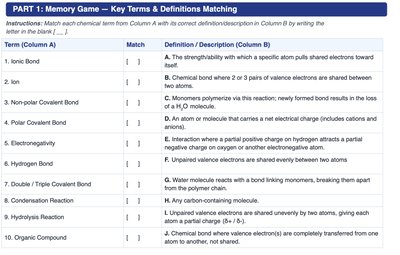
Key Terms and Definitions Table
Term | Definition |
|---|---|
Ionic Bond | Attraction between oppositely charged ions |
Ion | Atom or molecule with a net electrical charge |
Non-polar Covalent Bond | Bond where electrons are shared equally |
Polar Covalent Bond | Bond where electrons are shared unequally |
Electronegativity | Ability of an atom to attract electrons |
Hydrogen Bond | Weak bond between a hydrogen atom and an electronegative atom |
Double/Triple Covalent Bond | Bond where two or three pairs of electrons are shared |
Condensation Reaction | Reaction where monomers polymerize, releasing water |
Organic Compound | Compound containing carbon and hydrogen, often with other elements |
Summary
Understanding protein structure—from the sequence of amino acids to the complex folding of polypeptides—is essential for grasping how proteins function in biological systems. Their diverse roles are fundamental to life, and even small changes in structure can have significant biological consequences.
