 Back
Protein Structure and Function: An Introduction to Amino Acids and Protein Architecture
Study Guide - Smart Notes
 Tailored notes based on your materials, expanded with key definitions, examples, and context.
Protein Structure and Function
Introduction to Proteins
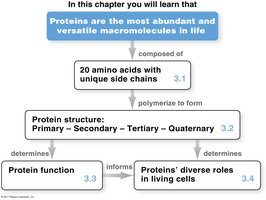
Proteins are vital, versatile, and diverse macromolecules essential to all living organisms. They are composed of amino acids, which serve as the building blocks for these complex polymers. The unique sequence and structure of amino acids in a protein determine its specific function within the cell.
Protein: A polymeric macromolecule made up of amino acid monomers.
Amino Acid: The monomeric unit of proteins, consisting of a central carbon, an amino group, a carboxyl group, and a variable side chain (R-group).
Amino Acids: Structure and Properties
General Structure of Amino Acids
Most proteins are constructed from just 20 different amino acids. Each amino acid contains a central carbon atom bonded to an amino group, a carboxyl group, a hydrogen atom, and a unique side chain (R-group). In aqueous environments, the amino group is typically ionized to NH3+ and the carboxyl group to COO–.
Amino Group: Acts as a base, attracting a proton.
Carboxyl Group: Acts as an acid, donating a proton.
R-group (Side Chain): Determines the chemical properties and reactivity of the amino acid.
Classification of Amino Acid Side Chains
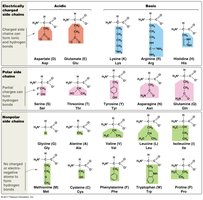
The 20 amino acids differ only in their R-groups, which can be classified into three main types based on their chemical properties:
Charged (Acidic or Basic): Hydrophilic, interact readily with water.
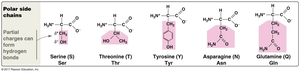
Uncharged Polar: Hydrophilic, form hydrogen bonds with water.
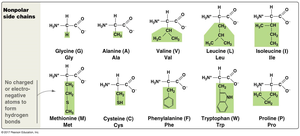
Nonpolar: Hydrophobic, do not interact with water.
Examples of Amino Acid Side Chains
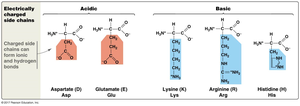
Below are examples of nonpolar, polar, and electrically charged side chains, which influence protein solubility and function.
Type | Examples |
|---|---|
Nonpolar | Glycine, Alanine, Valine, Leucine, Isoleucine, Methionine, Cysteine, Phenylalanine, Tryptophan, Proline |
Polar | Serine, Threonine, Tyrosine, Asparagine, Glutamine |
Charged | Aspartate, Glutamate (acidic); Lysine, Arginine, Histidine (basic) |
Formation and Breakdown of Proteins
Polymerization: Condensation (Dehydration) Reactions
Amino acids are linked together by peptide bonds through condensation reactions, which release a molecule of water. The resulting chain of amino acids is called a polypeptide.
Peptide Bond: A covalent bond formed between the carboxyl group of one amino acid and the amino group of another.
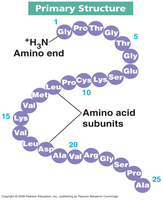
Directionality: Polypeptides have an N-terminus (amino end) and a C-terminus (carboxyl end), and are conventionally written from N- to C-terminus.
Hydrolysis: Breaking Down Proteins
Hydrolysis is the reverse of condensation, breaking peptide bonds by adding water and releasing individual amino acids.
Levels of Protein Structure
Overview of Protein Structure
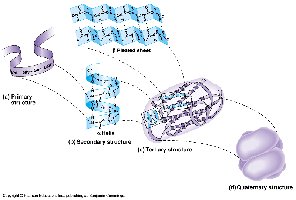
Proteins have four levels of structure, each contributing to the molecule's overall shape and function:
Primary Structure: The unique sequence of amino acids in a polypeptide.
Secondary Structure: Local folding patterns such as α-helices and β-pleated sheets, stabilized by hydrogen bonds.
Tertiary Structure: The overall three-dimensional shape of a polypeptide, resulting from interactions among R-groups and the peptide backbone.
Quaternary Structure: The arrangement of multiple polypeptide subunits in a functional protein.
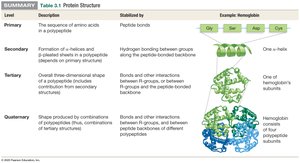
Level | Description | Stabilized by | Example (Hemoglobin) |
|---|---|---|---|
Primary | Sequence of amino acids | Peptide bonds | Gly-Ser-Asp-Glu |
Secondary | α-helices and β-sheets | Hydrogen bonds | One α-helix |
Tertiary | Three-dimensional shape | Bonds/interactions between R-groups | One of hemoglobin's subunits |
Quaternary | Combination of polypeptides | Bonds/interactions between subunits | Hemoglobin (four subunits) |
Primary Structure
The primary structure is the linear sequence of amino acids in a protein, determined by genetic information. The number of possible primary structures is nearly limitless, as there are 20 amino acids and polypeptides can be thousands of residues long.
Secondary Structure
Secondary structures are formed by hydrogen bonds between the carbonyl oxygen of one amino acid and the amide hydrogen of another. The two main types are α-helices and β-pleated sheets.
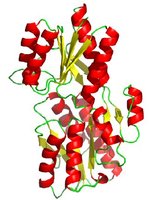
Tertiary Structure
Tertiary structure results from interactions between R-groups or between R-groups and the peptide backbone, causing the polypeptide to fold into a unique three-dimensional shape. These interactions include hydrogen bonds, ionic bonds, hydrophobic interactions, and disulfide bridges.
Quaternary Structure
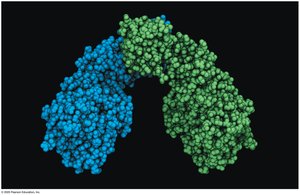
Some proteins consist of multiple polypeptide chains (subunits) that assemble into a functional complex. The quaternary structure describes the spatial arrangement of these subunits.
Protein Folding and Function
Importance of Protein Folding
Protein folding is essential for biological function. The correct three-dimensional structure is necessary for activity, and misfolded proteins can lead to loss of function or disease. Folding is often spontaneous, driven by hydrogen bonds and van der Waals interactions, and results in a more energetically stable molecule.
Misfolded Proteins and Disease
Misfolded proteins, known as prions, can cause infectious diseases such as mad cow disease, scrapie, and Creutzfeldt-Jakob disease. Prions have the same primary structure as normal proteins but differ in higher-order structure, making them highly resistant to degradation and capable of inducing misfolding in normal proteins.

Diverse Functions of Proteins
Major Functions of Proteins in Cells
Proteins perform a wide variety of functions in living cells, including:
Catalysis: Enzymes speed up chemical reactions.
Defense: Antibodies protect against disease.
Signaling: Proteins transmit signals within and between cells.
Transport: Proteins move substances across cell membranes.
Structure: Proteins provide support and shape to cells and tissues.
Movement: Motor proteins enable cellular and organismal movement.
Learning Outcomes
Describe how the structure of an amino acid affects its function and how amino acids polymerize to form polypeptides.
Describe the four levels of protein structure and predict how changes to one level may affect the structure of others.
Provide examples to show how protein folding is directly related to function.
Give examples of the general types of functions that are carried out in cells by different types of proteins.
