 Back
Protein Structure and Function: Foundations of Biological Macromolecules
Study Guide - Smart Notes
 Tailored notes based on your materials, expanded with key definitions, examples, and context.
Protein Structure and Function
Introduction to Proteins
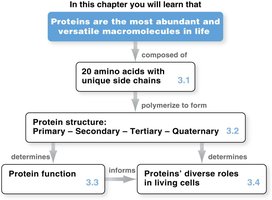
Proteins are the most abundant and versatile macromolecules in living organisms. They are essential for nearly every biological process, serving as catalysts, structural components, signaling molecules, and more. Proteins are polymers composed of 20 different amino acids, each with a unique side chain, which determines their chemical properties and functions.
The Structure of Amino Acids
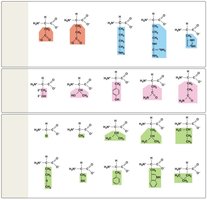
All amino acids share a common structure: a central (α) carbon atom bonded to an amino group, a carboxyl group, a hydrogen atom, and a variable side chain (R-group). The R-group determines the identity and properties of each amino acid. In aqueous solutions, the amino group is typically protonated (NH3+) and the carboxyl group is deprotonated (COO−).
Charged side chains: Can be acidic (negatively charged) or basic (positively charged).
Uncharged polar side chains: Contain electronegative atoms like oxygen, allowing hydrogen bonding.
Nonpolar side chains: Lack charged or highly electronegative atoms, making them hydrophobic.
Polymerization of Amino Acids: Peptide Bond Formation
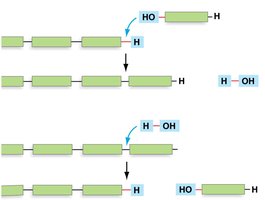
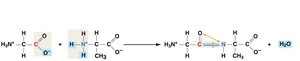
Amino acids are linked together by peptide bonds to form polypeptides. This process, called a condensation reaction, releases a molecule of water for each bond formed. The reverse process, hydrolysis, breaks peptide bonds by adding water.
Condensation reaction: Monomer in, water out.
Hydrolysis: Water in, monomer out.
Peptide Bond and Protein Backbone
Peptide bonds form between the carboxyl group of one amino acid and the amino group of another. This bond has partial double-bond character, restricting rotation and contributing to the protein's overall structure. The resulting polypeptide has directionality, with an N-terminus (amino end) and a C-terminus (carboxyl end).
Levels of Protein Structure
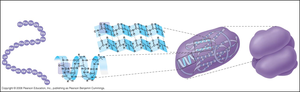
Proteins have four levels of structure, each contributing to their final shape and function:
Primary structure: The unique sequence of amino acids in a polypeptide chain.
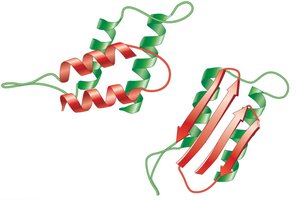
Secondary structure: Local folding patterns stabilized by hydrogen bonds, such as α-helices and β-pleated sheets.
Tertiary structure: The overall three-dimensional shape formed by interactions among R-groups and the peptide backbone.
Quaternary structure: The arrangement of multiple polypeptide subunits in a functional protein complex.
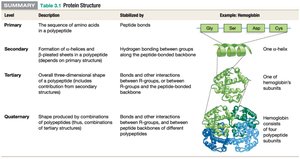
Summary Table: Protein Structure
Level | Description | Stabilized by | Example: Hemoglobin |
|---|---|---|---|
Primary | Sequence of amino acids in a polypeptide | Peptide bonds | Gly-Ser-Asp-Phe-Val-Tyr-Cys |
Secondary | Formation of α-helices and β-pleated sheets | Hydrogen bonding between groups along the peptide-bonded backbone | One α-helix |
Tertiary | Overall three-dimensional shape of a polypeptide | Bonds and other interactions between R-groups, or between R-groups and the peptide-bonded backbone | One of hemoglobin's subunits |
Quaternary | Shape produced by combinations of polypeptides (subunits) | Bonds and other interactions between R-groups, and between peptide backbones of different polypeptides | Hemoglobin (four polypeptides) |
Protein Folding and Stability
Protein folding is crucial for function and is often spontaneous, driven by the energetic favorability of the folded state. Environmental factors such as pH, temperature, and salt concentration can disrupt folding, leading to denaturation and loss of function. Molecular chaperones assist in proper folding within cells. Misfolded proteins, such as prions, can induce misfolding in normal proteins, leading to disease.
Protein Functions
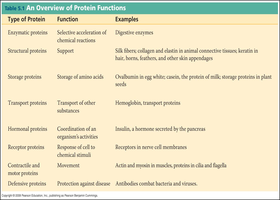
Proteins perform a vast array of functions in cells, including catalysis, defense, movement, signaling, structure, and transport. The specific function of a protein is determined by its structure, which is ultimately dictated by its amino acid sequence.
Type of Protein | Function | Examples |
|---|---|---|
Enzymatic proteins | Selective acceleration of chemical reactions | Digestive enzymes |
Structural proteins | Support | Collagen, keratin |
Storage proteins | Storage of amino acids | Ovalbumin, casein |
Transport proteins | Transport of substances | Hemoglobin |
Hormonal proteins | Coordination of activities | Insulin |
Receptor proteins | Response to chemical stimuli | Receptors in nerve cells |
Contractile and motor proteins | Movement | Actin, myosin |
Defensive proteins | Protection against disease | Antibodies |
Enzymes: Biological Catalysts
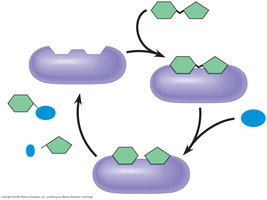
Enzymes are proteins that catalyze biochemical reactions by lowering activation energy and increasing reaction rates. They are highly specific, binding substrates at their active sites in a lock-and-key manner. Enzyme function is essential for metabolism and cellular processes.
Example: Sickle-Cell Disease and Protein Structure
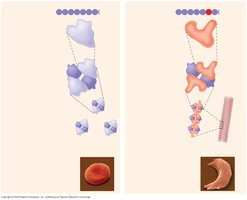
A single amino acid substitution in the primary structure of hemoglobin leads to sickle-cell disease. This change alters the protein's shape and function, demonstrating the importance of primary structure in determining protein properties.
Summary
Proteins are polymers of amino acids, with structure and function determined by the sequence and chemical properties of their monomers.
Protein structure is organized into four hierarchical levels: primary, secondary, tertiary, and quaternary.
Proper folding is essential for protein function; misfolding can lead to disease.
Proteins perform diverse roles in cells, including catalysis, structure, transport, and defense.
