 Back
Protein Structure and Function: Foundations of Biomolecular Diversity
Study Guide - Smart Notes
 Tailored notes based on your materials, expanded with key definitions, examples, and context.
Protein Structure and Function
Introduction to Organic Molecules and Biomolecules
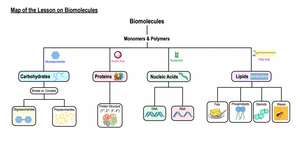
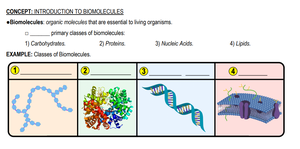
Organic molecules are the chemical foundation of life, characterized by the presence of both carbon and hydrogen atoms. The four major classes of biomolecules—carbohydrates, lipids, proteins, and nucleic acids—are essential for cellular structure and function. Each class is defined by its unique monomers and polymers, with proteins being polymers of amino acids.
Carbohydrates: Monosaccharides (monomers) form polysaccharides (polymers).
Lipids: Composed of fatty acids and glycerol; not true polymers.
Proteins: Amino acids (monomers) form polypeptides/proteins (polymers).
Nucleic Acids: Nucleotides (monomers) form DNA/RNA (polymers).
The Unique Properties of Carbon
Carbon atoms are small, with four valence electrons, allowing them to form up to four covalent bonds with other atoms such as hydrogen, oxygen, nitrogen, phosphorus, and sulfur. This versatility enables the formation of diverse organic molecules, including long chains, branched structures, rings, and complex macromolecules.
Stability: Carbon-carbon bonds are stable, supporting large and complex molecules.
Diversity: Single, double, and triple bonds, as well as ring structures, are possible.
Functional Groups and Chemical Reactivity
Functional groups are specific clusters of atoms attached to the carbon skeleton of organic molecules, conferring characteristic chemical properties and reactivity. They determine the polarity, solubility, and types of reactions the molecule can undergo.
Group | Structure | Compound | Significance |
|---|---|---|---|
Hydroxyl | -OH | Alcohols | Polar, forms hydrogen bonds |
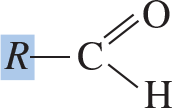
Carbonyl |
| Aldehydes, Ketones | Polar, reactive in energy reactions |
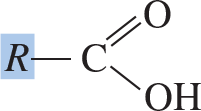
Carboxyl |
| Carboxylic acids | Acidic, donates H+ |
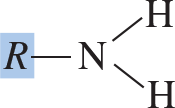
Amino |
| Amines | Basic, accepts H+ |
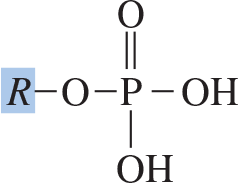
Phosphate |
| Organic phosphates | Energy transfer, polar |
Monomers, Polymers, and the Synthesis of Biomolecules
Most biomolecules are polymers, constructed from repeating monomer units. The process of joining monomers is called dehydration synthesis (condensation), while breaking polymers into monomers occurs via hydrolysis.
Dehydration Synthesis: Covalent bond forms between monomers, releasing water.
Hydrolysis: Water is added to break covalent bonds, separating monomers.
Amino Acids: Structure and Properties
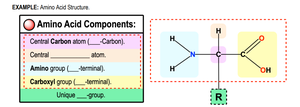
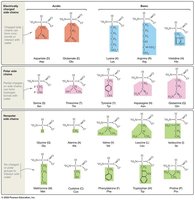
Amino acids are the building blocks of proteins, each consisting of a central (alpha) carbon atom bonded to a hydrogen atom, an amino group, a carboxyl group, and a variable R group (side chain). The R group determines the unique properties of each amino acid.
Core Structure: Central carbon, amino group (—NH2), carboxyl group (—COOH), hydrogen, and R group.
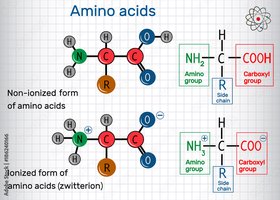
Ionization: In aqueous solutions, amino and carboxyl groups can ionize, affecting solubility and reactivity.
Classification of Amino Acids
Amino acids are classified based on the properties of their R groups:
Nonpolar (hydrophobic): R groups are mostly hydrocarbons.
Polar (hydrophilic): R groups contain electronegative atoms (e.g., oxygen, nitrogen).
Charged: Acidic (negatively charged) or basic (positively charged) side chains.
Peptide Bond Formation and Protein Polymerization
Amino acids are linked by peptide bonds, formed through dehydration synthesis between the carboxyl group of one amino acid and the amino group of another. The resulting chain is called a polypeptide.
Directionality: Polypeptides have an N-terminus (amino end) and a C-terminus (carboxyl end).
Flexibility: Peptide bonds are rigid, but single bonds adjacent to the peptide bond allow rotation.
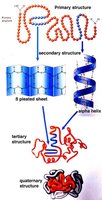
Levels of Protein Structure
Proteins exhibit four levels of structural organization, each contributing to the molecule's final shape and function:
Primary Structure: Linear sequence of amino acids in a polypeptide chain.
Secondary Structure: Local folding into alpha helices and beta-pleated sheets, stabilized by hydrogen bonds.
Tertiary Structure: Overall three-dimensional shape formed by interactions among R groups (hydrogen bonds, ionic bonds, hydrophobic interactions, disulfide bridges).
Quaternary Structure: Association of multiple polypeptide subunits into a functional protein complex.
Protein Folding and Function
Proper protein folding is essential for biological activity. Folding is driven by chemical interactions and often assisted by molecular chaperones. Misfolded proteins can lead to diseases such as cystic fibrosis and prion diseases.
Denaturation: Loss of structure (unfolding) results in loss of function.
Chaperones: Proteins that assist in correct folding and prevent aggregation.
Functions of Proteins in Living Systems
Proteins are the most functionally diverse biomolecules, performing a wide range of tasks in cells and organisms:
Catalysis: Enzymes accelerate biochemical reactions.
Structure: Provide support (e.g., collagen, keratin).
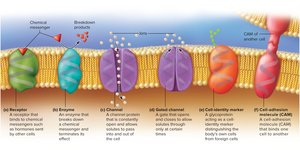
Transport: Move molecules across membranes (e.g., hemoglobin, membrane channels).
Signaling: Transmit signals within and between cells (e.g., hormones, receptors).
Defense: Antibodies protect against pathogens.
Movement: Motor proteins enable cellular and organismal movement.
Summary Table: Levels of Protein Structure
Level | Description | Stabilizing Bonds |
|---|---|---|
Primary | Sequence of amino acids | Peptide bonds |
Secondary | Alpha helix, beta sheet | Hydrogen bonds |
Tertiary | 3D folding of polypeptide | Hydrogen, ionic, hydrophobic, disulfide |
Quaternary | Multiple polypeptides | Same as tertiary, between subunits |
Additional info: Protein structure is hierarchical, and even a single amino acid change can disrupt function, as seen in diseases like sickle cell anemia and cystic fibrosis. Protein folding is regulated and sometimes requires binding to other molecules or chaperones to achieve the functional form.
