 Back
BackProtein Structure and Function: Study Notes
Study Guide - Smart Notes
 Tailored notes based on your materials, expanded with key definitions, examples, and context.
Protein Structure and Function
3.1 Amino Acids and Their Polymerization
Amino acids are the building blocks of proteins, each sharing a common core structure but differing in their side chains (R-groups). The chemical properties of amino acids are determined by their side chains, which influence protein structure and function.
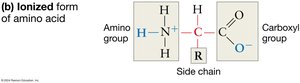
Structure of Amino Acids: Each amino acid consists of a central carbon atom (the alpha carbon) bonded to a hydrogen atom, an amino group (–NH2), a carboxyl group (–COOH), and a variable R-group (side chain).
Ionization in Water: In aqueous solutions, the amino group tends to gain a proton (becoming –NH3+), and the carboxyl group loses a proton (becoming –COO–), which helps amino acids stay in solution and affects their reactivity.
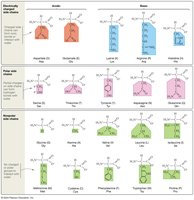
Nature of Side Chains (R-groups): The R-group is what makes each of the 20 amino acids unique. Side chains may contain functional groups that participate in chemical reactions, or they may be composed solely of carbon and hydrogen.
Classification by Polarity and Charge: Amino acids are classified based on the properties of their R-groups: charged (acidic or basic), uncharged polar, or nonpolar. This classification affects their solubility and interactions in water.
Determining Amino Acid Type: To classify an amino acid, ask:
Does the side chain have a negative charge? (Acidic)
Does the side chain have a positive charge? (Basic)
If uncharged, does it contain an oxygen atom? (Uncharged polar)
If none of the above, it is nonpolar.
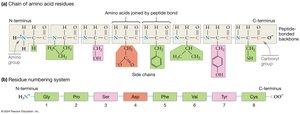
Polymerization of Amino Acids: Amino acids link via peptide bonds, which form between the carboxyl group of one amino acid and the amino group of another through a condensation reaction (releasing water).

Peptide-Bonded Backbone: Key features include:
R-group orientation: Side chains extend outward, allowing interactions.
Directionality: The chain has an N-terminus (free amino group) and a C-terminus (free carboxyl group); sequences are written from N- to C-terminus.
Flexibility: The peptide bond itself is rigid, but single bonds on either side can rotate, allowing the chain to fold.
Oligopeptides and Polypeptides: Chains with fewer than 50 amino acids are called oligopeptides or peptides; longer chains are polypeptides. A protein is a complete, functional polypeptide.
3.2 What Do Proteins Look Like?
Protein structure is hierarchical and determines function. Proteins are the most diverse class of biological molecules in terms of size, shape, and chemical properties.
Primary Structure: The unique sequence of amino acids in a protein. Even a single amino acid change can drastically alter protein function (e.g., sickle cell hemoglobin).
Secondary Structure: Local folding patterns stabilized by hydrogen bonds between backbone atoms. The main types are alpha-helices and beta-pleated sheets.
Tertiary Structure: The overall three-dimensional shape of a polypeptide, resulting from interactions among R-groups, including:
Hydrogen bonding
Hydrophobic interactions
van der Waals interactions
Covalent bonding (e.g., disulfide bridges)
Ionic bonding
Quaternary Structure: The arrangement of multiple polypeptide subunits in a protein. Subunits may be identical (homodimers) or different (heterodimers). Some proteins form large complexes called macromolecular machines (e.g., ribosomes).
Level of Structure | Stabilizing Bonds/Interactions | Description |
|---|---|---|
Primary | Peptide bonds | Linear sequence of amino acids |
Secondary | Hydrogen bonds | Alpha-helices and beta-sheets |
Tertiary | Hydrogen, hydrophobic, van der Waals, covalent, ionic | Three-dimensional folding |
Quaternary | Same as tertiary (between subunits) | Multiple polypeptides assembled |
3.3 Folding and Function
Proper protein folding is essential for function. Folding is driven by chemical interactions and is often spontaneous, resulting in a stable, low-energy structure. Misfolded proteins can lose function or become harmful.
Molecular Chaperones: Specialized proteins that assist in the proper folding of other proteins and prevent inappropriate interactions (e.g., heat shock proteins like Hsp90).
Protein Flexibility: Many proteins are dynamic and can adopt multiple conformations until they bind specific molecules or are activated.
Prions: Infectious, misfolded proteins that can induce normal proteins to adopt the abnormal conformation (e.g., prion protein PrP in mad cow disease).
3.4 Protein Functions Are as Diverse as Protein Structures
Proteins perform a vast array of functions in cells, including:
Catalysis: Enzymes accelerate chemical reactions by binding substrates at their active sites and orienting them for reaction.
Structure: Provide support and shape to cells and tissues.
Movement: Motor proteins move cells or molecules within cells.
Signaling: Transmit signals between cells.
Transport: Move molecules across membranes or throughout the body.
Defense: Antibodies recognize and neutralize pathogens.
Why Are Enzymes Good Catalysts? Enzymes are highly specific, binding substrates at their active sites and lowering the activation energy required for reactions to proceed.
Additional info: The diversity of protein structure underlies the diversity of protein function. Mutations affecting primary structure can have profound effects on higher-order structure and function, as seen in genetic diseases like sickle cell anemia.
