 Back
Protein Structure and Function: Study Notes
Study Guide - Smart Notes
 Tailored notes based on your materials, expanded with key definitions, examples, and context.
Protein Structure and Function
Introduction to Proteins
Proteins are essential macromolecules in all living organisms, responsible for a wide range of cellular functions. Their structure is directly related to their function, and understanding protein structure is fundamental to biology.
Amino Acids: The Building Blocks of Proteins
Basic Structure of Amino Acids
Amino acids are organic molecules composed of a central carbon atom (the alpha carbon) bonded to four different groups: an amino group (-NH2), a carboxyl group (-COOH), a hydrogen atom, and a variable side chain (R group). The properties of the R group determine the characteristics and classification of each amino acid.
Amino group: Acts as a base, accepting protons.
Carboxyl group: Acts as an acid, donating protons.
R group (side chain): Determines the identity and properties of the amino acid.
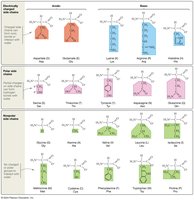
Classification of Amino Acids
Amino acids are classified based on the chemical nature of their side chains:
Nonpolar (hydrophobic): Side chains are mostly hydrocarbons.
Polar (hydrophilic): Side chains contain electronegative atoms, making them soluble in water.
Acidic: Side chains contain a carboxyl group and are negatively charged at physiological pH.
Basic: Side chains contain an amino group and are positively charged at physiological pH.
Peptide Bond Formation and Polypeptides
Peptide Bond Formation
Proteins are formed by linking amino acids together through peptide bonds. This is a dehydration synthesis reaction, where the carboxyl group of one amino acid reacts with the amino group of another, releasing a molecule of water.
Peptide bond: The covalent bond formed between the carboxyl carbon of one amino acid and the amino nitrogen of the next.
Polypeptide: A chain of many amino acids linked by peptide bonds.
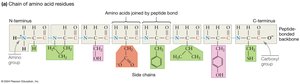
Features of Polypeptides
Polypeptides have directionality, with an N-terminus (amino end) and a C-terminus (carboxyl end). The sequence of amino acids (primary structure) determines the protein's final shape and function. R-groups extend outward from the backbone, allowing for diverse interactions and folding.

Levels of Protein Structure
Primary Structure
The primary structure of a protein is its unique sequence of amino acids. This sequence is determined by the genetic code and dictates all higher levels of structure.
Stabilized by: Covalent peptide bonds.
Importance: Even a single amino acid change can alter protein function (e.g., sickle cell anemia).
Secondary Structure
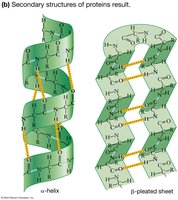
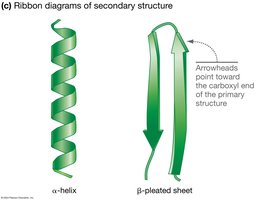
The secondary structure refers to regular, repeated patterns in regions of the polypeptide chain, stabilized by hydrogen bonds between backbone atoms. The two most common types are the alpha helix and beta-pleated sheet.
Alpha helix (α-helix): A right-handed coil stabilized by hydrogen bonds.
Beta-pleated sheet (β-sheet): Sheet-like arrangement formed by hydrogen bonds between parallel or antiparallel strands.
Tertiary Structure
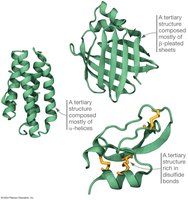
The tertiary structure is the overall three-dimensional shape of a single polypeptide chain, resulting from interactions between R-groups that may be far apart in the primary sequence. These interactions include hydrogen bonds, ionic bonds, hydrophobic interactions, and disulfide bridges.
Stabilized by: Hydrogen bonds, ionic bonds, hydrophobic interactions, van der Waals forces, and covalent disulfide bonds.
Importance: Determines the protein's specificity and function.
Quaternary Structure
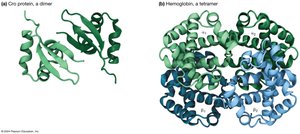
Some proteins consist of more than one polypeptide chain (subunit). The quaternary structure is the arrangement and interaction of these subunits. Not all proteins have quaternary structure, but for those that do, all subunits must be present for functionality.
Examples: Hemoglobin (tetramer), collagen (trimer).
Stabilized by: The same interactions as tertiary structure, but between different polypeptide chains.
Types of Tertiary Structure Interactions
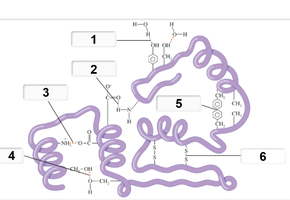
Within the tertiary structure, several types of interactions stabilize the folded protein:
Disulfide bonds: Covalent bonds between cysteine residues.
Hydrophobic interactions: Nonpolar side chains cluster away from water.
Hydrogen bonds: Between polar side chains or backbone atoms.
Ionic bonds: Between oppositely charged side chains.
Protein Folding and Denaturation
Protein Folding
Protein folding is the process by which a polypeptide chain acquires its functional, three-dimensional structure. The primary structure (amino acid sequence) determines the final folded shape, as it dictates the pattern of interactions that can occur. Proper folding is essential for protein function.
Chaperones: Specialized proteins that assist in the folding process.
Misfolding: Can lead to loss of function or diseases (e.g., prion diseases).
Protein Denaturation
Denaturation is the loss of a protein's native structure (and function) due to disruption of non-covalent interactions. Denaturation can be caused by:
Heat
pH extremes
Certain salts or chemicals (e.g., urea, detergents)
Denatured proteins may lose their biological activity, but primary structure (peptide bonds) often remains intact.
Functions of Proteins
Common Protein Functions
Proteins perform a vast array of functions in cells, including:
Catalysis: Enzymes accelerate chemical reactions.
Defense: Antibodies recognize and neutralize pathogens.
Movement: Motor proteins move cells or cellular components.
Signaling: Proteins transmit signals within and between cells.
Structure: Structural proteins provide support and shape to cells and tissues.
Transport: Transport proteins move substances across membranes or throughout the body.
Practice: Peptide Bond Formation
Suggested Practice for Amino Acid Structure
To reinforce understanding, practice drawing two amino acids side-by-side (using "R" for the side chain), circle the three atoms that will be lost during peptide bond formation (a water molecule: H from the amino group and OH from the carboxyl group), and redraw the resulting dipeptide. Key vocabulary: amino group, carboxyl group, peptide bond, dehydration synthesis, dipeptide, polypeptide.
Additional info: Understanding the relationship between protein structure and function is foundational for advanced studies in biochemistry, molecular biology, and medicine.
