 Back
Protein Structure and Function: Study Notes for General Biology
Study Guide - Smart Notes
 Tailored notes based on your materials, expanded with key definitions, examples, and context.
Proteins
Monomers: Amino Acids
Proteins are essential biomolecules composed of monomers called amino acids. There are 20 different kinds of amino acids, each distinguished by its unique R group (side chain), which determines the chemical properties and function of the amino acid.
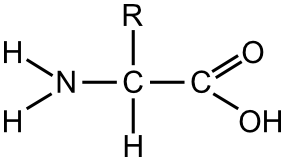
Amino Acid Structure: Each amino acid contains a central carbon (alpha carbon), an amino group (–NH2), a carboxyl group (–COOH), a hydrogen atom, and an R group.
R Group: The R group is what differentiates one amino acid from another.
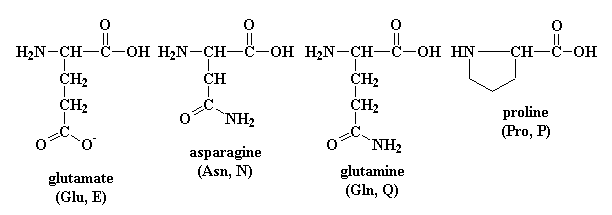
Examples: Glutamate, asparagine, glutamine, and proline are examples of amino acids with distinct R groups.
Polymers: Polypeptides and Proteins
Amino acids are linked together by peptide bonds through a process called dehydration synthesis, forming long chains known as polypeptides. The sequence and type of amino acids in a polypeptide determine its properties and function.
Peptide Bond: A covalent bond formed between the carboxyl group of one amino acid and the amino group of another, releasing water.
Polypeptide: A chain of amino acids; hundreds of amino acids may be required to form a single polypeptide.
Protein: One or more polypeptides folded into a specific three-dimensional structure.
Levels of Protein Structure
Primary Structure
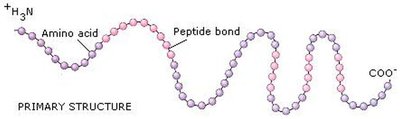
The primary structure of a protein is the unique sequence of amino acids in a polypeptide chain. This sequence is determined by the genetic code and is fundamental to the protein's function.
Visualization: Can be imagined as a string of pearls or parade beads.
Importance: The order of amino acids dictates all higher levels of structure.
Secondary Structure
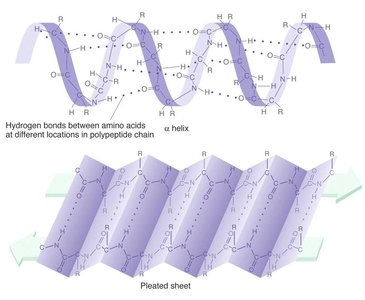
The secondary structure arises from hydrogen bonding between backbone atoms in the polypeptide chain, causing the chain to bend and coil into specific shapes.
Alpha Helix (α helix): A coiled structure stabilized by hydrogen bonds.
Pleated Sheet (β sheet): A folded, sheet-like structure also stabilized by hydrogen bonds.
Tertiary Structure
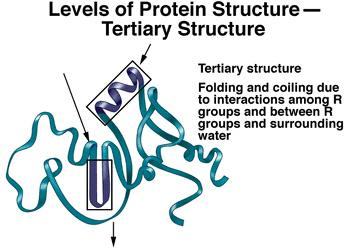
The tertiary structure is the overall three-dimensional shape of a single polypeptide chain, formed by interactions among R groups and between R groups and the surrounding environment.
Interactions: Includes hydrogen bonds, ionic bonds, hydrophobic interactions, and disulfide bridges.
Shape Determines Function: The specific folding pattern is critical for the protein's biological activity.
Quaternary Structure
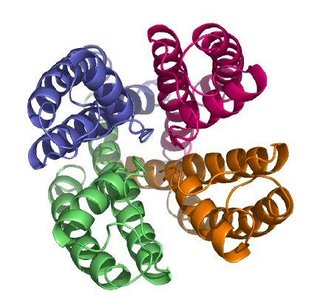
The quaternary structure is formed when two or more polypeptide chains (tertiary structures) assemble into a functional protein complex.
Examples: Hemoglobin is a protein with quaternary structure, consisting of four polypeptide subunits.
Function: The arrangement of subunits affects the protein's properties and activity.
Protein Stability and Denaturation
Environmental Sensitivity
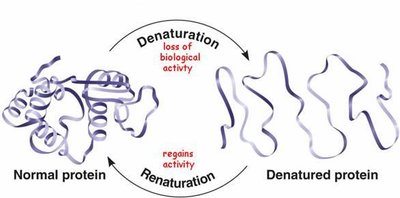
Proteins are sensitive to environmental conditions such as temperature and pH. Unfavorable conditions can cause proteins to denature, resulting in loss of structure and function.
Denaturation: The unfolding of a protein, leading to loss of biological activity.
Renaturation: Sometimes, proteins can refold and regain function if conditions return to normal.
Examples: Cooking an egg (heat denatures proteins), fever, and diseases like Alzheimer's and Parkinson's (improperly folded proteins).
Summary Table: Levels of Protein Structure
Level | Description | Bond/Interaction |
|---|---|---|
Primary | Sequence of amino acids | Peptide bonds |
Secondary | Local folding (α helix, β sheet) | Hydrogen bonds |
Tertiary | 3D folding of single polypeptide | R group interactions |
Quaternary | Assembly of multiple polypeptides | Inter-polypeptide interactions |
Key Equations
Peptide Bond Formation:
Additional info: Proper protein folding is essential for biological function. Misfolded proteins can lead to diseases, and understanding protein structure is fundamental in biotechnology and medicine.
