 Back
BackProtein Synthesis and the Genetic Code
Study Guide - Smart Notes
 Tailored notes based on your materials, expanded with key definitions, examples, and context.
Protein Synthesis and the Genetic Code
Structure of RNA
The flow of genetic information in cells follows the central dogma: DNA → RNA → Protein. DNA directs the synthesis of RNA, which in turn controls protein synthesis. RNA is chemically similar to DNA, but with key differences:
Sugar Component: RNA contains ribose sugar, while DNA contains deoxyribose. The difference is that deoxyribose lacks an oxygen atom on the second carbon in the ring.
Nitrogenous Bases: RNA uses uracil (U) instead of thymine (T). Thus, DNA nucleotides are A, G, C, T; RNA nucleotides are A, G, C, U.
Strandedness: RNA is usually single-stranded, whereas DNA is double-stranded.
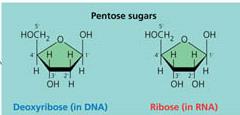
Types of RNA Molecules
Three main types of RNA are involved in protein synthesis:
Messenger RNA (mRNA): Carries the genetic code from DNA in the nucleus to ribosomes in the cytoplasm for translation.
Transfer RNA (tRNA): Brings amino acids to the ribosome in the correct sequence to build proteins.
Ribosomal RNA (rRNA): Combines with proteins to form ribosomes, the site of protein synthesis.
The Genetic Code
The genetic code translates the four nucleotide bases of DNA and RNA into the twenty amino acids that make up proteins. The code is read in sets of three bases, called codons:
There are only four different nucleotides in RNA (A, G, C, U).
If one base coded for one amino acid, only four amino acids could be specified.
If two bases coded for one amino acid, 16 combinations would exist ().
With three bases per codon, there are 64 possible combinations (), enough to code for all 20 amino acids.
Triplet Code – Codons
Each three-base sequence in mRNA is a codon.
Some amino acids are specified by more than one codon (redundancy).
Special codons exist: AUG (methionine) is the start codon; UAA, UAG, and UGA are stop codons.
The genetic code is nearly universal among all organisms.
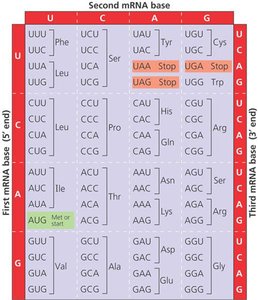
The Dictionary of the Genetic Code
The three bases of an mRNA codon are read in the 5′ → 3′ direction. The codon AUG serves as both the start signal and codes for methionine. The stop codons (UAA, UAG, UGA) signal the end of translation. The code is universal, meaning the same codon specifies the same amino acid in nearly all organisms.
One Gene – One Enzyme Hypothesis
Beadle and Tatum's experiments supported the hypothesis that each gene dictates the production of a specific enzyme. This was later modified as scientists learned more about proteins:
Not all proteins are enzymes (e.g., keratin, insulin).
The hypothesis was updated to "one gene–one protein".
Many proteins are made of multiple polypeptides, each coded by a different gene (e.g., hemoglobin consists of two types of polypeptides).
Thus, the hypothesis evolved to "one gene–one polypeptide".
Some genes code for functional RNA molecules that are not translated into proteins.
Summary Table: Evolution of the One Gene Hypothesis
Original Hypothesis | Updated Understanding |
|---|---|
One gene – one enzyme | One gene – one protein |
One gene – one polypeptide | |
Some genes code for functional RNAs |
Example: Hemoglobin is composed of two different polypeptides, each encoded by a separate gene.
Additional info: Some RNA molecules, such as rRNA and tRNA, are functional end products and are not translated into proteins.
