 Back
BackProtein Synthesis: From DNA to Functional Protein
Study Guide - Smart Notes
 Tailored notes based on your materials, expanded with key definitions, examples, and context.
Protein Synthesis
Overview of Genetic Information Flow
Protein synthesis is the process by which cells generate proteins based on genetic instructions encoded in DNA. This process involves two main stages: transcription and translation. The central dogma of molecular biology describes the directional flow of genetic information: DNA → RNA → Protein.
Transcription: The synthesis of messenger RNA (mRNA) from a DNA template.
Translation: The decoding of mRNA to assemble amino acids into a polypeptide (protein).
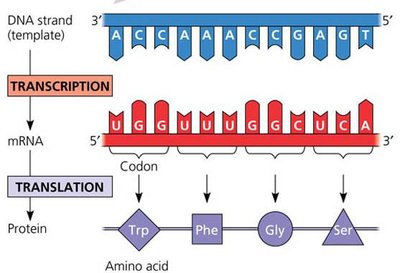
Transcription: DNA to mRNA
Structure of mRNA
mRNA (messenger RNA) is a single-stranded nucleic acid composed of RNA nucleotides. It serves as the intermediary, carrying genetic instructions from DNA in the nucleus to ribosomes in the cytoplasm, where proteins are synthesized.

Mechanism of Transcription
Transcription is the process of copying genetic information from DNA to mRNA. It occurs in the nucleus of eukaryotic cells and involves several key steps:
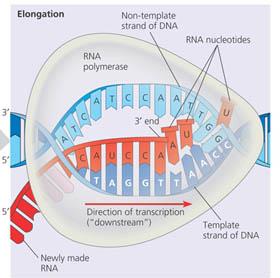
Template Strand: Only one of the two DNA strands is used as a template for mRNA synthesis. The template strand is read in the 3′→5′ direction, and mRNA is synthesized in the 5′→3′ direction.
RNA Polymerase: The enzyme responsible for synthesizing RNA. Unlike DNA polymerase, RNA polymerase does not require a primer and can initiate synthesis de novo.
Base Pairing: RNA nucleotides pair with complementary DNA bases, except uracil (U) replaces thymine (T).
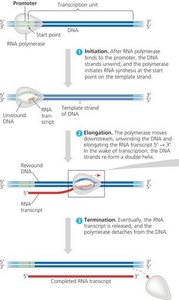
Phases of Transcription
Initiation: RNA polymerase binds to a specific DNA sequence called the promoter, which signals the start of a gene. The DNA strands unwind, and RNA synthesis begins at the start point.
Elongation: RNA polymerase moves along the DNA, synthesizing the RNA transcript by adding nucleotides complementary to the DNA template.
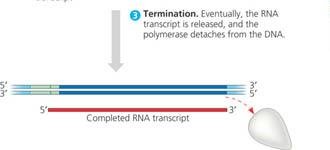
Termination: When RNA polymerase reaches a terminator sequence, transcription ends, and the RNA transcript is released.
Modification of Transcribed Sequence (RNA Processing)
In eukaryotes, the initial RNA transcript (pre-mRNA) undergoes several modifications before becoming mature mRNA:
5′ Cap: Addition of a modified guanine nucleotide to the 5′ end.
Poly-A Tail: Addition of a chain of 50–250 adenine nucleotides to the 3′ end.
RNA Splicing: Removal of noncoding regions (introns) and joining of coding regions (exons).
These modifications protect mRNA, facilitate its export from the nucleus, and help ribosomes recognize the mRNA for translation.
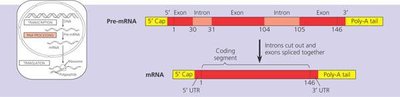
RNA Splicing: Introns and Exons
Most eukaryotic genes contain introns (noncoding sequences) and exons (coding sequences). Both are transcribed, but only exons are translated into protein. Spliceosomes (complexes of snRNPs and proteins) remove introns and join exons, producing a continuous coding sequence in mature mRNA.
Alternative Splicing: A single gene can produce multiple polypeptides by varying which exons are included in the final mRNA.
Translation: mRNA to Protein
Role of tRNA and Ribosomes
tRNA (transfer RNA) molecules serve as adaptors, matching amino acids to the appropriate codons in mRNA. Each tRNA has an anticodon complementary to an mRNA codon and carries a specific amino acid. Ribosomes are the molecular machines that facilitate the coupling of tRNA anticodons with mRNA codons and catalyze peptide bond formation.

Phases of Translation
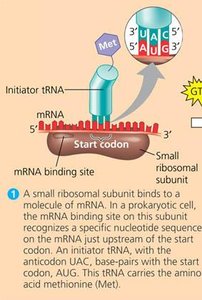
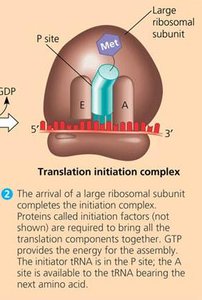
Initiation: The small ribosomal subunit binds to mRNA. The initiator tRNA (carrying methionine) pairs with the start codon (AUG). The large ribosomal subunit then joins, forming a functional ribosome.
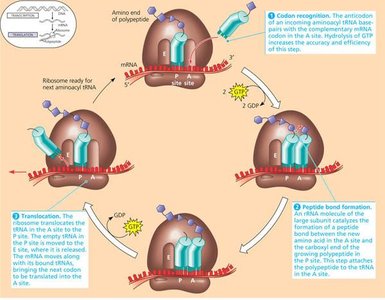
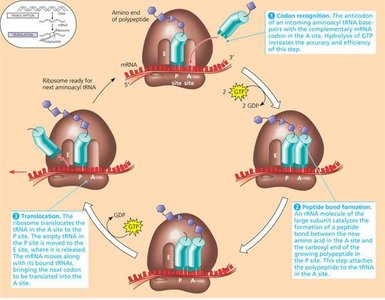
Elongation: The polypeptide chain grows as amino acids are added one by one. This phase involves three steps:
Codon Recognition: The anticodon of an incoming tRNA pairs with the mRNA codon in the A site of the ribosome.
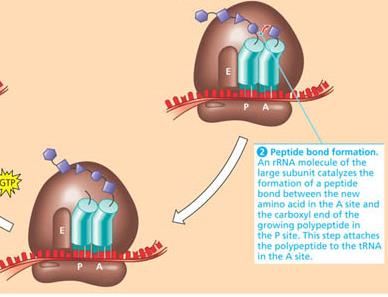
Peptide Bond Formation: The polypeptide is transferred from the tRNA in the P site to the amino acid on the tRNA in the A site, forming a peptide bond.
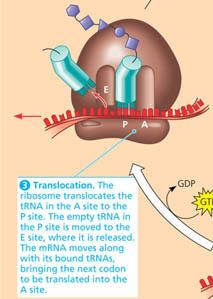
Translocation: The ribosome moves along the mRNA, shifting the tRNAs from the A site to the P site, and from the P site to the E site, where the empty tRNA exits.

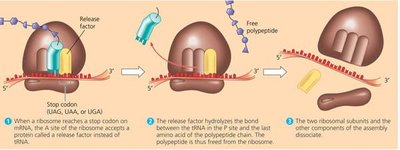
Termination: When a stop codon (UAA, UAG, or UGA) is reached, a release factor binds to the ribosome, causing the completed polypeptide to be released and the ribosomal subunits to dissociate.
Efficiency of Protein Synthesis: Polyribosomes
Polyribosomes (Polysomes)
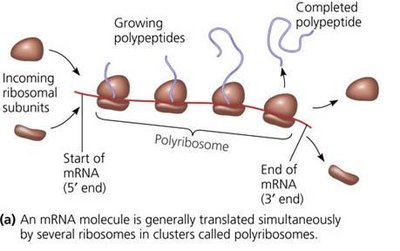
Multiple ribosomes can simultaneously translate a single mRNA molecule, forming structures called polyribosomes or polysomes. This allows cells to rapidly produce many copies of a protein from a single mRNA transcript.
Summary Table: Key Steps in Protein Synthesis
Stage | Main Events | Location |
|---|---|---|
Transcription | DNA is used as a template to synthesize pre-mRNA; includes initiation, elongation, and termination | Nucleus (eukaryotes) |
RNA Processing | Pre-mRNA is capped, polyadenylated, and spliced to form mature mRNA | Nucleus (eukaryotes) |
Translation | mRNA is decoded by ribosomes and tRNAs to assemble a polypeptide chain | Cytoplasm (on ribosomes) |
Key Terms and Concepts
Gene: A segment of DNA that encodes a functional product, usually a protein.
Codon: A sequence of three mRNA nucleotides that specifies a particular amino acid.
Anticodon: A sequence of three nucleotides on tRNA complementary to an mRNA codon.
Promoter: DNA sequence where RNA polymerase binds to initiate transcription.
Terminator: DNA sequence signaling the end of transcription.
Introns/Exons: Noncoding/coding regions of a gene, respectively.
Polyribosome: A cluster of ribosomes translating a single mRNA simultaneously.
