Back
BackProtein Synthesis: From Gene to Protein Packaging
Study Guide - Smart Notes
 Tailored notes based on your materials, expanded with key definitions, examples, and context.
Protein Synthesis
Overview of Protein Synthesis
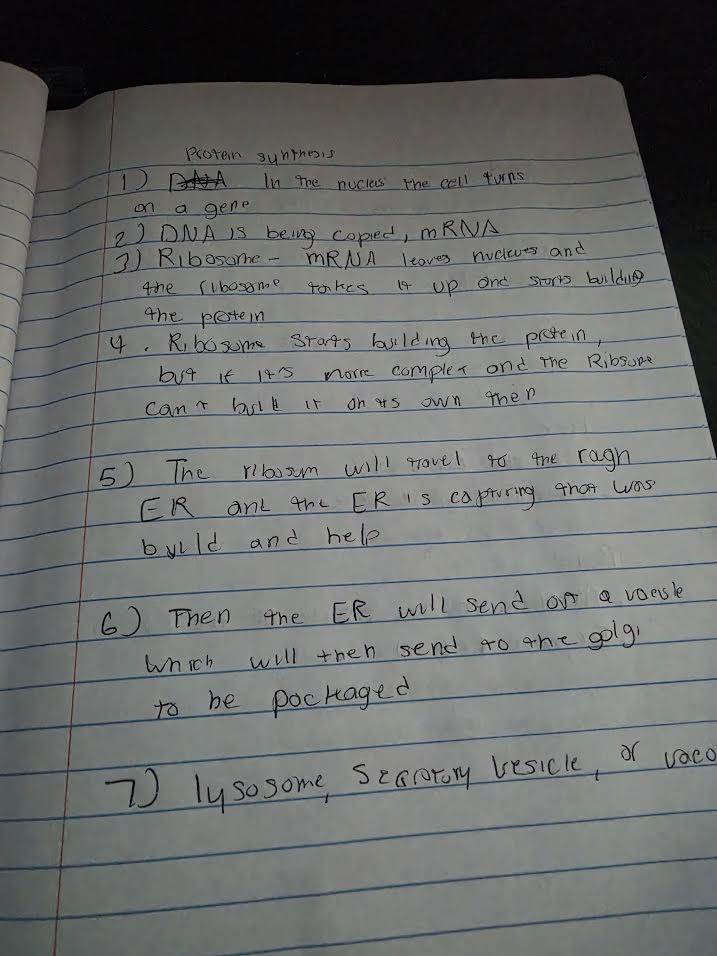
Protein synthesis is the cellular process by which genetic information encoded in DNA is used to produce proteins, which are essential for cell structure and function. This process involves several key steps and cellular organelles, ensuring that proteins are accurately constructed and delivered to their proper cellular locations.
Step 1: Transcription – DNA to mRNA
DNA in the nucleus contains genes, which are specific sequences of nucleotides that code for proteins.
The cell initiates transcription, where a segment of DNA is used as a template to synthesize messenger RNA (mRNA).
Key Point: mRNA is a single-stranded copy of the gene that carries genetic instructions from the nucleus to the cytoplasm.
Example: The gene for hemoglobin is transcribed into mRNA in red blood cell precursors.
Step 2: mRNA Processing and Export
After transcription, the mRNA leaves the nucleus through nuclear pores and enters the cytoplasm.
Key Point: mRNA carries the genetic code that will be translated into a protein sequence.
Step 3: Translation – Ribosome and Protein Assembly
Ribosomes, either free in the cytoplasm or attached to the rough endoplasmic reticulum (ER), bind to the mRNA.
The ribosome reads the mRNA sequence in sets of three nucleotides (codons), each coding for a specific amino acid.
Key Point: Transfer RNA (tRNA) molecules bring the appropriate amino acids to the ribosome, where they are joined together to form a polypeptide chain.
Example: The codon AUG on mRNA codes for the amino acid methionine, which is usually the first amino acid in a new protein.
Step 4: Protein Completion and ER Involvement
If the protein is not fully synthesized or requires further processing, the ribosome may attach to the rough ER.
The rough ER assists in the folding and modification of the protein, especially for proteins destined for secretion or for use in membranes.
Key Point: The ER ensures proper protein folding and may add carbohydrate groups (glycosylation).
Step 5: Vesicle Transport to the Golgi Apparatus
The ER packages the newly synthesized protein into a transport vesicle.
This vesicle buds off from the ER and moves to the Golgi apparatus for further processing and sorting.
Key Point: The Golgi apparatus modifies, sorts, and packages proteins for their final destinations.
Step 6: Final Packaging and Delivery
After processing in the Golgi, proteins are sorted into vesicles that will deliver them to their final locations.
These vesicles may become lysosomes, secretory vesicles, or vacuoles, depending on the protein's function.
Key Point: Secretory proteins are released from the cell by exocytosis, while lysosomal proteins remain inside the cell to digest cellular waste.
Summary Table: Key Steps and Organelles in Protein Synthesis
Step | Process | Main Organelle(s) |
|---|---|---|
1 | Transcription (DNA to mRNA) | Nucleus |
2 | mRNA export | Nuclear envelope |
3 | Translation (mRNA to protein) | Ribosome |
4 | Protein folding/modification | Rough ER |
5 | Vesicle transport | Transport vesicle |
6 | Processing and sorting | Golgi apparatus |
7 | Final delivery | Lysosome, secretory vesicle, or vacuole |
Key Terms and Definitions
Gene: A segment of DNA that codes for a specific protein.
Transcription: The process of copying a gene's DNA sequence into mRNA.
Translation: The process by which ribosomes synthesize proteins using the mRNA template.
Ribosome: A molecular machine that assembles amino acids into proteins.
Endoplasmic Reticulum (ER): An organelle involved in protein and lipid synthesis; the rough ER is studded with ribosomes.
Golgi Apparatus: An organelle that modifies, sorts, and packages proteins for secretion or delivery to other organelles.
Vesicle: A small, membrane-bound sac that transports substances within a cell.
Lysosome: An organelle containing digestive enzymes for breaking down waste.
Secretory Vesicle: A vesicle that transports proteins to the cell membrane for release outside the cell.
Vacuole: A storage organelle, especially prominent in plant cells.
Relevant Equation: Central Dogma of Molecular Biology
The flow of genetic information in cells is often summarized as: