 Back
Proteins, Amino Acids, and Nucleic Acids: Structure and Function
Study Guide - Smart Notes
 Tailored notes based on your materials, expanded with key definitions, examples, and context.
Proteins and Amino Acids
Structure of Amino Acids
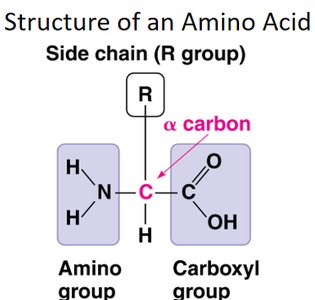
Amino acids are the building blocks of proteins. Each amino acid contains a central carbon atom (the alpha carbon), an amino group, a carboxyl group, a hydrogen atom, and a variable side chain (R group) that determines the amino acid's properties.
Amino group (–NH2): Acts as a base and can accept a proton.
Carboxyl group (–COOH): Acts as an acid and can donate a proton.
R group (side chain): Unique to each amino acid; determines chemical nature and function.
Classification of Amino Acids by Side Chains
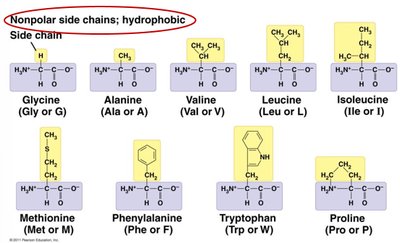
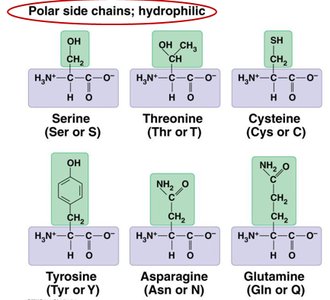
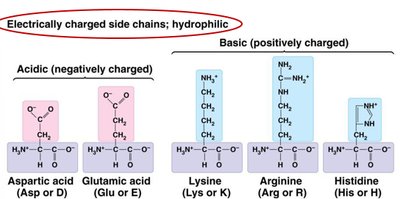
Amino acids are classified based on the properties of their side chains (R groups):
Nonpolar side chains: Hydrophobic; tend to be found in the interior of proteins and within membranes.
Polar side chains: Hydrophilic; often participate in hydrogen bonding and are found on protein surfaces.
Electrically charged side chains: Hydrophilic; can be acidic (negatively charged) or basic (positively charged).
Peptide Bonds and Protein Structure
Proteins are polymers of amino acids linked by peptide bonds. These covalent bonds form through dehydration synthesis between the amino group of one amino acid and the carboxyl group of another, always in the N-terminus to C-terminus direction.
Primary structure: The unique sequence of amino acids in a polypeptide chain.
Secondary structure: Local folding patterns such as alpha helices and beta pleated sheets, stabilized by hydrogen bonds.
Tertiary structure: The overall three-dimensional shape of a polypeptide, determined by interactions among side chains (disulfide bridges, ionic bonds, hydrophobic interactions, van der Waals forces, and hydrogen bonds).
Quaternary structure: The association of two or more polypeptide chains to form a functional protein.
Denaturation occurs when proteins lose their structure (and function) due to changes in temperature, pH, salt concentration, or other environmental factors.
Example: Sickle cell anemia results from a single amino acid substitution in the hemoglobin protein, demonstrating the importance of primary structure.
Nucleic Acids
Structure and Function
Nucleic acids (DNA and RNA) are polymers of nucleotides that store and transmit genetic information. Each nucleotide consists of three components:
Pentose sugar: Ribose in RNA, deoxyribose in DNA.
Nitrogenous base: Adenine, thymine (DNA only), uracil (RNA only), cytosine, or guanine.
Phosphate group
Nucleotides are joined by phosphodiester bonds (formed by dehydration synthesis), creating a sugar-phosphate backbone. The two strands of DNA are held together by hydrogen bonds between complementary bases, making DNA highly stable.
Central dogma: Information flows from DNA to RNA to protein.
ATP (adenosine triphosphate): A nucleotide that serves as the main energy currency of the cell.
RNA: Less stable than DNA due to its structure; involved in protein synthesis and gene regulation.
Lipids
General Properties
Lipids are a diverse group of hydrophobic molecules that do not dissolve well in water. They include fats, phospholipids, and steroids, and serve as energy storage, membrane structure, and signaling molecules.
Large Biological Molecules Overview
The four major classes of large biological molecules are carbohydrates, lipids, proteins, and nucleic acids. Each class has distinct components, examples, and functions in living organisms.
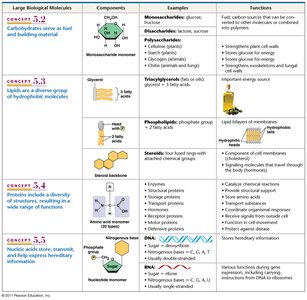
Class | Components | Examples | Functions |
|---|---|---|---|
Carbohydrates | Monosaccharide monomers | Glucose, starch, cellulose | Fuel, building material, cell wall structure |
Lipids | Glycerol, fatty acids | Fats, phospholipids, steroids | Energy storage, membrane structure, signaling |
Proteins | Amino acids | Enzymes, antibodies, structural proteins | Catalysis, defense, structure, transport, signaling |
Nucleic acids | Nucleotide monomers | DNA, RNA, ATP | Genetic information storage and transfer, energy |
Additional info: The table above summarizes the main classes of biological macromolecules, their building blocks, representative examples, and primary functions in cells.
