 Back
Proteins and Gene Expression: Structure, Function, and Genetic Flow
Study Guide - Smart Notes
 Tailored notes based on your materials, expanded with key definitions, examples, and context.
Proteins & Gene Expression
Flow of Genetic Information: From DNA to Protein
The central dogma of molecular biology describes the flow of genetic information within a biological system. This process involves the transfer of information from DNA to mRNA (transcription), and from mRNA to protein (translation). Proteins are the final products that carry out most cellular functions.
Transcription: DNA is used as a template to synthesize messenger RNA (mRNA).
Translation: mRNA is decoded by ribosomes to assemble amino acids into a specific protein.
Gene Expression: The process by which information from a gene is used to synthesize a functional gene product (often a protein).
Mutations are changes in the DNA sequence that can alter the resulting protein's structure and function. While some mutations are harmful, others can be neutral or even beneficial, contributing to adaptation and evolution.
Roles of Proteins in Living Systems
Proteins are essential macromolecules that perform a wide variety of functions in living organisms:
Enzymes: Catalyze biochemical reactions (e.g., DNA polymerase, amylase).
Structural Proteins: Provide support and shape to cells and tissues (e.g., collagen, keratin).
Transport Proteins: Carry molecules across cell membranes or throughout the body (e.g., hemoglobin).
Signaling Proteins: Transmit signals to coordinate biological processes (e.g., insulin, growth factors).
Defensive Proteins: Protect against disease (e.g., antibodies).
Storage Proteins: Store amino acids or other substances (e.g., ferritin).
Diversity of Protein Structure and Function
The remarkable diversity of protein functions arises from the variety of their structures. Proteins are composed of 20 different amino acids, each with a unique side chain (R group). The sequence and chemical properties of these amino acids determine the protein's structure and function.
Primary Structure: The linear sequence of amino acids in a polypeptide chain.
Secondary Structure: Local folding patterns such as alpha-helices and beta-sheets, stabilized by hydrogen bonds.
Tertiary Structure: The overall three-dimensional shape of a single polypeptide, determined by interactions among R groups.
Quaternary Structure: The arrangement of multiple polypeptide subunits in a protein complex.
The primary structure is responsible for the unique sequence of amino acids, which ultimately determines all higher levels of structure and the protein's specific function.
General Structure of an Amino Acid
All amino acids share a common structure, consisting of a central carbon atom (the alpha carbon) bonded to four groups:
Amino group (–NH2)
Carboxyl group (–COOH)
Hydrogen atom (–H)
R group (side chain): This group varies among different amino acids and determines their properties.
The diversity of R groups leads to the classification of amino acids as nonpolar, polar, or electrically charged (acidic or basic).
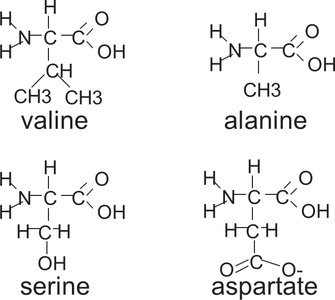
Example: The image above shows the structures of four amino acids, highlighting the differences in their R groups (side chains).
Classification of Amino Acids by Side Chains
Amino acids are classified based on the chemical nature of their side chains (R groups):
Nonpolar (hydrophobic): Side chains are mostly hydrocarbons (e.g., valine, alanine).
Polar (hydrophilic): Side chains contain electronegative atoms, making them interact with water (e.g., serine).
Electrically charged: Side chains are either acidic (negatively charged, e.g., aspartate) or basic (positively charged).
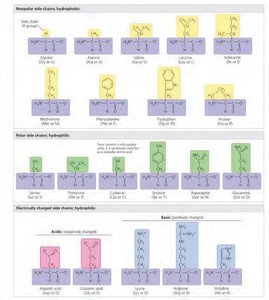
Table Purpose: The table above classifies the 20 amino acids by the properties of their side chains, which influence protein folding and function.
Mutations and Protein Variation
Mutations are changes in the DNA sequence that can alter the amino acid sequence of a protein. This may result in:
Silent mutations: No change in protein function.
Missense mutations: Change one amino acid, possibly altering protein function.
Nonsense mutations: Introduce a premature stop codon, truncating the protein.
Some mutations can be beneficial, providing new traits that may help organisms adapt to their environment.
