 Back
Proteins and Macromolecules: Structure, Function, and Biological Importance
Study Guide - Smart Notes
 Tailored notes based on your materials, expanded with key definitions, examples, and context.
Proteins and Macromolecules
Overview of Macromolecules
Macromolecules are large, complex molecules essential for life, including carbohydrates, lipids, proteins, and nucleic acids. Each type has unique elements, chemical groups, solubility properties, and biological functions.
Elements contained: Most macromolecules contain carbon, hydrogen, oxygen, and nitrogen; some also contain sulfur and phosphorus.
Major chemical groups: Functional groups such as hydroxyl, carboxyl, amino, and phosphate are common.
Hydrophobic vs. hydrophilic: Macromolecules may be hydrophobic (water-repelling) or hydrophilic (water-attracting) depending on their structure.
Polymers and monomers: Many macromolecules are polymers made of repeating monomer subunits. For proteins, the monomers are amino acids.
Bonds between monomers: Covalent bonds such as peptide bonds (in proteins) link monomers.
Functions: Macromolecules play roles in structure, energy storage, information transfer, catalysis, and defense.
Key Functions of Proteins
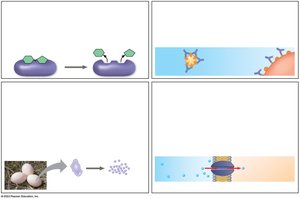
Proteins are versatile macromolecules with diverse functions in cells. Their structure determines their function.
Enzymatic proteins: Catalyze chemical reactions (e.g., digestive enzymes).
Defensive proteins: Protect against disease (e.g., antibodies).
Storage proteins: Store amino acids (e.g., casein in milk, ovalbumin in eggs).
Transport proteins: Move substances (e.g., hemoglobin transports oxygen).
Hormonal proteins: Coordinate activities (e.g., insulin regulates blood sugar).
Receptor proteins: Respond to chemical signals (e.g., nerve cell receptors).
Contractile and motor proteins: Enable movement (e.g., actin and myosin in muscles).
Structural proteins: Provide support (e.g., keratin, collagen).
Amino Acids: The Building Blocks of Proteins
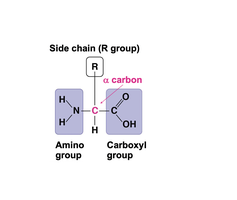
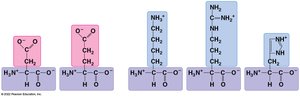
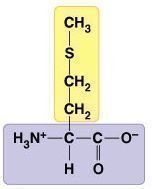
Amino acids are the monomers of proteins. Each amino acid has a central carbon (α carbon) bonded to an amino group, a carboxyl group, a hydrogen atom, and a unique side chain (R group).
Side chains (R groups): Determine the properties of each amino acid (polar, nonpolar, acidic, basic).
Classification: Amino acids can be grouped by their side chain properties: hydrophobic, hydrophilic, acidic, or basic.
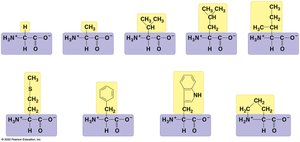
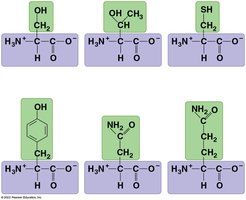
Examples of Amino Acids
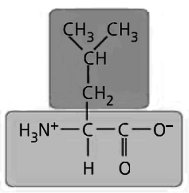
Nonpolar (hydrophobic): Glycine, Alanine, Valine, Leucine, Isoleucine, Methionine, Phenylalanine, Tryptophan, Proline
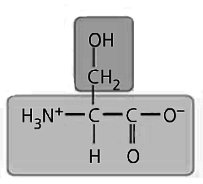
Polar (hydrophilic): Serine, Threonine, Cysteine, Tyrosine, Asparagine, Glutamine
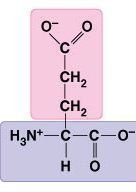
Acidic: Aspartic acid, Glutamic acid
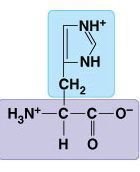
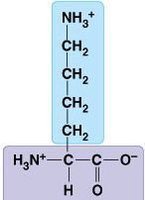
Basic: Lysine, Arginine, Histidine
Peptide Bonds and Protein Polymerization
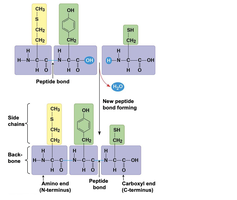
Amino acids are linked by peptide bonds, forming polypeptide chains. The polarity of amino acid groups influences protein folding and structure.
Peptide bond: A covalent bond formed between the amino group of one amino acid and the carboxyl group of another, releasing water (dehydration synthesis).
Polypeptide: A chain of amino acids linked by peptide bonds.
Levels of Protein Structure
Proteins have four structural levels, each stabilized by specific types of bonds and interactions.
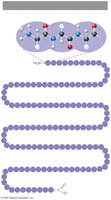
Primary structure: The unique sequence of amino acids in a polypeptide.
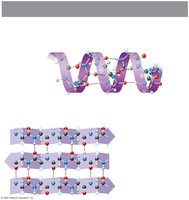
Secondary structure: Coils and folds (α helix, β pleated sheet) stabilized by hydrogen bonds between backbone atoms.
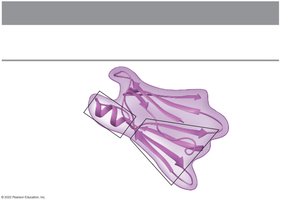
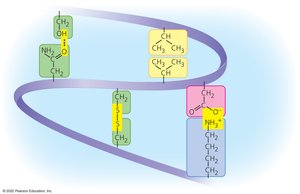
Tertiary structure: The overall 3D shape, determined by interactions among side chains (hydrophobic interactions, ionic bonds, hydrogen bonds, disulfide bridges).
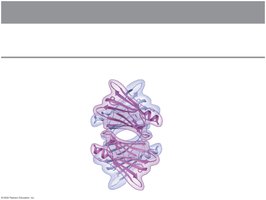
Quaternary structure: Association of multiple polypeptide chains into a functional protein complex.
Primary Structure
The sequence of amino acids determines all higher levels of structure.
Secondary Structure
Hydrogen bonds between backbone atoms create α helices and β sheets.
Tertiary Structure
Interactions between side chains (R groups) fold the polypeptide into a unique 3D shape.
Quaternary Structure
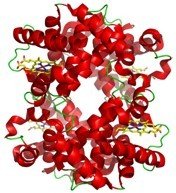
Multiple polypeptide chains assemble into a functional protein (e.g., hemoglobin, transthyretin).
Protein Structure and Disease: Sickle Cell Anemia
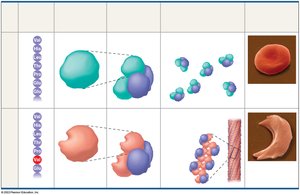
Changes in primary structure can affect all higher levels of protein structure and function. Sickle cell anemia is caused by a single amino acid substitution in hemoglobin, leading to abnormal protein aggregation and altered red blood cell shape.
Normal hemoglobin: Four polypeptides, each carrying oxygen efficiently.
Sickle-cell hemoglobin: Mutated β subunit causes aggregation, reducing oxygen capacity and distorting cell shape.
Practice and Application Questions
Identifying Peptide Bonds
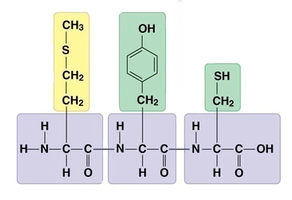
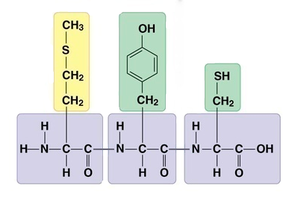
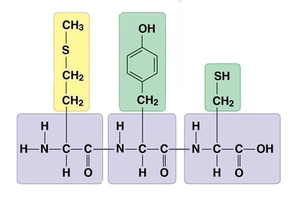
Peptide bonds are the covalent links between amino acids in a polypeptide chain.
Amino Acid Solubility
Amino acids vary in hydrophilicity based on their side chains. Ranking their solubility helps understand protein folding and function.
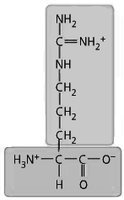
Amino Acid Interactions
Charged amino acids interact with oppositely charged groups in enzyme active sites, influencing substrate binding and catalysis.
Application: Galactosemia and Carbohydrate Metabolism
Galactosemia is a metabolic disorder where the enzyme converting galactose to glucose is non-functional, leading to toxic accumulation of galactose and symptoms such as failure to thrive and jaundice.
Lactose: A disaccharide (carbohydrate) made of glucose and galactose.
Hydrolysis: Reaction that splits lactose into its monomers, requiring water.
Enzymes: Proteins that catalyze the conversion of galactose to glucose.
Practice: Polarity and pH
Polarity in molecules: Atoms with higher electronegativity hold partial negative charges (e.g., O in NO).
Bond polarity: Electrons are evenly distributed in bonds between atoms of similar electronegativity (e.g., Br-Br).
pH and acidity: A solution with pH 5 is 100 times more acidic than a neutral solution (pH 7).
Practice: Protein Structure and Denaturation
Denaturation disrupts secondary, tertiary, and quaternary structures, but not primary structure.
Practice: Identifying Macromolecules
Polymers: Proteins are polymers of amino acids; polysaccharides are polymers of sugars.
Functions: Energy storage, information storage, structural support.
Hydrolysis: Water is added to break down polymers.
Hydrophobic regions: Some macromolecules have large hydrophobic areas.
Practice: Macromolecule Solubility
Solubility in water depends on the presence of polar or charged groups.
Practice: Macromolecule Linkages
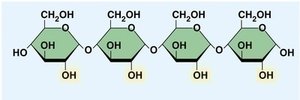
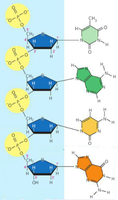
Peptide bonds are found in proteins; other bonds include glycosidic (carbohydrates) and phosphodiester (nucleic acids).
Level of Structure | Bond/Interaction | Example |
|---|---|---|
Primary | Peptide bonds | Amino acid sequence |
Secondary | Hydrogen bonds | α helix, β sheet |
Tertiary | Hydrophobic, ionic, hydrogen, disulfide | 3D folding |
Quaternary | Interactions between polypeptides | Hemoglobin, transthyretin |
Additional info: The notes cover Chapter 3 and 4 content relevant to General Biology, focusing on protein structure, function, amino acid properties, and macromolecule identification. Practice questions reinforce key concepts for exam preparation.
