 Back
Proteins and Nucleic Acids: Structure, Function, and Biological Importance
Study Guide - Smart Notes
 Tailored notes based on your materials, expanded with key definitions, examples, and context.
Proteins and Nucleic Acids
Introduction
Proteins and nucleic acids are two major classes of large biological molecules essential for life. Proteins perform a vast array of functions in cells, while nucleic acids store and transmit genetic information.
Proteins
What are Proteins?
Proteins are polymers composed of amino acids, each with a unique structure and function. They are made up of one or more polypeptides, each folded and coiled into a specific three-dimensional shape.
Monomer: Amino acids (20 different kinds)
Structure: Each protein has a unique sequence and structure, determining its function.
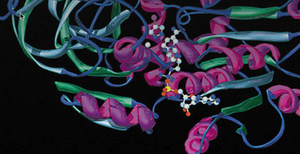
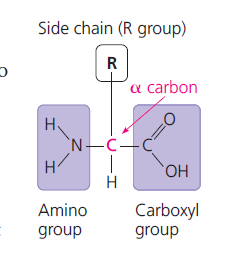
Structure of Amino Acids
Amino acids share a common structure: an amino group and a carboxyl group attached to a central α carbon. The side chain (R group) varies among amino acids, conferring different properties such as hydrophobicity or hydrophilicity.
Hydrophobic amino acids: Repel water, often found in the interior of proteins.
Hydrophilic amino acids: Attract water, often found on the protein surface.
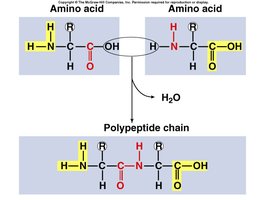
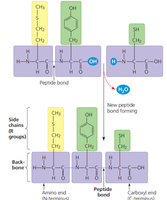
Peptide Bond Formation
Amino acids are linked by peptide bonds formed through dehydration (condensation) reactions, where water is removed. The peptide bond connects the amino group of one amino acid to the carboxyl group of another, resulting in a polypeptide chain with an N-terminus (amino end) and a C-terminus (carboxyl end).
Reaction: Removal of H2O during bond formation
Directionality: Chains have distinct ends (N-terminus and C-terminus)
Functions of Proteins
Proteins serve diverse functions in biological systems, including:
Enzyme catalysis: Speed up chemical reactions
Defense: Protect against disease
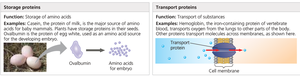
Storage: Store amino acids
Transport: Move substances across membranes
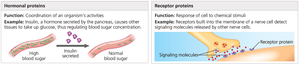
Hormonal: Coordinate activities
Receptor: Respond to chemical stimuli
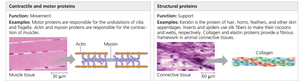
Contractile and motor: Enable movement
Structural: Provide support

Levels of Protein Structure
Proteins have four levels of structure, each contributing to their function:
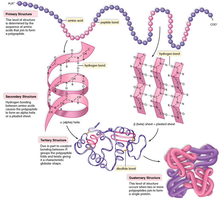
Primary structure: Linear sequence of amino acids joined by peptide bonds
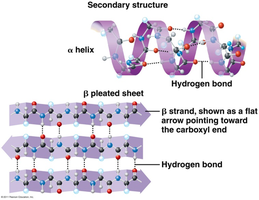
Secondary structure: Local folding into α-helices and β-pleated sheets stabilized by hydrogen bonds
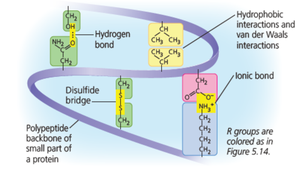
Tertiary structure: Overall three-dimensional shape formed by further folding, involving various bonds and interactions
Quaternary structure: Association of two or more polypeptides, sometimes stabilized by disulfide bonds
Types of Bonds in Protein Structure
Different levels of protein structure are stabilized by specific types of bonds and interactions:
Primary: Peptide bonds
Secondary: Hydrogen bonds
Tertiary and Quaternary: Hydrogen bonds, disulfide bridges, ionic bonds, hydrophobic interactions
Protein Properties and Denaturation
Fibrous proteins: Structural, hydrophobic (e.g., collagen)
Globular proteins: Functional, hydrophilic (e.g., enzymes, hemoglobin)
Denaturation: Loss of protein function due to disruption of bonds by heat, pH, or salt concentration; often irreversible
Sickle Cell Disease: A Change in Primary Structure
Sickle cell disease results from a single amino acid substitution (glutamic acid replaced by valine) in hemoglobin, causing red blood cells to become sickle-shaped and reducing oxygen-carrying capacity.
Nucleic Acids
What are Nucleic Acids?
Nucleic acids are polymers of nucleotides, forming long chains called polynucleotides. Types include DNA (deoxyribonucleic acid), RNA (ribonucleic acid), and ATP (adenosine triphosphate).
Monomer: Nucleotide
Roles: DNA stores heritable information; DNA directs RNA synthesis, which controls protein synthesis (gene expression)
Structure of Nucleotides
Each nucleotide consists of a phosphate group, a pentose sugar (ribose in RNA, deoxyribose in DNA), and a nitrogenous base.
Pyrimidines: Cytosine, Uracil, Thymine
Purines: Adenine, Guanine
Structure of DNA
DNA is a double helix with a sugar-phosphate backbone and paired nitrogenous bases. Nucleotides are joined by phosphodiester bonds.
Base pairing: Purines pair with pyrimidines via hydrogen bonds
Backbone: Sugar-phosphate
Complimentary Base Pairing
A with T/U: Double hydrogen bond
C with G: Triple hydrogen bond
Differences Between DNA and RNA
Feature | DNA | RNA |
|---|---|---|
Sugar | Deoxyribose | Ribose |
Bases | A, G, C, T | A, G, C, U |
Strands | Double-stranded, antiparallel | Single-stranded |
Structure of RNA
RNA is single-stranded, with a sugar-phosphate backbone and ribose as the sugar. Base pairing occurs between A and U.
Role of Nucleic Acids
Nucleic acids are central to gene expression, with DNA transcribed to RNA, and RNA translated to proteins. Genes are segments of DNA that determine traits.
Genomics and Proteomics
Advances in genomics and proteomics have transformed biological research, enabling DNA sequencing, bioinformatics, and molecular genealogy. DNA and proteins serve as "tape measures" of evolution, revealing relationships between species.
ATP: The Energy Molecule
ATP (adenosine triphosphate) is a phosphorylated nucleotide that serves as the primary energy carrier in cells.
Structure: Adenine base, ribose sugar, three phosphate groups
Function: Provides energy for cellular processes
Summary Table: Protein Functions
Function | Example |
|---|---|
Enzymatic | Digestive enzymes |
Defensive | Antibodies |
Storage | Casein, ovalbumin |
Transport | Hemoglobin |
Hormonal | Insulin |
Receptor | Neurotransmitter receptors |
Contractile/Motor | Actin, myosin |
Structural | Collagen, keratin |
Additional info: Expanded explanations and context were added to ensure completeness and academic quality.
