 Back
BackCHAPTER 5 PART 2: Proteins: Structure, Function, and Factors Affecting Protein Folding
Study Guide - Smart Notes
 Tailored notes based on your materials, expanded with key definitions, examples, and context.
Proteins: Structure, Function, and Factors Affecting Protein Folding
Protein Functions
Proteins are essential macromolecules that perform a wide variety of functions in biological systems. They account for more than 50% of the dry mass of most cells and are involved in numerous cellular processes.
Catalysts (Enzymes): Proteins accelerate biochemical reactions.
Structure: Proteins provide structural support (e.g., collagen in connective tissues).
Movement: Proteins enable cellular and organismal movement (e.g., actin and myosin in muscles).
Defense: Proteins function in immune responses (e.g., antibodies).
Transport: Proteins transport molecules across membranes (e.g., hemoglobin transports oxygen).
Signaling: Proteins transmit signals within and between cells (e.g., hormones).
Nutrition: Proteins serve as nutrient sources.
Proteins as Polymers of Amino Acids
Proteins are polymers composed of amino acids. There are twenty different amino acids, each used in varying amounts and sequences to construct proteins. The bond linking amino acids is called a peptide bond, and a chain of amino acids linked by peptide bonds is known as a polypeptide. A protein is a biologically functional molecule consisting of one or more polypeptides.
Amino Acids: Organic molecules with an amino group, a carboxyl group, a hydrogen atom, and a unique side chain (R group) attached to a central carbon atom.
Peptide Bond Formation: Peptide bonds are formed by dehydration reactions and broken by hydrolysis reactions.
Polypeptide Length: Polypeptides can range from a few to over 30,000 amino acids.
Polypeptide Ends: Each polypeptide has an amino end (N-terminus) and a carboxyl end (C-terminus).
Protein Structure and Function
The function of a protein is determined by its complex three-dimensional structure. There are four levels of protein structure:
Primary Structure: The linear sequence of amino acids, determined by the gene encoding the protein.
Secondary Structure: Local folding of the polypeptide backbone, stabilized by hydrogen bonds. Common structures include the α helix and β-pleated sheet.
Tertiary Structure: The overall three-dimensional shape of a single polypeptide, resulting from interactions between R groups (hydrogen bonds, ionic bonds, hydrophobic interactions, and van der Waals forces).
Quaternary Structure: The association of two or more polypeptide chains to form a functional protein (e.g., collagen, hemoglobin).
Factors Influencing Protein Structure
Protein structure can be affected by physical and chemical conditions, including pH, salt concentration, temperature, and other environmental factors. The loss of a protein’s native structure is called denaturation, which can often be reversed in a process called renaturation.
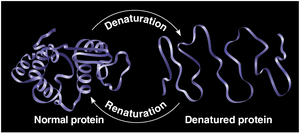
Denaturation: Disruption of the protein’s three-dimensional structure, leading to loss of function.
Renaturation: Restoration of the protein’s native structure under favorable conditions.
Genetic and Disease Influences on Protein Structure
Protein structure can also be affected by genetic mutations and diseases. For example, sickle-cell anemia is caused by a genetic mutation that alters the quaternary structure of hemoglobin. Incorrectly folded proteins are implicated in many neurodegenerative diseases, such as Alzheimer’s, Parkinsonism, Huntington’s disease, and prion diseases.
Sickle-cell Anemia: Mutation in hemoglobin gene leads to abnormal protein structure and function.
Neurodegenerative Diseases: Misfolded proteins accumulate and disrupt cellular function.
Summary Table: Levels of Protein Structure
Level | Description | Stabilizing Forces | Example |
|---|---|---|---|
Primary | Linear sequence of amino acids | Covalent peptide bonds | Insulin |
Secondary | Local folding (α helix, β sheet) | Hydrogen bonds | Keratin |
Tertiary | Overall 3D shape of polypeptide | Hydrogen bonds, ionic bonds, hydrophobic interactions, van der Waals forces | Myoglobin |
Quaternary | Association of multiple polypeptides | Same as tertiary, plus polypeptide interactions | Hemoglobin |
Additional info: The notes have been expanded to provide academic context and examples for each level of protein structure, as well as explanations of factors influencing protein folding and disease relevance.
