 Back
Protist Diversity and Eukaryotic Evolution: Origins, Innovations, and Ecological Roles
Study Guide - Smart Notes
 Tailored notes based on your materials, expanded with key definitions, examples, and context.
Eukaryotes – Protist Diversity
Introduction to Protists and Eukaryotic Evolution
Protists represent a diverse group of eukaryotic organisms that are neither plants, animals, nor fungi. Their evolutionary history is marked by key innovations such as the development of mitochondria, chloroplasts, and the nuclear envelope, which have shaped their diversity and ecological significance.
Protists are paraphyletic, meaning they include some but not all descendants of their most recent common ancestor.
They exhibit a wide range of reproductive, feeding, and motility strategies.
Protists play crucial roles in ecosystems and have impacted human history through disease and mutualistic relationships.
Morphological Innovations in Protists
Origin of Mitochondria: Endosymbiosis Theory
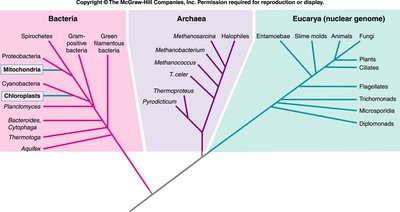
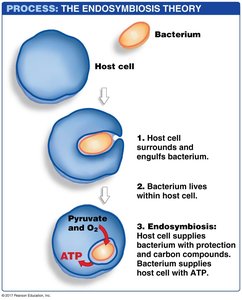
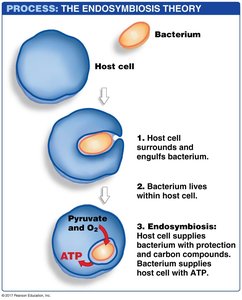
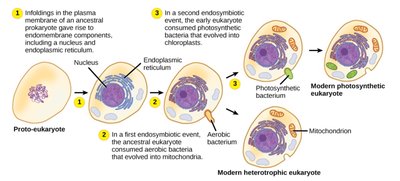
The mitochondrion is a defining organelle of eukaryotes, responsible for ATP production. The endosymbiosis theory posits that mitochondria originated when a bacterial cell was engulfed by a proto-eukaryotic cell, forming a symbiotic relationship.
Symbiosis: Two different species living in close physical contact.
Endosymbiosis: One species living inside the cells of another.
Evidence for endosymbiosis includes mitochondria's similarity to α-proteobacteria, replication by fission, double membranes, and circular genomes.

Origin of Chloroplasts: Primary and Secondary Endosymbiosis
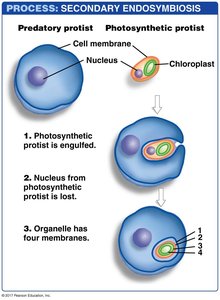
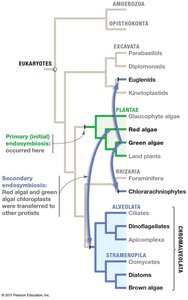
Chloroplasts in photosynthetic eukaryotes are believed to have originated from cyanobacteria via primary endosymbiosis. Some protists acquired chloroplasts through secondary endosymbiosis, engulfing other photosynthetic protists.
Primary endosymbiosis: A eukaryote engulfs a cyanobacterium.
Secondary endosymbiosis: A eukaryote engulfs another eukaryote (alga) with chloroplasts.
Chloroplasts have bacteria-like characteristics, circular DNA, and peptidoglycan in their cell walls.
Mutualisms and Modern Examples of Endosymbiosis
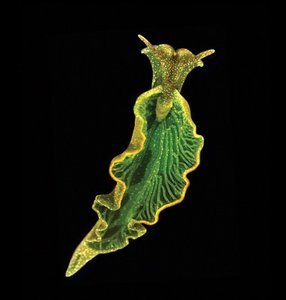
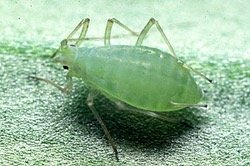
Endosymbiotic relationships are observed in modern organisms, such as the green sea slug that retains chloroplasts from ingested algae and aphids with endosymbiotic proteobacteria.
These relationships illustrate ongoing gene transfer and symbiosis in nature.
Origin of the Nuclear Envelope
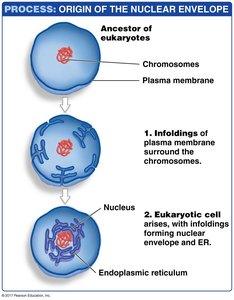
The nuclear envelope is thought to have evolved from infoldings of the plasma membrane, which also gave rise to the endoplasmic reticulum (ER).
Infoldings are observed in some extant bacteria.
The nuclear envelope and ER are continuous in eukaryotes.
Protist Classification and Characteristics
What is a Protist?
Protists are eukaryotes that are not classified as plants, animals, or fungi. They are a paraphyletic group lacking shared derived traits (synapomorphies).
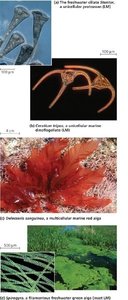
Examples include amoeba, slime molds, euglena, diatoms, and algae.
Protists are highly diverse in form and function.
Protist Characteristics
Protists can be unicellular or multicellular (without tissues), and they acquire energy through various means.
Photoautotrophs: Use photosynthesis.
Heterotrophs: Free-living, decomposers, or parasites.
Most live in aquatic environments.
Reproduction can be sexual (meiosis, gamete fusion) or asexual (mitosis, binary fission, budding).
Motility is achieved via cilia, flagella, or pseudopodia.
Major Lineages of Protists
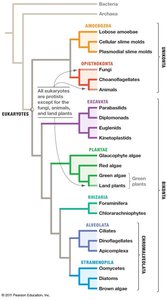
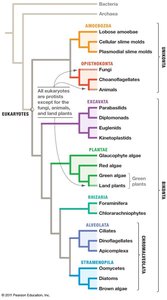
Protists are classified into seven major lineages, each with unique synapomorphies and characteristics.
Lineages include Amoebozoa, Opisthokonta, Excavata, Plantae, Rhizaria, Alveolata, and Stramenopila.
Cellular Organelle Diversity
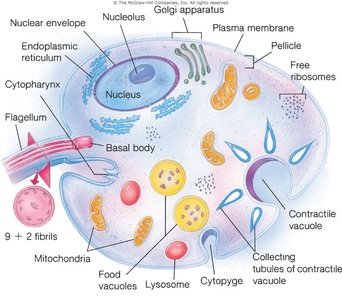
Despite being unicellular, protists possess complex organelles and structures.
Organelles include nucleus, mitochondria, plastids, contractile vacuoles, and more.
Energy Acquisition and Movement in Protists
Feeding Strategies
Protists acquire energy as autotrophs or heterotrophs, with heterotrophs further classified as phagotrophs (ingest particles) or osmotrophs (ingest soluble food).
Phagocytosis: Ingestion of particles.
Pinocytosis: Ingestion of soluble food.
Movement and Feeding Organelles
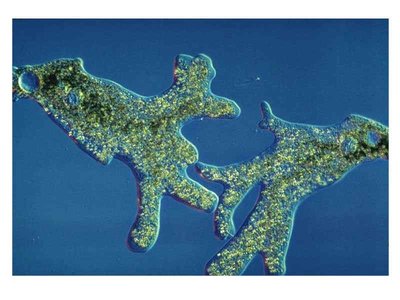
Protists move using cilia, flagella, or pseudopodia, which also aid in feeding, reproduction, excretion, and osmoregulation.
Cilia: Short, hair-like structures for movement.
Flagella: Long, whip-like structures for movement.
Pseudopodia: Temporary projections of the cell for movement and feeding.
Ecological Roles and Importance of Protists
Ecological Significance
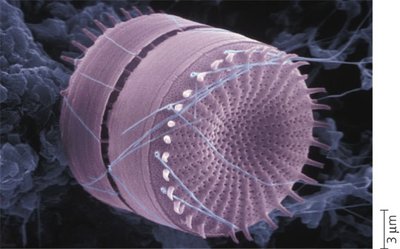
Protists are abundant and play vital roles in ecosystems as photosynthesizers, sources of biomass, and contributors to natural gas and oil formation.
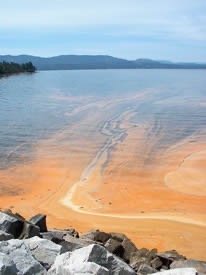
Some protists cause harmful algal blooms (red tides) and diseases such as malaria, amoebic dysentery, and giardia.
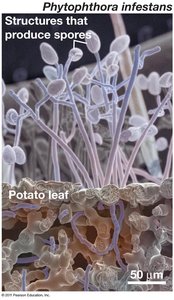
Protists have impacted agriculture, e.g., the Irish potato famine caused by crop pests.
Synapomorphies and Lineage Characteristics
Distinguishing Features of Major Eukaryotic Lineages
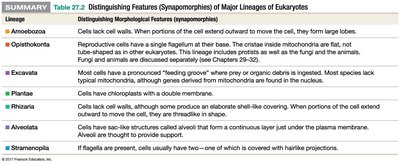
The seven main lineages of eukaryotes are distinguished by unique morphological features (synapomorphies).
Lineage | Distinguishing Features |
|---|---|
Amoebozoa | Cells lack cell walls; portions of the cell extend outward to move the cell; form large lobes. |
Opisthokonta | Reproductive cells have a single flagellum at their base; includes animals and fungi. |
Excavata | Most cells have a pronounced "feeding groove"; lack typical mitochondria. |
Plantae | Cells have chloroplasts with double membrane. |
Rhizaria | Cells lack cell walls; elaborate shell-like covering; threadlike shape. |
Alveolata | Cells have sac-like structures under the plasma membrane. |
Stramenopila | If flagella are present, cells usually have two, one with hairlike projections. |
Photosynthetic Diversity in Protists
Photosynthetic Pigments and Endosymbiosis
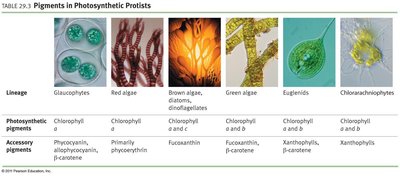
Photosynthetic protists possess a variety of pigments, which arose through primary or secondary endosymbiosis. Pigment diversity is linked to evolutionary history and adaptation.
Primary endosymbiosis led to chlorophyll a in Plantae.
Secondary endosymbiosis introduced novel pigments (chlorophyll b & c) in other protist lineages.
Lineages such as Euglenids and Chlorarachniophytes ingested green algae, while Alveolata and Stramenopila ingested red algae.
Lineage | Photosynthetic Pigments | Accessory Pigments |
|---|---|---|
Glaucophytes | Chlorophyll a | Phycocyanin, allophycocyanin, β-carotene |
Red algae | Chlorophyll a | Primarily phycoerythrin |
Brown algae, diatoms, dinoflagellates | Chlorophyll a and c | Fucoxanthin, β-carotene |
Green algae | Chlorophyll a and b | Fucoxanthin, β-carotene |
Euglenids | Chlorophyll a and b | Xanthophylls, β-carotene |
Chlorarachniophytes | Chlorophyll a and b | Xanthophylls, β-carotene |
Multicellularity and Eukaryotic Diversification
Evolution of Multicellularity
Multicellularity is defined as a permanent association of cells with some specialization. It arose independently multiple times in algae and slime molds, likely related to increased atmospheric oxygen.
Green algae include unicellular (Chlamydomonas), colonial (Volvox), and multicellular (Codium) members.
Multicellularity involves differential regulation of gene expression rather than a large increase in gene number.
Eukaryotic Diversification and Transition to Land
The major eukaryotic lineages (fungi, animals, plants) diversified in aquatic environments before transitioning to land. Mutualisms, such as lichens, facilitated early land colonization.
Fungi, animals, and plants each transitioned to land at different times.
Mycorrhizal associations were crucial for plant colonization of terrestrial habitats.
Additional info: The notes expand on brief points by providing definitions, examples, and context for each topic, ensuring completeness and academic quality for exam preparation.
