 Back
BackProtist Diversity and Eukaryotic Evolution: Structure, Function, and Phylogeny
Study Guide - Smart Notes
 Tailored notes based on your materials, expanded with key definitions, examples, and context.
Cladistics and Phylogenetic Terms
Key Concepts in Phylogenetics
Understanding evolutionary relationships among organisms requires specific terminology and concepts. These are foundational for interpreting phylogenetic trees and classifying life forms.
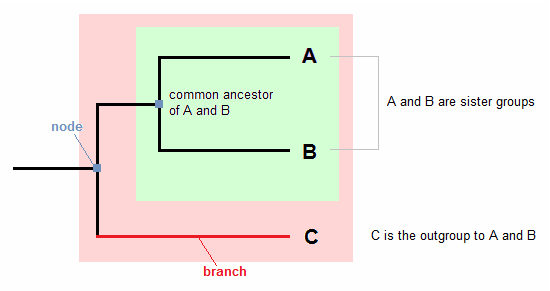
Clade: A group of organisms that includes an ancestor and all its descendants, representing a single branch on the tree of life.
Sister Group/Taxon: Two lineages that are each other's closest relatives, sharing a most recent common ancestor.
Outgroup: A distantly related group used as a reference point for rooting the tree and determining evolutionary direction.
Node: The point on a phylogenetic tree where a single lineage splits into two or more distinct lineages, representing a common ancestor.
Branch: A line on a phylogenetic tree representing the evolutionary path of a lineage.
Monophyletic, Paraphyletic, and Polyphyletic Groups:
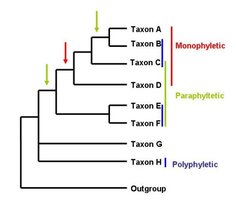
Monophyletic: Includes a common ancestor and all its descendants.
Paraphyletic: Includes a common ancestor and some, but not all, descendants.
Polyphyletic: Includes taxa with different ancestors, not including the most recent common ancestor of all members.
Introduction to Protists and Eukaryotic Diversity
Protists: General Characteristics
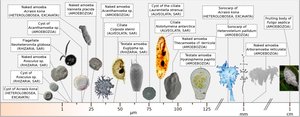
Protists are a diverse group of mostly unicellular eukaryotes. They are not classified as a single kingdom due to their polyphyletic nature. Advances in systematics have led to frequent changes in their classification.
Eukaryotic: Protists have membrane-bound organelles and a nucleus, making them structurally more complex than prokaryotes.
Unicellularity: Most protists are unicellular, but some form colonies or are multicellular.
Structural Diversity: Protists exhibit the greatest structural and functional diversity among eukaryotes.
Unique Organelles in Protists
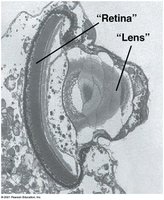
Some protists possess organelles not found in other eukaryotes. For example, certain dinoflagellates have an eye-like organelle called an ocelloid, which functions similarly to a camera-type eye.
Nutrition and Life Cycles in Protists
Nutritional Diversity
Protists are the most nutritionally diverse eukaryotes, displaying a range of feeding strategies:
Photoautotrophs: Contain chloroplasts and perform photosynthesis.
Heterotrophs: Absorb organic molecules or ingest larger food particles.
Mixotrophs: Combine photosynthesis and heterotrophic nutrition.
Protists may reproduce asexually, sexually, or alternate between both. All three basic types of sexual life cycles (animal, plant, fungal) are represented among protists.
Major Supergroups of Eukaryotes
Overview of Supergroups
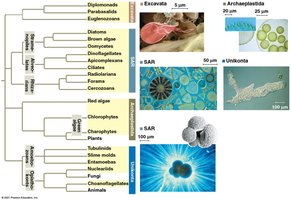
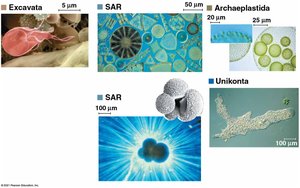
Current hypotheses divide eukaryotes into four supergroups, each containing diverse protist lineages:
Excavata
SAR (Stramenopiles, Alveolates, Rhizaria)
Archaeplastida
Unikonta
Endosymbiosis and the Origin of Eukaryotic Organelles
Primary and Secondary Endosymbiosis
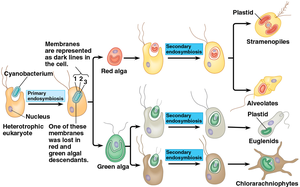
Endosymbiosis is a key evolutionary process where one organism lives inside another. Mitochondria and plastids (e.g., chloroplasts) originated via endosymbiosis:
Mitochondria: Evolved from engulfed alpha-proteobacteria.
Plastids: Evolved from engulfed cyanobacteria, giving rise to red and green algae.
Secondary Endosymbiosis: Occurred when a eukaryote engulfed a red or green alga, leading to further diversification (e.g., in chlorarachniophytes).
Supergroup Excavata
Key Clades: Diplomonads, Parabasalids, Euglenozoans
Excavata includes several important protist groups, many of which are characterized by unique flagella and reduced mitochondria.
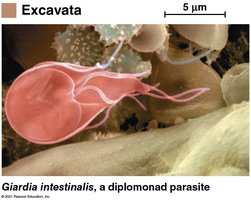
Diplomonads: Lack plastids, have reduced mitochondria (mitosomes), live in anaerobic environments, and often are parasites (e.g., Giardia intestinalis).
Parabasalids: Have reduced mitochondria (hydrogenosomes) that generate energy anaerobically, releasing hydrogen gas as a by-product (e.g., Trichomonas vaginalis).
Euglenozoans: Distinguished by a spiral or crystalline rod inside their flagella; includes kinetoplastids and euglenids.
Supergroup SAR
Stramenopiles, Alveolates, and Rhizarians
The SAR supergroup is highly diverse and defined by DNA similarities. It includes three major clades:
Stramenopiles: Important photosynthetic organisms with "hairy" and "smooth" flagella (e.g., diatoms, golden algae, brown algae).
Alveolates: Have membrane-enclosed sacs (alveoli) under the plasma membrane (e.g., dinoflagellates, apicomplexans, ciliates).
Rhizarians: Mostly amoebas with threadlike pseudopodia (e.g., radiolarians, forams, cercozoans).
Supergroup Archaeplastida
Red Algae, Green Algae, and Plants
Archaeplastida includes red algae, green algae, and land plants. This group is united by the presence of plastids derived from primary endosymbiosis with cyanobacteria.
Red Algae: Contain the pigment phycoerythrin, which masks chlorophyll and allows survival at greater depths.
Green Algae: Have chloroplasts similar to those of plants; includes chlorophytes and charophytes (the latter are most closely related to plants).
Supergroup Unikonta
Amoebozoans and Opisthokonts
Unikonta includes amoebozoans (with lobe- or tube-shaped pseudopodia) and opisthokonts (animals, fungi, and related protists). The evolutionary root of this group is still debated.
Amoebozoans: Includes tubulinids, slime molds, and entamoebas.
Opisthokonts: Includes animals, fungi, and several protist groups.
Ecological Roles of Protists
Symbionts and Producers
Protists play essential roles in ecosystems as both symbionts and primary producers.
Symbiotic Protists: Some benefit their hosts (e.g., dinoflagellates in corals, protists in termite guts), while others are parasitic (e.g., Plasmodium causes malaria).
Photosynthetic Protists: Major producers in aquatic environments, forming the base of many food webs. Their populations are sensitive to nutrient availability and climate change.
Summary Table: Major Protist Supergroups and Examples
Supergroup | Key Clades | Representative Examples | Key Features |
|---|---|---|---|
Excavata | Diplomonads, Parabasalids, Euglenozoans | Giardia intestinalis, Trichomonas vaginalis, Euglena | Reduced mitochondria, unique flagella |
SAR | Stramenopiles, Alveolates, Rhizarians | Diatoms, Brown algae, Dinoflagellates, Forams | Photosynthetic diversity, complex life cycles |
Archaeplastida | Red algae, Green algae, Plants | Volvox, Ulva, Porphyra | Primary plastids, multicellularity |
Unikonta | Amoebozoans, Opisthokonts | Slime molds, Entamoeba, Animals, Fungi | Lobe-shaped pseudopodia, multicellularity |
Additional info: This guide covers the main concepts of protist diversity, eukaryotic evolution, and ecological roles, as outlined in a typical introductory biology curriculum (Ch. 28 - Protists). Images were included only when directly relevant to the explanation of the adjacent paragraph.
