 Back
BackProtist Diversity and Evolution: Endosymbiosis, Major Clades, and Ecological Roles
Study Guide - Smart Notes
 Tailored notes based on your materials, expanded with key definitions, examples, and context.
Protist Diversity and Evolution
Introduction to Protists
Protists are a highly diverse, paraphyletic group of eukaryotic organisms that do not fit into the kingdoms of plants, animals, or fungi. They are found in all major eukaryotic supergroups and play crucial roles in ecological and evolutionary processes.
Species Diversity: Approximately 200,000 described species, with a wide range of morphologies and life cycles.
Reproduction: Protists exhibit both sexual and asexual reproduction, contributing to their adaptability and evolutionary success.
Ecological Importance: Many protists, such as algae and phytoplankton, are foundational producers in aquatic ecosystems.
Note: The unikonta supergroup (including fungi and animals) is not covered here.
Endosymbiotic Theory in Eukaryotic Evolution
Origin of Mitochondria and Plastids
The endosymbiotic theory explains the origin of key eukaryotic organelles. According to this theory, mitochondria and plastids (e.g., chloroplasts) originated when ancestral eukaryotic cells engulfed prokaryotic cells, which then became endosymbionts and eventually organelles.
Mitochondria: Evolved from an aerobic prokaryote (likely an alpha-proteobacterium).
Plastids: Evolved from a photosynthetic cyanobacterium, leading to the development of red and green algae.
Gene Transfer: Genes from the endosymbiont were transferred to the host nucleus, making the organelle dependent on the host cell.
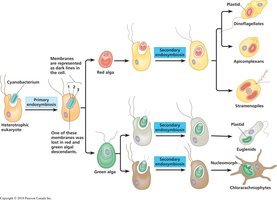
Primary and Secondary Endosymbiosis
Primary endosymbiosis refers to the initial engulfment of a prokaryote by a eukaryote, while secondary endosymbiosis involves a eukaryote engulfing another eukaryotic alga. This process has led to the diversity of plastid-containing protists.
Evidence: Plastid genes in red and green algae closely resemble those of cyanobacteria.
Secondary Endosymbiosis: Red and green algae were themselves engulfed by other eukaryotes, spreading plastids to additional lineages.
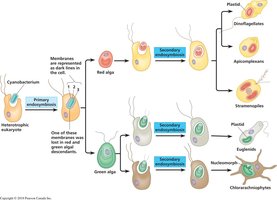
Major Protist Supergroups
Overview of Eukaryotic Supergroups
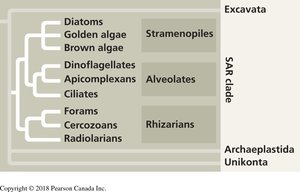
Protists are distributed among several major eukaryotic supergroups, including Excavata, SAR (Stramenopiles, Alveolates, Rhizarians), and Archaeplastida.
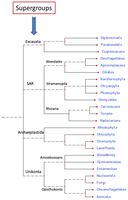
Excavata
The Excavata are characterized by a unique cytoskeleton and, in many species, an excavated feeding groove. This group includes diplomonads, parabasalids, and euglenozoans.
Euglenozoans: A diverse clade including predatory heterotrophs, photosynthetic autotrophs, and parasites. Their main distinguishing feature is a spiral or crystalline rod inside their flagella.
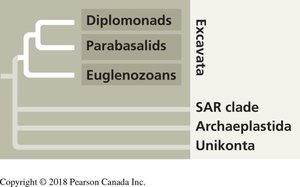
Euglenids
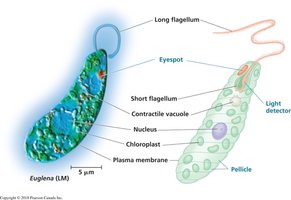
Euglenids are a subgroup of euglenozoans with one or two flagella emerging from a pocket at one end of the cell. Some are mixotrophs, capable of both autotrophy and heterotrophy.
The SAR Clade
The SAR clade is a monophyletic supergroup composed of Stramenopiles, Alveolates, and Rhizarians. It includes many ecologically significant protists.
Stramenopiles
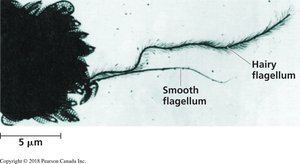
Stramenopiles are defined by the presence of a "hairy" flagellum paired with a smooth flagellum. This group includes diatoms, golden algae, and brown algae.
Diatoms
Diatoms are unicellular algae with unique, glass-like cell walls made of silicon dioxide. They are a major component of phytoplankton and play a significant role in the global carbon cycle by sequestering CO2 in the ocean.

Brown Algae
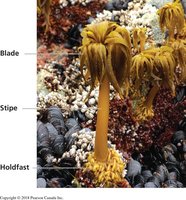
Brown algae are the largest and most complex algae, all multicellular and mostly marine. They include seaweeds such as kelp, which have plant-like structures (holdfast, stipe, blades) that are analogous, not homologous, to plant organs.
Archaeplastida
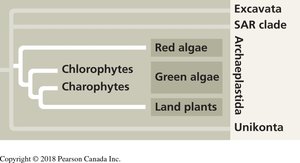
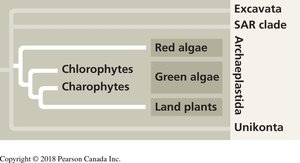
Archaeplastida is the supergroup that includes red algae, green algae, and land plants. This group is defined by the presence of plastids derived from primary endosymbiosis with cyanobacteria.
Red Algae
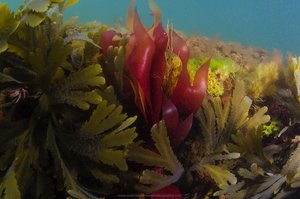
Red algae are usually multicellular and are characterized by the presence of the accessory pigment phycoerythrin, which gives them a reddish color. Their coloration varies with depth due to light absorption properties.
Green Algae
Green algae have grass-green chloroplasts and are a paraphyletic group that includes chlorophytes and charophytes. Charophytes are the closest relatives of land plants. Green algae inhabit diverse environments, including freshwater, marine, damp soil, and as symbionts in lichens.
Ecological Roles of Protists
Photosynthetic Protists as Primary Producers
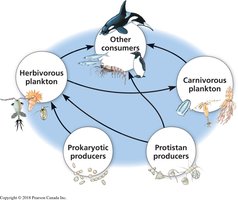
Photosynthetic protists, such as algae and phytoplankton, are key primary producers in aquatic ecosystems. They form the base of the food web and are essential for supporting higher trophic levels.
Limiting Nutrients: Growth of photosynthetic protists is limited by phosphorus in freshwater and nitrogen in saltwater environments.
Population Blooms: When limiting nutrients are added, protist populations can rapidly increase (bloom).
Impact of Climate Change on Protist Biomass
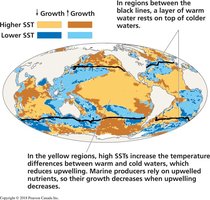
The biomass of photosynthetic protists has declined as sea surface temperatures (SST) have increased. Warmer surface layers inhibit the upwelling of nutrient-rich water, limiting protist growth and affecting marine ecosystems, fisheries, and the global carbon cycle.
Summary
Protists are a diverse group of eukaryotes, including all eukaryotes except fungi, plants, and animals.
Endosymbiosis has played a central role in the evolution of eukaryotic organelles and protist diversity.
Major protist groups include Excavata, SAR, and Archaeplastida, each with unique features and ecological roles.
Photosynthetic protists are vital primary producers, and their abundance is sensitive to environmental changes such as nutrient availability and climate change.
