 Back
BackProtists: Diversity, Structure, and Ecological Roles
Study Guide - Smart Notes
 Tailored notes based on your materials, expanded with key definitions, examples, and context.
Protists: Diversity, Structure, and Ecological Roles
Introduction to Protists
Protists are a diverse group of mostly unicellular eukaryotic organisms that do not fit into the kingdoms of plants, animals, or fungi. They exhibit remarkable structural, functional, and nutritional diversity, and play key roles in ecological systems.
Definition: Protists are all eukaryotes that are not classified as plants, animals, or fungi.
Classification: Protists are not a single kingdom; some are more closely related to plants, fungi, or animals than to other protists.
Cell Structure: Protist cells contain a nucleus and membrane-bound organelles, and possess a well-developed cytoskeleton that allows for complex shapes and movement.
Complexity: Unicellular protists are among the most complex cells, as each cell must perform all life functions.

Structural and Functional Diversity
Protists display greater structural and functional diversity than any other group of eukaryotes. While most are unicellular, some form colonies or are multicellular.
Unique Organelles: Some protists, such as dinoflagellates, possess specialized organelles like the ocelloid, which resembles an eye.
Nutritional Diversity: Protists can be photoautotrophs (with chloroplasts), heterotrophs (absorbing or ingesting food), or mixotrophs (combining both modes).
Reproduction: Protists reproduce asexually, sexually, or alternate between both. All three basic types of sexual life cycles are found among protists.

Endosymbiosis and Eukaryotic Evolution
Endosymbiosis has played a critical role in the evolution of protists and other eukaryotes. This process involves one organism living inside another, leading to the origin of mitochondria and plastids.
Mitochondria: Evolved from engulfed alpha proteobacteria.
Plastids: Evolved from engulfed cyanobacteria, giving rise to photosynthetic lineages.
Evidence: Molecular data indicate that mitochondria and plastids each evolved only once.
Supergroups of Eukaryotes
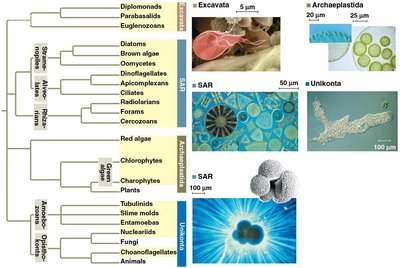
Modern classification divides eukaryotes into four supergroups: Excavata, SAR, Archaeplastida, and Unikonta. Each supergroup contains diverse protist lineages.
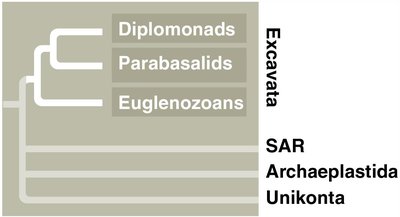
Excavata: Includes diplomonads, parabasalids, and euglenozoans.
SAR: Includes stramenopiles, alveolates, and rhizarians.
Archaeplastida: Includes red algae, green algae, and plants.
Unikonta: Includes amoebozoans and opisthokonts (animals, fungi, and related protists).
Excavata
Characteristics and Major Clades
Excavata is a supergroup characterized by a unique cytoskeleton and, in some members, an excavated feeding groove. It includes three main clades: diplomonads, parabasalids, and euglenozoans.
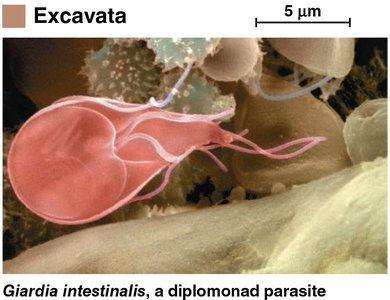
Diplomonads: Lack plastids, have reduced mitochondria (mitosomes), live in anaerobic environments, and often are parasites (e.g., Giardia intestinalis).
Parabasalids: Have reduced mitochondria (hydrogenosomes), generate energy anaerobically, and include parasites such as Trichomonas vaginalis.
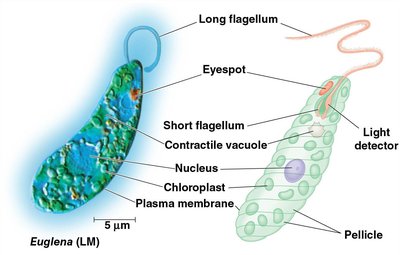
Euglenozoans: Distinguished by a spiral or crystalline rod inside their flagella; include kinetoplastids and euglenids.
Kinetoplastids and Euglenids
Kinetoplastids: Have a single mitochondrion with a kinetoplast (organized DNA mass). Some are free-living, others are parasites (e.g., Trypanosoma causes sleeping sickness and Chagas' disease).
Euglenids: Possess one or two flagella emerging from a pocket; some are mixotrophs, switching between autotrophy and heterotrophy.

SAR Supergroup
Overview and Major Clades
The SAR supergroup is a monophyletic group defined by DNA similarities and includes Stramenopila, Alveolata, and Rhizaria.
Stramenopiles: Most have a "hairy" and a "smooth" flagellum; includes diatoms, brown algae, and oomycetes.
Alveolates: Have membrane-bound sacs (alveoli) under the plasma membrane; includes dinoflagellates, apicomplexans, and ciliates.
Rhizarians: Mostly amoebas with threadlike pseudopodia; includes radiolarians, forams, and cercozoans.
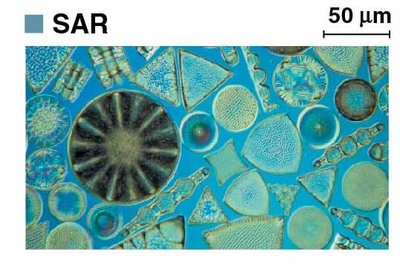

Stramenopiles
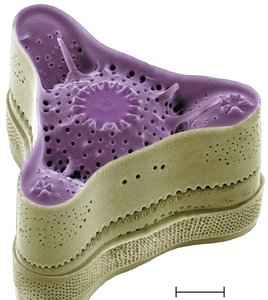
Diatoms: Unicellular algae with glass-like walls of silicon dioxide; major component of phytoplankton, important in the global carbon cycle.
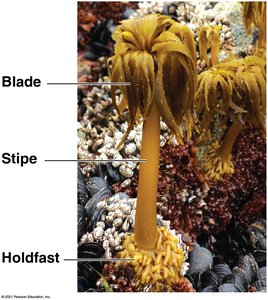
Brown Algae: Largest and most complex algae; multicellular, mostly marine, includes kelps and seaweeds. Contains carotenoids for brown color.
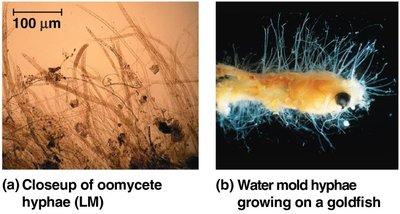
Oomycetes: Water molds with cellulose cell walls; resemble fungi but are not closely related.
Alveolates
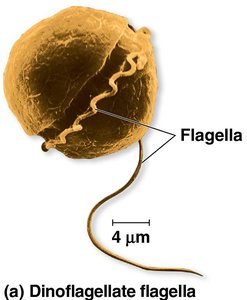
Dinoflagellates: Have two flagella in grooves of cellulose plates; cause red tides, some are toxic.
Apicomplexans: Animal parasites with complex life cycles (e.g., Plasmodium causes malaria).
Ciliates: Move and feed using cilia; have micronuclei and macronuclei.
Rhizarians
Radiolarians: Marine protists with silica skeletons and radiating pseudopodia.
Forams: Have porous calcium carbonate shells (tests); important in dating sediments.
Cercozoans: Amoeboid and flagellated protists with threadlike pseudopodia.
Archaeplastida
Red and Green Algae
Archaeplastida includes red algae, green algae, and plants. Plastids in this group originated from a cyanobacterial endosymbiont.
Red Algae: Contain phycoerythrin pigment, allowing survival at various depths; mostly multicellular.
Green Algae: Have chloroplasts similar to plants; include charophytes (closest relatives to plants) and chlorophytes.
Unikonta
Amoebozoans and Opisthokonts
Unikonta includes amoebas with lobe- or tube-shaped pseudopodia, animals, fungi, and related protists.
Amoebozoans: Includes tubulinids (predators and detritivores), slime molds (convergent with fungi), and entamoebas (parasitic).
Opisthokonts: Includes animals, fungi, and related protists.
Ecological Roles of Protists
Symbionts and Producers
Protists are essential in ecological communities as symbionts and primary producers.
Symbiotic Protists: Some benefit hosts (e.g., dinoflagellates in corals, protists in termite guts), while others are parasitic (e.g., Plasmodium in humans).
Photosynthetic Protists: Major producers in aquatic ecosystems, forming the base of food webs and influencing the global carbon cycle.
Environmental Impact: Climate change and warming oceans threaten protist populations, with potential consequences for marine ecosystems and the carbon cycle.
Summary Table: Major Protist Supergroups and Examples
Supergroup | Major Clades | Examples | Key Features |
|---|---|---|---|
Excavata | Diplomonads, Parabasalids, Euglenozoans | Giardia, Trichomonas, Euglena | Modified mitochondria, unique flagella, some with feeding groove |
SAR | Stramenopiles, Alveolates, Rhizarians | Diatoms, Brown algae, Dinoflagellates, Forams | Hairy/smooth flagella, alveoli, threadlike pseudopodia |
Archaeplastida | Red algae, Green algae, Plants | Volvox, Chlamydomonas, Laminaria | Primary plastids, photosynthetic |
Unikonta | Amoebozoans, Opisthokonts | Amoeba proteus, Slime molds, Animals, Fungi | Lobe/tube-shaped pseudopodia, includes animals and fungi |
