 Back
BackProtists: Diversity, Structure, and Life Cycles
Study Guide - Smart Notes
 Tailored notes based on your materials, expanded with key definitions, examples, and context.
Protists: Diversity, Structure, and Life Cycles
Chromosomal Sets and Cell Division
Understanding the chromosomal composition and cell division processes is fundamental to studying protists and their evolutionary relationships.
Haploid: Cells containing one set of chromosomes (n).
Diploid: Cells containing two sets of chromosomes (2n).
Mitosis: Cell division producing two genetically identical diploid cells; essential for growth and repair.
Meiosis: Cell division producing four genetically distinct haploid cells; forms gametes for sexual reproduction.
Gamete: A haploid sex cell (e.g., sperm or egg).
Zygote: A diploid cell formed by the fusion of two gametes.
Alternation of Generations
Many protists and algae exhibit a life cycle known as alternation of generations, involving both multicellular haploid and diploid stages.
Gametophyte: The haploid stage that produces gametes via mitosis.
Sporophyte: The diploid stage that produces haploid spores via meiosis.
Spore: A haploid cell capable of developing into a gametophyte without fertilization.
Germination: The process by which a spore grows into a new organism under suitable conditions.
Characteristics of Protists
Protists are a diverse group of mostly unicellular eukaryotes that inhabit moist or aquatic environments.
Eukaryotic: Possess a nucleus and membrane-bound organelles.
Structural Diversity: Mostly unicellular, some are multicellular or colonial.
Habitat: Live in moist or aquatic environments.
Lack Complex Tissues: Most protists do not form complex tissues like plants, animals, or fungi.
Diverse Nutrition: Protists may be photoautotrophic, heterotrophic, or mixotrophic.
Protist Reproduction
Protists reproduce through various mechanisms, both asexual and sexual.
Asexual Reproduction: Commonly by binary fission.
Sexual Reproduction: Includes processes such as conjugation or gamete fusion.
Types of Protists by Nutrition
Photoautotrophs: Use sunlight to synthesize food via photosynthesis.
Heterotrophs: Obtain food by ingesting or absorbing organic matter.
Mixotrophs: Combine photosynthesis and heterotrophic feeding.
Endosymbiosis Theory
The endosymbiosis theory explains the origin of eukaryotic organelles from free-living bacteria.
Mitochondria: Originated from aerobic proteobacteria.
Plastids (e.g., chloroplasts): Originated from cyanobacteria.
Secondary Endosymbiosis: Occurred when a eukaryote engulfed another photosynthetic eukaryote.
Major Protist Supergroups
Protists are classified into several supergroups based on molecular and morphological evidence.
Excavata
Diplomonads: Two nuclei, multiple flagella, lack typical mitochondria (e.g., Giardia).
Parabasalids: No mitochondria, have hydrogenosomes, many are parasites (e.g., Trichomonas).
Euglenozoans: Single or two flagella, flexible pellicle, includes kinetoplastids (large mitochondria with kinetoplast DNA, e.g., Trypanosoma) and euglenids (many have chloroplasts, eyespot, contractile vacuole, e.g., Euglena).
SAR (Stramenopiles, Alveolates, Rhizaria)
Stramenopiles:
Diatoms: Glasslike silica walls (frustules), major aquatic producers (e.g., Navicula).
Golden Algae: Yellow-brown pigments, mostly unicellular (e.g., Dinobryon).
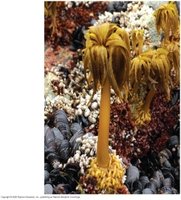
Brown Algae: Large multicellular seaweeds, contain fucoxanthin pigment, body called thallus, with holdfast, stipe, and blades. Exhibit alternation of generations, which may be heteromorphic (sporophyte and gametophyte look different) or isomorphic (look similar). Examples: Laminaria, Fucus.
Oomycetes: Water molds with cellulose cell walls, diploid dominant stage, hyphae for nutrient absorption (e.g., Phytophthora).
Alveolates:
Dinoflagellates: Two flagella, cellulose plates, many are photosynthetic, some cause red tides.
Apicomplexans: Parasitic, apical complex for host penetration (e.g., Plasmodium, malaria parasite; lifecycle involves mosquito vector and human host).
Ciliates: Move and feed using cilia, have two types of nuclei, reproduce by binary fission and exchange genetic material via conjugation (e.g., Paramecium).
Rhizaria:
Radiolarians: Silica skeletons, radial symmetry (e.g., Actinomma).
Forams: Marine, use pseudopodia, have calcium carbonate shells (tests) (e.g., Globigerina).
Cercozoans: Thin, threadlike pseudopodia, mostly soil and freshwater species (e.g., Plasmodiophora).
Archaeplastida
Red Algae: Mostly multicellular, marine, contain phycoerythrin pigment (e.g., Porphyra).
Green Algae:
Chlorophytes: Mostly aquatic, have chlorophyll a and b, alternate between haploid and diploid stages.
Charophyceans: Closest relatives of land plants, share traits like cellulose cell walls and similar enzymes.
Land Plants: Multicellular, protected embryos, adapted to terrestrial life.
Unikonta
Amoebozoans:
Tubulinids: Lobed pseudopodia, move by cytoplasmic streaming, feed by engulfing food (e.g., Amoeba proteus).
Slime Molds: Heterotrophic decomposers; plasmodial slime molds form multinucleate plasmodium, cellular slime molds aggregate into multicellular slugs under stress.
Gymnamoebas: Free-living amoebas, lack protective shells, move using pseudopodia.
Entamoebas: Parasitic, live in animal intestines.
Opisthokonts:
Nucleariids: Unicellular, closely related to fungi.
Fungi: Heterotrophic absorbers, chitin cell walls.
Choanoflagellates: Single flagellum, collar of microvilli, closest living relatives of animals.
Animals: Multicellular heterotrophs, ingest food, have specialized tissues.
Protist Symbiosis and Ecological Roles
Symbionts: Some protists provide nutrients (e.g., sugars from photosynthesis), aid digestion, or protect hosts from pathogens.
Producers: Organisms that synthesize their own food via photosynthesis or chemosynthesis, forming the base of aquatic food webs.
Summary Table: Major Protist Groups and Key Features
Supergroup | Representative Groups | Key Features | Examples |
|---|---|---|---|
Excavata | Diplomonads, Parabasalids, Euglenozoans | Flagella, modified mitochondria, flexible pellicle | Giardia, Trichomonas, Euglena |
SAR | Stramenopiles, Alveolates, Rhizaria | Silica or cellulose walls, cilia/flagella, pseudopodia | Diatoms, Paramecium, Forams |
Archaeplastida | Red algae, Green algae, Land plants | Chlorophyll, multicellularity, alternation of generations | Porphyra, Chlamydomonas, Mosses |
Unikonta | Amoebozoans, Opisthokonts | Pseudopodia, absorptive nutrition, multicellularity | Amoeba, Slime molds, Fungi, Animals |
Additional info: This summary expands on the original notes by providing definitions, examples, and a comparative table for clarity and exam preparation.
