 Back
Pyruvate Oxidation and the Formation of Acetyl CoA
Study Guide - Smart Notes
 Tailored notes based on your materials, expanded with key definitions, examples, and context.
Pyruvate Oxidation
Overview of Pyruvate Oxidation
Pyruvate oxidation is a critical metabolic process that links glycolysis to the citric acid cycle. It occurs in the mitochondria of eukaryotic cells and involves the conversion of pyruvate, a three-carbon molecule produced during glycolysis, into acetyl coenzyme A (Acetyl CoA), a two-carbon molecule that enters the citric acid cycle.
Location: Mitochondrial matrix (after pyruvate is transported from the cytosol).
Main Purpose: To generate electron carriers (NADH) and produce reactive Acetyl CoA for further energy extraction in the citric acid cycle.
Key Steps in Pyruvate Oxidation
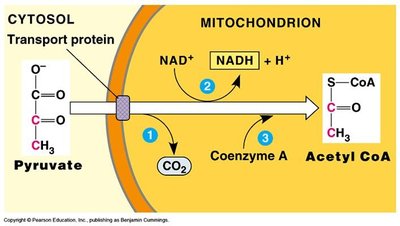
Transport of Pyruvate: Pyruvate is transported from the cytosol into the mitochondrial matrix via a transport protein.
Decarboxylation: One carbon atom is removed from pyruvate as carbon dioxide (CO2), resulting in a two-carbon fragment.
Oxidation: The two-carbon fragment is oxidized, and electrons are transferred to NAD+, forming NADH and H+.
Formation of Acetyl CoA: Coenzyme A (CoA) is attached to the oxidized two-carbon fragment, forming Acetyl CoA, which has high potential energy due to the thioester bond.
Summary Equation
The overall reaction for pyruvate oxidation can be summarized as:
Significance of Acetyl CoA
High Potential Energy: The thioester bond in Acetyl CoA stores significant energy, which is later used in the citric acid cycle.
Central Metabolic Intermediate: Acetyl CoA is a key molecule that links carbohydrate, fat, and protein metabolism.
Example: Cellular Respiration Pathway
After glycolysis, each glucose molecule yields two pyruvate molecules. Each pyruvate undergoes oxidation, producing two Acetyl CoA, two NADH, and two CO2 per glucose molecule.
Additional info: The enzyme complex responsible for pyruvate oxidation is called the pyruvate dehydrogenase complex, which is highly regulated to control the flow of carbon into the citric acid cycle.
