 Back
Regulation of Enzyme Activity and Metabolic Control
Study Guide - Smart Notes
 Tailored notes based on your materials, expanded with key definitions, examples, and context.
Regulation of Enzyme Activity
Overview of Metabolic Regulation
Cells must tightly regulate their metabolic pathways to maintain order and efficiency. This regulation is achieved by controlling when and where enzymes are active, either by switching genes on and off or by modulating enzyme activity after synthesis. The latter is accomplished through mechanisms such as allosteric regulation, feedback inhibition, and enzyme localization.
Allosteric Regulation of Enzymes
Definition and Mechanism
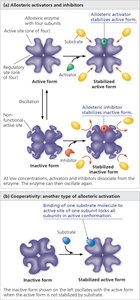
Allosteric regulation refers to the modulation of a protein's function at one site by the binding of a regulatory molecule to a separate site. This can result in either inhibition or stimulation of enzyme activity. Most allosterically regulated enzymes are composed of multiple subunits, each with its own active site. The enzyme complex can oscillate between active and inactive forms, depending on the binding of regulatory molecules.
Allosteric activators stabilize the active form of the enzyme, increasing its catalytic activity.
Allosteric inhibitors stabilize the inactive form, reducing enzyme activity.
Regulatory molecules bind noncovalently to allosteric sites, often at the interface between subunits.
A single activator or inhibitor can affect all subunits due to structural changes transmitted throughout the enzyme complex.
Cooperativity
Cooperativity is a special form of allosteric activation where the binding of a substrate to one active site in a multisubunit enzyme increases the catalytic activity at other active sites. This amplifies the enzyme's response to substrates, making it more efficient.
Binding of one substrate molecule primes the enzyme to act on additional substrate molecules more readily.
Cooperativity is seen in enzymes and other proteins like hemoglobin, which increases its affinity for oxygen as more binding sites are filled.
Feedback Inhibition
Mechanism and Biological Importance
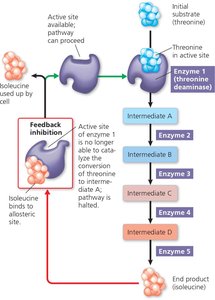
Feedback inhibition is a common mode of metabolic control where the end product of a pathway inhibits an enzyme that acts early in the pathway. This prevents the cell from producing excess product and conserves resources.
End product binds allosterically to the enzyme, halting the pathway.
Example: Synthesis of the amino acid isoleucine from threonine is regulated by feedback inhibition. As isoleucine accumulates, it inhibits the first enzyme in the pathway, stopping further production.
Localization of Enzymes Within the Cell
Compartmentalization and Structural Order
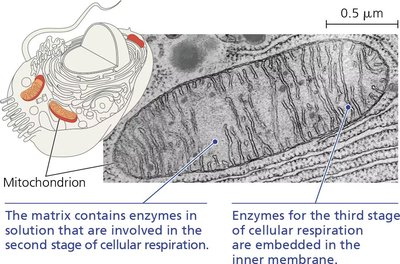
Cells are highly organized, with enzymes and substrates compartmentalized to facilitate metabolic pathways. Enzyme complexes may be assembled together, allowing sequential reactions to occur efficiently. Some enzymes are fixed in specific locations, such as membranes or organelles, creating distinct internal environments for different metabolic processes.
Multienzyme complexes allow for efficient substrate transfer between steps.
Enzymes for cellular respiration are localized within mitochondria, with specific stages occurring in the matrix or embedded in the inner membrane.
Summary Table: Types of Enzyme Regulation
Type | Mechanism | Effect | Example |
|---|---|---|---|
Allosteric Regulation | Regulatory molecule binds to allosteric site | Activation or inhibition | ATP/ADP regulation of catabolic enzymes |
Cooperativity | Substrate binding increases activity at other sites | Amplifies enzyme response | Hemoglobin oxygen binding |
Feedback Inhibition | End product inhibits early enzyme | Halts pathway, conserves resources | Isoleucine synthesis from threonine |
Localization | Enzymes organized in complexes or organelles | Efficient substrate transfer, compartmentalization | Cellular respiration in mitochondria |
Key Terms and Concepts
Allosteric site: A site on an enzyme other than the active site where regulatory molecules bind.
Activator: A molecule that increases enzyme activity by stabilizing the active form.
Inhibitor: A molecule that decreases enzyme activity by stabilizing the inactive form.
Feedback inhibition: Regulation of a pathway by its end product.
Cooperativity: Enhanced enzyme activity due to substrate binding at one site affecting others.
Compartmentalization: Organization of enzymes and substrates within specific cellular structures.
Example Equations
Enzyme kinetics can be described by the Michaelis-Menten equation:
Where: = reaction rate = maximum rate = substrate concentration = Michaelis constant
Concept Check
How do an activator and an inhibitor have different effects on an allosterically regulated enzyme?
Regulation of isoleucine synthesis is an example of feedback inhibition of an anabolic pathway. With that in mind, explain how ATP might be involved in feedback inhibition of a catabolic pathway.
Additional info: ATP acts as an allosteric inhibitor in catabolic pathways, slowing down catabolism when ATP levels are high, while ADP acts as an activator when ATP production lags behind usage.
