 Back
BackRegulation of Eukaryotic Gene Expression: Mechanisms and Stages
Study Guide - Smart Notes
 Tailored notes based on your materials, expanded with key definitions, examples, and context.
Regulation of Eukaryotic Gene Expression
Overview of Gene Expression Regulation
Eukaryotic gene expression is a highly regulated process that occurs at multiple stages, from chromatin modification to protein degradation. This regulation ensures that genes are expressed at the right time, place, and amount, which is essential for cellular function and development.
Chromatin modification: Alters DNA accessibility for transcription.
Transcriptional control: Involves enhancers, activators, and transcription factors.
RNA processing: Includes alternative splicing and mRNA modifications.
Translational control: Regulates mRNA translation and stability.
Protein processing and degradation: Modifies and removes proteins as needed.
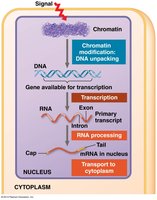
Chromatin Modification
Histone Acetylation and DNA Methylation
Chromatin structure plays a critical role in gene accessibility. Two major modifications are histone acetylation and DNA methylation:
Histone acetylation: Addition of acetyl groups to histone tails loosens chromatin, promoting transcription initiation.
DNA methylation: Addition of methyl groups to DNA bases (usually cytosine) is associated with reduced transcription and can cause long-term gene silencing, such as in genomic imprinting.
Genomic imprinting is a phenomenon where methylation regulates the expression of either maternal or paternal alleles at the start of development.
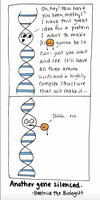
Transcriptional Regulation
Control Elements, Enhancers, and Activators
Transcriptional regulation involves noncoding DNA segments called control elements that serve as binding sites for transcription factors. These elements interact with specific proteins to regulate gene transcription.
Enhancers: Distal control elements that increase transcription rates when bound by activators.
Activators: Proteins that bind to enhancers and promote transcription.
General transcription factors: Required for RNA polymerase II to initiate transcription at the promoter region.
Only when the complete initiation complex is assembled can RNA polymerase II begin transcription.
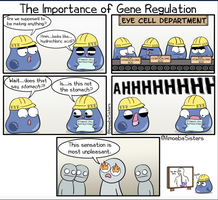
Organization of a Typical Eukaryotic Gene
Eukaryotic genes contain promoters, enhancers, exons, introns, and regulatory sequences. The interaction of these elements determines gene expression patterns.
Promoter: Site where transcription begins.
Enhancer: Upstream or distal regulatory element.
Exons and introns: Coding and noncoding regions, respectively.
Cell-Type Specific Gene Expression
Different cell types express different genes due to the presence of specific activators and control elements. For example, liver cells and lens cells express distinct sets of genes based on available transcription factors.
Cell Type | Available Activators | Expressed Gene |
|---|---|---|
Liver Cell | Albumin activators | Albumin gene |
Lens Cell | Crystallin activators | Crystallin gene |
RNA Processing
Alternative RNA Splicing
Alternative splicing allows a single gene to produce multiple mRNA variants by treating different RNA segments as exons or introns. This increases protein diversity and is common in humans.
More than 90% of human protein-coding genes undergo alternative splicing.
Splicing decisions are regulated by splicing factors and cellular context.
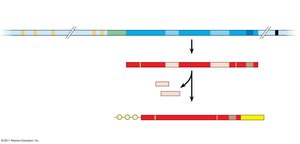
Translational Regulation and mRNA Degradation
Translation Initiation and mRNA Stability
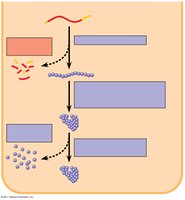
Translation of mRNA can be regulated by proteins that bind to mRNA sequences or structures, blocking ribosome access. The stability and lifespan of mRNA are influenced by sequences in the untranslated regions (UTRs), especially at the 3' end.
Regulatory proteins can block translation initiation.
Translation initiation factors may be activated in response to signals (e.g., fertilization in eggs).
mRNA degradation is controlled by nucleotide sequences in the UTRs.
Protein Processing and Degradation
Proteasomes and Ubiquitin Tagging
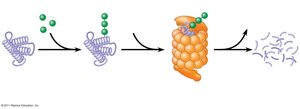
After translation, proteins may undergo chemical modifications or be cleaved to become active. Proteins that are no longer needed are tagged with ubiquitin and degraded by proteasomes, large protein complexes that break down proteins into peptides.
Ubiquitin: Small protein that tags other proteins for degradation.
Proteasome: Degrades ubiquitinated proteins into smaller fragments.
Summary Table: Stages of Eukaryotic Gene Expression Regulation
Stage | Mechanism | Effect |
|---|---|---|
Chromatin Modification | Histone acetylation, DNA methylation | Alters DNA accessibility |
Transcription | Enhancers, activators, transcription factors | Regulates mRNA synthesis |
RNA Processing | Alternative splicing, capping, polyadenylation | Generates mature mRNA |
Translation | Initiation factors, mRNA stability | Controls protein synthesis |
Protein Processing/Degradation | Ubiquitin tagging, proteasome degradation | Modifies or removes proteins |
Additional info:
Gene regulation is essential for cell differentiation and function, as illustrated by the importance of expressing the correct genes in specific cell types.
Errors in gene regulation can lead to diseases, including cancer and developmental disorders.
