 Back
Regulation of Gene Expression and Cell Differentiation
Study Guide - Smart Notes
 Tailored notes based on your materials, expanded with key definitions, examples, and context.
Regulation of Gene Expression
Regulation of Metabolic Pathways
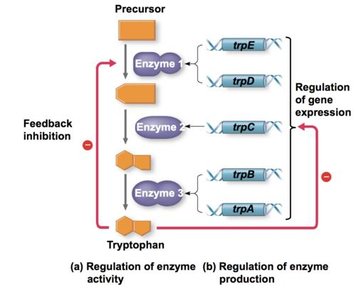
Cells regulate metabolic pathways to adapt to changing environmental and internal conditions. Two primary mechanisms are used: feedback inhibition and regulation of gene expression.
Feedback inhibition: A rapid response mechanism where the end product of a pathway inhibits an enzyme early in the pathway, preventing overproduction.
Regulation of gene expression: A slower, long-term mechanism where cells control the transcription and translation of genes encoding pathway enzymes.
Example: Tryptophan biosynthesis is regulated both by feedback inhibition and by controlling the expression of genes encoding the enzymes.
Operator and Operons in Bacteria
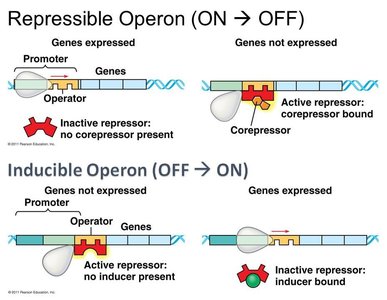
Bacteria often regulate gene expression at the transcriptional level using operons, which are clusters of genes under the control of a single promoter and operator.
Operator: A DNA segment acting as an on/off switch for gene expression.
Operon: Includes the promoter, operator, and structural genes.
Types of gene regulation:
Negative regulation: Expression decreases when a regulatory element (repressor) is present. Example: Tryptophan operon
Positive regulation: Expression increases when a regulatory element (activator) is present. Example: Lac operon
Tryptophan Operon (trp Operon)
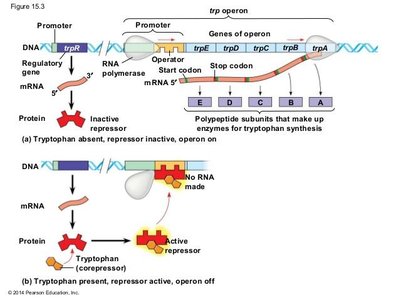
The trp operon is a classic example of a repressible operon, which is turned off in the presence of its end product, tryptophan.
Regulatory gene: Codes for a repressor protein.
Corepressor: Tryptophan acts as a corepressor, binding to the repressor and activating it.
Mechanism:
When tryptophan is absent, the repressor is inactive and the operon is ON, allowing synthesis of tryptophan.
When tryptophan is present, it binds to the repressor, activating it and turning the operon OFF.
Lac Operon
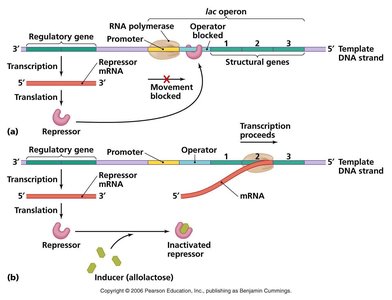
The lac operon is an inducible operon, activated in the presence of lactose and absence of glucose.
Inducer: Lactose (specifically allolactose) binds to the repressor, inactivating it and allowing transcription.
Activator: cAMP receptor protein (CRP) binds to DNA and stimulates transcription when glucose is absent.
Mechanism:
Lactose present and glucose absent: lac operon is ON, allowing production of enzymes for lactose metabolism.
Lactose absent: lac operon is OFF.
Regulation of Eukaryotic Gene Expression
Stages of Regulation
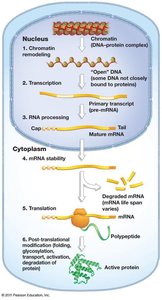
Eukaryotic gene expression is regulated at multiple stages, from chromatin remodeling to post-translational modification.
Chromatin remodeling: Histone modification and DNA methylation affect accessibility of DNA.
Transcriptional regulation: Promoters, repressors, and enhancers control transcription initiation.
RNA processing: RNA splicing removes introns and joins exons.
mRNA degradation: Controls the lifespan and translation of mRNA.
Post-translational modification: Modifies proteins after translation for activity, localization, or stability.
Histone Modification
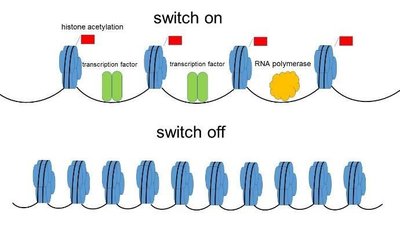
Histone acetylation and deacetylation regulate chromatin structure and gene expression.
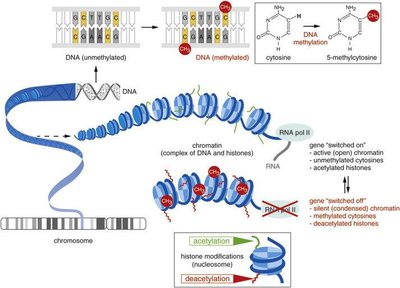
Acetylation: Addition of acetyl groups to histone tails loosens chromatin, allowing transcription.
Deacetylation: Removal of acetyl groups compacts chromatin, repressing transcription.
DNA Methylation
DNA methylation involves the addition of methyl groups to cytosine bases, leading to gene silencing.
More methylation: Turns off genes or entire chromosome segments.
Inheritance: Methylation patterns can be inherited across generations.
Example: X-chromosome inactivation in females.
Epigenetic Inheritance
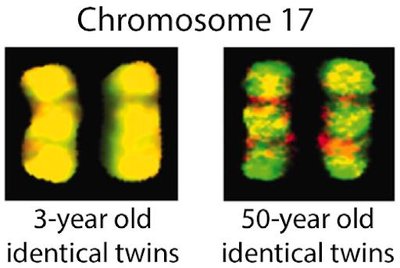
Epigenetic inheritance refers to heritable changes in gene expression that do not involve changes in DNA sequence.
Causes: Environmental factors such as diet, toxins, stress, and disease.
Example: Identical twins can have different epigenetic tags as they age.
Transcript Regulation and mRNA Degradation
Gene expression is further regulated by control elements, RNA splicing, and mRNA degradation.
Control elements: DNA sequences that bind transcription factors and mediator proteins.
RNA splicing: Removes introns and joins exons to produce mature mRNA.
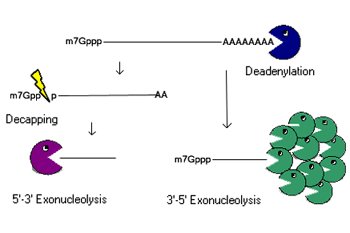
mRNA degradation:
Deadenylation: Removes poly-A tail.
Decapping: Removes 5' cap.
Exonucleolysis: Breaks apart mRNA from ends.
Non-coding RNAs and Gene Expression
Types of RNA
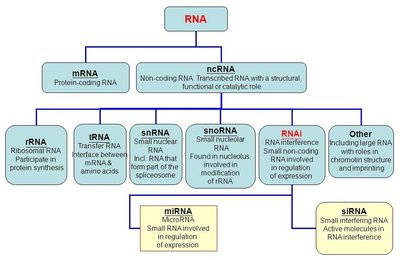
RNA molecules can be classified as coding or non-coding, with non-coding RNAs playing diverse roles in gene regulation.
Coding RNA: mRNA codes for proteins.
Non-coding RNA: Includes microRNAs (miRNA), small interfering RNAs (siRNA), and long non-coding RNAs (lncRNA).
Small RNAs: Can degrade or block mRNA, regulating gene expression post-transcriptionally.
RNA Interference
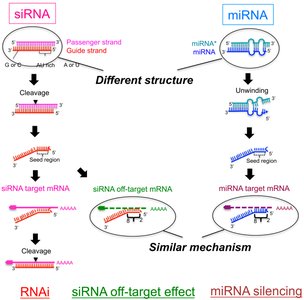
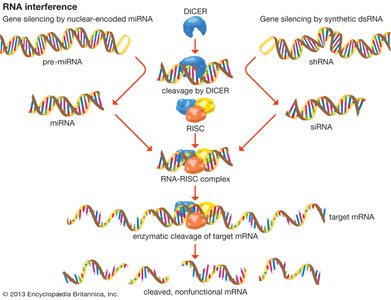
RNA interference (RNAi) is a process where small RNAs (siRNA and miRNA) silence gene expression by degrading mRNA or blocking translation.
siRNA: Small interfering RNA, often used experimentally to knock out genes.
miRNA: MicroRNA, regulates gene expression in normal cellular processes.
Long Non-coding RNAs (lncRNA)
Long non-coding RNAs are involved in various regulatory functions, including X-chromosome inactivation and chromatin modification.
Length: 200–1000+ base pairs.
Functions: Gene activation, suppression, chromatin modification, and scaffolding.
Differential Gene Expression and Cell Differentiation
Embryonic Development and Cell Differentiation
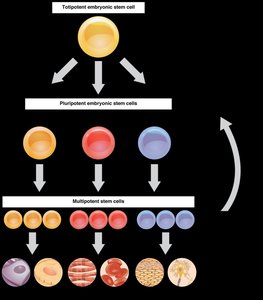
Multicellular organisms develop specialized cell types through differential gene expression during embryonic development.
Zygote: Fertilized egg that undergoes division and specialization.
Stem cells:
Totipotent: Can differentiate into any cell type, including extraembryonic tissues.
Pluripotent: Can differentiate into any embryonic cell type.
Multipotent: Can differentiate into multiple, but limited, cell types.
Specialized cells: Mature cells with specific functions.
Morphogenesis and Pattern Formation
Morphogenesis is the process by which an organism develops its shape and structure. Pattern formation establishes spatial organization of tissues and organs.
Pattern formation: Determines body axes (anterior/posterior, dorsal/ventral, left/right).
Positional information: Molecular cues guide cells to their correct locations.
Hox Genes and Body Organization
Hox genes are highly conserved homeobox genes that control the development of body regions along the head-tail axis.
Function: Turn on specific genes for development of major organ systems.
Mutations: Can cause major anatomical changes.
Evolution: Duplication of Hox gene clusters contributed to animal diversity.
Transposons and Genome Structure
Transposons
Transposons are mobile genetic elements that can move within the genome, potentially affecting gene expression and contributing to genetic diversity.
Types: "Copy/paste" and "cut/paste" mechanisms.
Human genome: 44% consists of transposons; 5–8% are endogenous retroviruses (HERV).
Types of DNA Sequences in the Human Genome
The human genome contains a variety of DNA sequences, including exons, introns, regulatory sequences, and repetitive elements.
Exons: Coding regions.
Introns: Non-coding regions within genes.
Regulatory sequences: Control gene expression.
Transposable elements: Alu and L1 sequences.
Additional info: This guide expands on brief points with academic context, definitions, and examples to ensure completeness and clarity for exam preparation.
