 Back
BackRegulation of Gene Expression in Prokaryotes: The Operon Model
Study Guide - Smart Notes
 Tailored notes based on your materials, expanded with key definitions, examples, and context.
Regulation of Gene Expression
Introduction to Gene Regulation in Bacteria
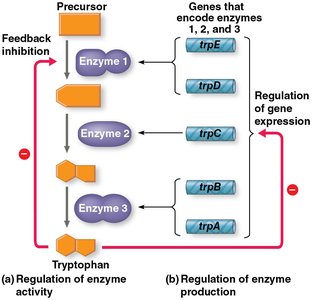
Bacteria must efficiently regulate gene expression to adapt to changing environmental conditions. This regulation ensures that only necessary proteins are synthesized, conserving energy and resources. Two primary mechanisms are used: feedback inhibition and gene regulation at the transcriptional level.
Feedback inhibition: The end product of a metabolic pathway inhibits an enzyme involved earlier in the pathway, preventing overproduction.
Gene regulation: Cells control the transcription of genes encoding enzymes, often using the operon model.
The Operon Model
Basic Structure and Function
An operon is a cluster of functionally related genes regulated together by a single "on-off switch" called the operator. The operon includes the operator, promoter, and the genes they control. Regulation is achieved through proteins called repressors and sometimes corepressors.
Operator: DNA segment acting as the switch, located within or near the promoter.
Repressor: Protein that binds to the operator to block RNA polymerase, preventing transcription. It is encoded by a separate regulatory gene.
Corepressor: Small molecule that activates the repressor, enabling it to bind the operator.
Regulation of the trp Operon
Function and Control of the trp Operon
The trp operon in E. coli contains genes for enzymes involved in tryptophan biosynthesis. Its regulation is a classic example of a repressible operon.
Default state: The operon is usually "on" and the genes are transcribed.
Regulation by tryptophan: When tryptophan is abundant, it acts as a corepressor, activating the trp repressor, which binds the operator and blocks transcription.
Low tryptophan: The repressor is inactive, the operator is unbound, and transcription proceeds.
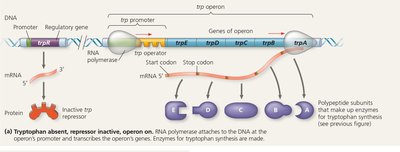
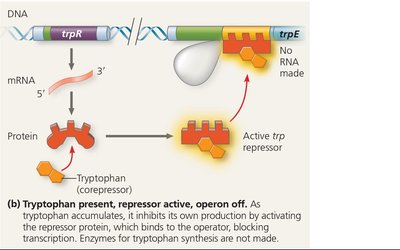
Example: If tryptophan is not present in the environment, E. coli synthesizes it using enzymes encoded by the trp operon. When tryptophan is available, synthesis stops to conserve resources.
Types of Negative Gene Regulation: Repressible vs. Inducible Operons
Repressible Operons
Repressible operons, such as the trp operon, are typically active but can be turned off by a repressor when the end product is abundant.
Example: trp operon (anabolic pathway, synthesizes tryptophan)
Inducible Operons
Inducible operons, such as the lac operon, are usually off but can be turned on by an inducer molecule when the substrate is present.
Example: lac operon (catabolic pathway, breaks down lactose)
The lac Operon
Structure and Regulation
The lac operon contains genes for enzymes that metabolize lactose. Its regulation involves a repressor protein encoded by the lacI gene and an inducer molecule, allolactose.
lac repressor: By default, the repressor is active and binds the operator, blocking transcription.
Inducer (allolactose): When lactose is present, allolactose binds the repressor, inactivating it and allowing transcription.
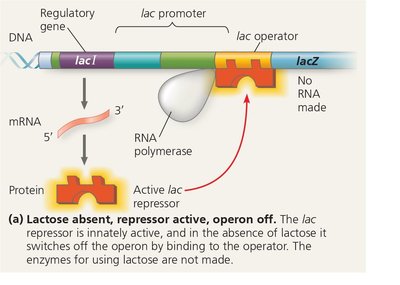
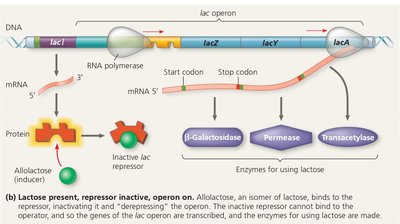
Example: When E. coli encounters lactose, the lac operon is induced, and enzymes for lactose metabolism are produced.
Enzyme Function and Pathways
Inducible enzymes: Typically function in catabolic pathways (e.g., breaking down lactose).
Repressible enzymes: Typically function in anabolic pathways (e.g., synthesizing tryptophan).
Positive Gene Regulation
Role of CRP (CAP) and cAMP in the lac Operon
Some operons are also regulated by positive control, where an activator protein enhances transcription. In the lac operon, the cyclic AMP receptor protein (CRP), also known as catabolite activator protein (CAP), plays this role.
Activation: When glucose is scarce, cAMP levels rise and bind to CRP, activating it.
CRP-cAMP complex: Binds to the promoter, increasing RNA polymerase affinity and boosting transcription of the lac operon.
High glucose: cAMP levels drop, CRP is inactive, and transcription of the lac operon decreases.
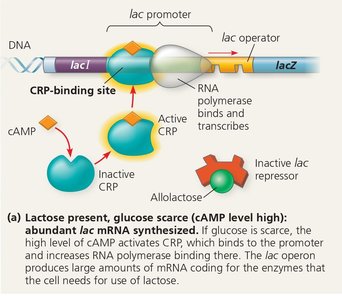
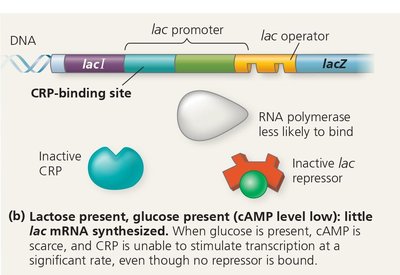
Example: The lac operon is most active when lactose is present and glucose is absent, ensuring efficient use of available sugars.
Summary Table: Comparison of trp and lac Operons
Feature | trp Operon | lac Operon |
|---|---|---|
Type of Regulation | Repressible (usually on) | Inducible (usually off) |
Pathway Type | Anabolic (biosynthesis) | Catabolic (breakdown) |
Regulatory Molecule | Corepressor (tryptophan) | Inducer (allolactose) |
Default State | On | Off |
Effect of End Product | Turns operon off | Turns operon on |
Key Terms and Concepts
Operon: A unit of genetic function found in bacteria and phages, consisting of a promoter, an operator, and a coordinately regulated cluster of genes whose products function in a common pathway.
Repressor: A protein that inhibits gene transcription by binding to the operator and blocking RNA polymerase.
Inducer: A molecule that inactivates the repressor to turn on transcription of an inducible operon.
Corepressor: A small molecule that cooperates with a repressor protein to switch an operon off.
CRP (CAP): A regulatory protein that, when bound to cAMP, stimulates transcription of certain genes.
Sample Equations
Feedback inhibition (generalized): inhibits
Practice Questions
What does the operon model attempt to explain? Answer: The coordinated control of gene expression in bacteria.
When tryptophan is absent in the medium, what is true about the trp operon? Answer: The repressor is inactive, and RNA polymerase can synthesize mRNA.
Which molecule acts as an inducer of the lac operon? Answer: Allolactose.
Under which condition is the lac operon highly active? Answer: Low glucose, high lactose.
