 Back
Regulation of Gene Expression in Prokaryotes: The trp and lac Operons Part 1
Study Guide - Smart Notes
 Tailored notes based on your materials, expanded with key definitions, examples, and context.
Regulation of Gene Expression in Prokaryotes
Overview of Gene Regulation
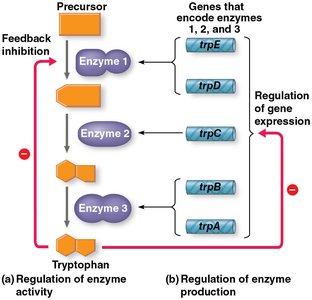
Gene regulation allows prokaryotic cells, such as Escherichia coli, to adapt to environmental changes by controlling the expression of specific genes. This ensures that cellular resources are used efficiently, producing enzymes only when needed. Regulation can occur through feedback inhibition or by controlling gene expression at the transcriptional level.
Feedback inhibition: The end product of a metabolic pathway inhibits an enzyme involved earlier in the pathway, preventing overproduction.
Gene regulation: Cells adjust enzyme production by regulating the transcription of genes encoding those enzymes.
Operons: The Basic Concept
Structure and Function of Operons
An operon is a cluster of functionally related genes regulated together by a single "on-off switch" called the operator. The operon includes the operator, promoter, and the genes they control. The operator is a DNA segment positioned within or near the promoter. A repressor protein, encoded by a regulatory gene, can bind to the operator to block transcription by RNA polymerase. The repressor's activity is modulated by other molecules, such as corepressors or inducers.
Regulation of the trp Operon
Function and Regulation of the trp Operon
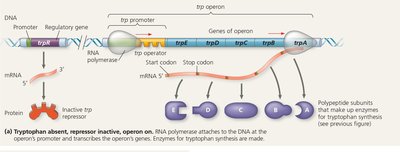
The trp operon in E. coli contains genes required for tryptophan synthesis. Its regulation ensures tryptophan is synthesized only when not available from the environment. The operon is typically "on" but can be repressed when tryptophan is abundant.
Default state: The trp operon is active, and enzymes for tryptophan synthesis are produced.
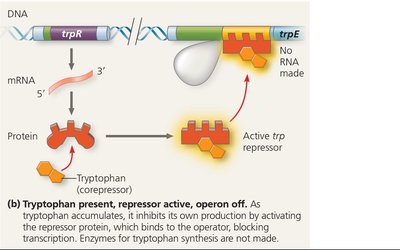
Regulation by tryptophan: When tryptophan is present, it acts as a corepressor, binding to the trp repressor protein and activating it. The active repressor binds to the operator, blocking transcription.
Low tryptophan: The repressor is inactive, and the operon is transcribed.
High tryptophan: The operon is repressed, preventing unnecessary enzyme production.
Types of Negative Gene Regulation: Repressible and Inducible Operons
Repressible vs. Inducible Operons
Operons can be classified based on their regulatory mechanisms:
Repressible operons: Usually "on"; can be turned "off" by a repressor (e.g., trp operon).
Inducible operons: Usually "off"; can be turned "on" by an inducer that inactivates the repressor (e.g., lac operon).
The lac Operon: Inducible Gene Regulation
Function and Regulation of the lac Operon
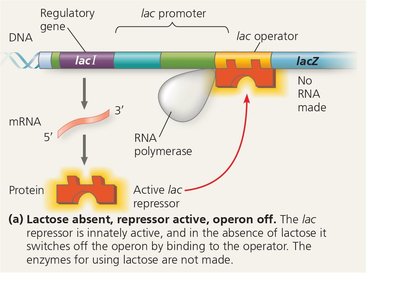
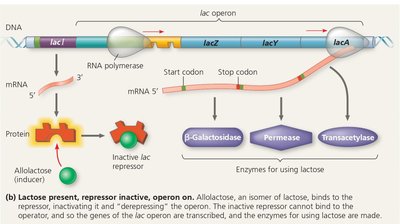
The lac operon contains genes for enzymes that metabolize lactose. Its regulatory gene (lacI) encodes a repressor protein that keeps the operon off unless lactose is present. The operon is induced by allolactose, an isomer of lactose, which inactivates the repressor and allows transcription.
Lactose absent: The lac repressor is active and binds to the operator, blocking transcription.
Lactose present: Allolactose binds to the repressor, inactivating it. The operon is transcribed, and enzymes for lactose metabolism are produced.
Enzyme Function in Pathways
Inducible enzymes: Typically function in catabolic pathways (breaking down molecules); synthesis is induced by a substrate.
Repressible enzymes: Typically function in anabolic pathways (building molecules); synthesis is repressed by the end product.
Positive Gene Regulation: The Role of CRP (CAP)
Positive Control of the lac Operon
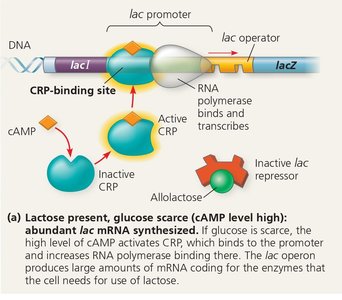
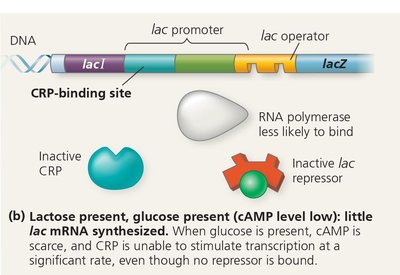
Some operons are also regulated by positive control mechanisms. The cyclic AMP receptor protein (CRP), also known as catabolite activator protein (CAP), acts as an activator of transcription. When glucose is scarce, cAMP levels rise, activating CRP. The CRP–cAMP complex binds to the promoter, increasing RNA polymerase's affinity and enhancing transcription of the lac operon.
Low glucose, high lactose: High cAMP activates CRP, leading to abundant transcription of the lac operon.
High glucose: Low cAMP; CRP is inactive, and transcription of the lac operon is low, even if lactose is present.
Summary Table: Comparison of trp and lac Operons
Feature | trp Operon | lac Operon |
|---|---|---|
Type | Repressible (anabolic) | Inducible (catabolic) |
Default State | On | Off |
Regulatory Molecule | Corepressor (tryptophan) | Inducer (allolactose) |
Regulation Mechanism | Negative control by repressor | Negative and positive control (repressor and CRP) |
Pathway Type | Anabolic (biosynthesis) | Catabolic (breakdown) |
Key Equations and Concepts
Feedback inhibition: End product inhibits an earlier enzyme in the pathway.
Gene regulation: Repressor binding to operator prevents RNA polymerase from transcribing genes.
Positive control:
Practice Questions
What does the operon model attempt to explain? Answer: The coordinated control of gene expression in bacteria.
When tryptophan is absent, what is the state of the trp operon? Answer: The repressor is inactive, and RNA polymerase can synthesize mRNA.
Which molecule acts as an inducer of the lac operon? Answer: Allolactose.
Under which condition is the lac operon transcribed at high levels? Answer: Low glucose, high lactose.
What molecule signals low glucose levels to the lac operon regulatory system? Answer: Cyclic AMP (cAMP).
