 Back
Regulation of Gene Expression in Prokaryotes and Eukaryotes
Study Guide - Smart Notes
 Tailored notes based on your materials, expanded with key definitions, examples, and context.
Regulation of Gene Expression
Gene Regulation in Bacteria
Bacteria respond to environmental changes by regulating transcription, allowing them to adapt quickly to new conditions. The operon model is a central concept in prokaryotic gene regulation.
Operons: Clusters of genes under the control of a single promoter and operator, allowing coordinated expression.
Repressible Operons: Usually active; can be turned off by a repressor. Example: trp operon.
Inducible Operons: Usually inactive; can be turned on by an inducer. Example: lac operon.
lac Operon: Contains genes for lactose metabolism. The repressor (encoded by lacI) is inactivated by allolactose, allowing transcription.
Negative Regulation: Both trp and lac operons are controlled by repressors that inhibit transcription.
Positive Regulation: Activators such as CRP (cAMP receptor protein) enhance transcription when glucose is scarce.
Gene Regulation in Eukaryotes
Eukaryotic gene expression is regulated at multiple stages, from chromatin structure to post-translational modifications. This regulation is essential for cell specialization and response to environmental signals.
Differential Gene Expression: Different cell types express different genes, despite having identical genomes.
Chromatin Structure: Genes in tightly packed heterochromatin are not expressed, while those in loosely packed euchromatin can be transcribed.
Histone Modifications: Acetylation of histone tails opens chromatin, promoting transcription; methylation condenses chromatin, reducing transcription.
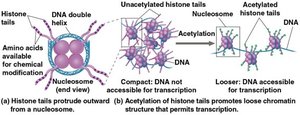
DNA Methylation: Addition of methyl groups to DNA bases reduces transcription and can cause long-term gene inactivation.
Epigenetic Inheritance: Chromatin modifications can be inherited without changes to DNA sequence, explaining differences in disease susceptibility among identical twins.

Transcription Initiation: Controlled by chromatin-modifying enzymes and transcription factors binding to control elements.
General Transcription Factors: Required for transcription of all protein-coding genes; assemble at the promoter with RNA polymerase II.
Specific Transcription Factors: Bind to enhancers or proximal control elements to regulate transcription of particular genes.
Enhancers: Distal control elements that can be far from the gene; activators bind to enhancers to stimulate transcription.
Repressors: Inhibit gene expression by blocking activator binding or altering chromatin structure.
Combinatorial Control: Multiple control elements and transcription factors allow precise regulation of gene expression.
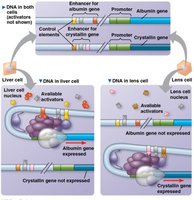
Coordinately Controlled Genes: Eukaryotic genes with similar control elements can be simultaneously expressed, even if located on different chromosomes.
Nuclear Architecture: Chromatin loops congregate at transcription factories, specialized sites for gene expression.
Post-Transcriptional Regulation
Gene expression can be regulated after transcription, allowing rapid adaptation to environmental changes.
Alternative RNA Splicing: Produces different mRNAs from the same transcript, increasing protein diversity.
Translation Initiation: Can be blocked by regulatory proteins or influenced by translation initiation factors.
mRNA Degradation: The lifespan of mRNA affects protein synthesis; sequences in the 3' UTR regulate stability.
Protein Processing and Degradation: Proteins are modified and selectively degraded by proteasomes, often marked by ubiquitin.
Noncoding RNAs and Gene Regulation
Noncoding RNAs (ncRNAs) play crucial roles in gene regulation, challenging the concept of "junk DNA."
MicroRNAs (miRNAs): Bind to mRNA, causing degradation or blocking translation; regulate expression of many genes.
Small Interfering RNAs (siRNAs): Similar to miRNAs; cause RNA interference (RNAi), used experimentally to silence genes.
piwi-interacting RNAs (piRNAs): Induce heterochromatin formation, silencing transposons.
Long Noncoding RNAs (lncRNAs): Can scaffold complexes and regulate gene expression; involved in X chromosome inactivation.
Differential Gene Expression in Development
Embryonic development involves tightly regulated gene expression, leading to cell differentiation and morphogenesis.
Cell Differentiation: Cells become specialized in structure and function through regulated gene expression.
Cytoplasmic Determinants: Maternal substances in the egg influence early development; uneven distribution leads to different cell fates.
Inductive Signals: Signals from nearby cells induce differentiation via signal transduction pathways.
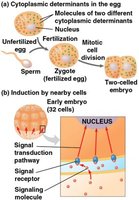
Determination: Irreversible commitment to a cell fate, marked by expression of tissue-specific proteins.
Cancer and Gene Regulation
Cancer arises from genetic changes affecting cell cycle control, often involving the same regulatory systems as development.
Oncogenes: Mutated proto-oncogenes that promote uncontrolled cell growth.
Tumor-Suppressor Genes: Normally inhibit cell division, repair DNA, and control cell adhesion; mutations can lead to cancer.
Mutations: Can be epigenetic, translocations, gene amplifications, or point mutations.
ras and p53 Genes: Commonly mutated in cancers; ras promotes cell division, p53 suppresses the cell cycle and promotes DNA repair or apoptosis.
Multistep Model: Multiple mutations are required for cancer development, increasing with age.
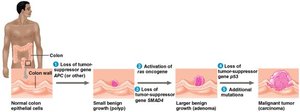
Inherited Predisposition: Mutations in genes like APC, BRCA1, and BRCA2 increase cancer risk.
Viruses: Can cause cancer by interfering with gene regulation.
Additional info: These notes cover key concepts from Chapter 18: Regulation of Gene Expression, relevant to General Biology college courses, including prokaryotic and eukaryotic gene regulation, epigenetics, noncoding RNAs, development, and cancer.
