 Back
Regulation of Gene Expression in Prokaryotes and Eukaryotes
Study Guide - Smart Notes
 Tailored notes based on your materials, expanded with key definitions, examples, and context.
Regulation of Gene Expression
Overview of Gene Expression Regulation
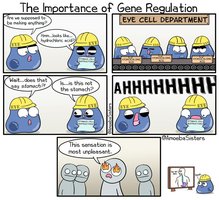
Gene expression regulation is essential for cellular function, development, and health. Organisms must precisely control which genes are expressed in response to environmental and developmental cues. In multicellular eukaryotes, gene expression is responsible for cell differentiation and the diversity of cell types.
Differential gene expression allows cells to respond to environmental changes and developmental signals.
Protein and RNA molecules play key roles in regulating gene expression.
Regulation is crucial for maintaining cellular functionality and organismal health.
Gene Expression in Prokaryotes
Bacterial Gene Transcription and Operons
Bacteria regulate gene expression to conserve resources and adapt to environmental changes. The operon model is a primary mechanism for gene regulation in prokaryotes.
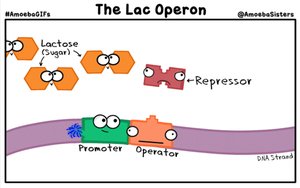
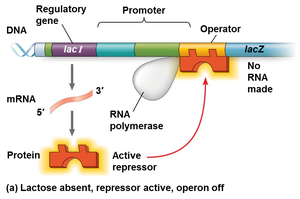
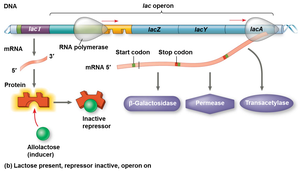
Operon: A cluster of functionally related genes controlled by a single "on-off switch" called an operator.
The repressor protein, produced by a regulatory gene, can bind to the operator to block transcription.
Operons can be regulated by repressors (negative control) or activators (positive control).
Types of Operons: Repressible and Inducible
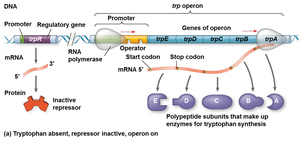
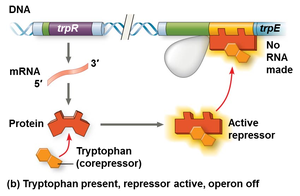
Repressible operon: Usually on; can be turned off by a repressor (e.g., trp operon).
Inducible operon: Usually off; can be turned on by an inducer that inactivates the repressor (e.g., lac operon).
Negative and Positive Control of Operons
Negative control: Operons are switched off by active repressors (e.g., trp and lac operons).
Inducible enzymes: Function in catabolic pathways; synthesis induced by a chemical signal.
Repressible enzymes: Function in anabolic pathways; synthesis repressed by high levels of end product.
Positive control: Protein synthesis is stimulated by an activator (e.g., CAP-cAMP system in the lac operon).
Gene Expression in Eukaryotes
Complexity of Eukaryotic Gene Regulation
Eukaryotic gene regulation is more complex due to larger genomes, multiple chromosomes, and the physical separation of transcription and translation. Regulation occurs at multiple levels, including chromatin structure, transcription, and post-transcriptional modifications.
Regulation is essential for cell specialization and development.
Somatic cells are genetically identical; differences arise from differential gene expression.
Regulation by Chromatin Structure
Chromatin packing: Genes in tightly packed heterochromatin are usually not expressed; unpacked euchromatin is accessible for transcription.
Histone modifications: Acetylation of histone tails loosens chromatin, promoting transcription.
DNA methylation: Addition of methyl groups (often to cytosines) condenses chromatin and reduces transcription; can cause long-term gene inactivation (epigenetic inheritance).
Control Elements and Transcription Factors
Control elements: Noncoding DNA segments that serve as binding sites for transcription factors.
Proximal control elements: Located near the promoter.
Distal control elements (enhancers): Can be far from the gene; activators bind to enhancers to stimulate transcription.
General transcription factors: Required for transcription of all protein-coding genes.
Specific transcription factors: Lead to high levels of transcription of particular genes.
Combinatorial Control and Nuclear Architecture
Combinatorial control: Multiple transcription factors and control elements interact to regulate gene expression precisely.
Nuclear architecture: Chromatin loops may congregate in transcription factories, specialized regions rich in transcription factors and RNA polymerases.
Post-Transcriptional Regulation
Alternative RNA splicing: Different mRNA molecules are produced from the same primary transcript.
mRNA stability: The lifespan of mRNA molecules affects how much protein is produced; influenced by sequences in the 3' untranslated region (UTR).
Translational control: Translation initiation factors can block or activate translation of mRNA.
Protein Processing and Degradation
Post-translational modifications can regulate protein activity.
Proteins marked with ubiquitin are targeted for degradation by proteasomes.
Noncoding RNAs (ncRNAs)
Most of the genome does not code for proteins; many noncoding RNAs regulate gene expression.
MicroRNAs (miRNAs): Small RNAs that bind to mRNA, leading to degradation or blocking translation.
Small interfering RNAs (siRNAs): Similar to miRNAs; can silence genes through RNA interference (RNAi).
Differential Gene Expression and Development
Cell Differentiation and Morphogenesis
Cell differentiation: Process by which cells become specialized; driven by differential gene expression.
Morphogenesis: Physical processes that give an organism its shape.
Cytoplasmic determinants: Maternal substances in the egg that influence early development.
Induction: Signals from neighboring cells influence cell differentiation.
Pattern Formation and Axis Establishment
Pattern formation: Development of spatial organization of tissues and organs.
Maternal effect genes: Encode cytoplasmic determinants that establish body axes (e.g., bicoid gene in Drosophila).
Homeotic genes: Control pattern formation in later stages of development.
Cancer and Gene Regulation
Genetic Changes Leading to Cancer
Oncogenes: Cancer-causing genes derived from proto-oncogenes, which normally regulate cell growth and division.
Proto-oncogenes can become oncogenes through DNA movement, gene amplification, or point mutations.
Tumor-suppressor genes: Normally prevent uncontrolled cell growth; mutations can lead to cancer.
Mutations in genes like ras and p53 are common in human cancers.
The Role of Viruses in Cancer
Some viruses can cause cancer by integrating their DNA into the host genome and disrupting normal gene regulation.
Viral oncogenes can alter tumor suppressor genes and cell cycle checkpoints.
