 Back
Regulation of Gene Expression in Prokaryotes and Eukaryotes
Study Guide - Smart Notes
 Tailored notes based on your materials, expanded with key definitions, examples, and context.
Regulation of Gene Expression
Overview
Gene expression is the process by which information from a gene is used to synthesize functional gene products, such as proteins. Both prokaryotes and eukaryotes regulate gene expression to respond to environmental changes and to ensure proper development and cell specialization. Regulation occurs at multiple levels, including transcription, translation, and post-translational modifications.
Regulation of Gene Expression in Prokaryotes
Transcriptional Regulation in Bacteria
Bacteria often regulate gene expression at the transcriptional level to adapt quickly to environmental changes. This regulation allows cells to conserve energy and resources by producing only the enzymes needed at any given time.
Feedback Inhibition: The end product of a metabolic pathway inhibits the activity of the first enzyme in the pathway, providing a rapid response to changes in product concentration.
Gene Regulation: Cells can adjust enzyme production by regulating the expression of the genes encoding those enzymes, a slower but longer-lasting response.
Example: Regulation of tryptophan synthesis in E. coli involves both feedback inhibition and gene regulation.
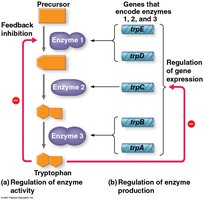
The Operon Model
The operon model is a fundamental mechanism for regulating groups of genes in prokaryotes. An operon is a cluster of functionally related genes controlled by a single "on-off" switch called the operator.
Operator: A DNA segment positioned within or near the promoter that acts as the regulatory switch.
Repressor: A protein that binds to the operator to block transcription. It is encoded by a separate regulatory gene.
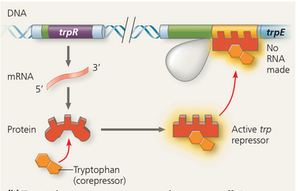
Corepressor: A molecule that activates the repressor, enabling it to shut off the operon.
The trp Operon: Repressible Operon
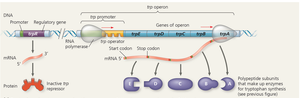
The trp operon in E. coli is a classic example of a repressible operon, which is usually active but can be turned off when the end product (tryptophan) is abundant.
When tryptophan is absent: The repressor is inactive, and the operon is on, allowing transcription of genes for tryptophan synthesis.
When tryptophan is present: Tryptophan acts as a corepressor, activating the repressor and shutting off the operon.
Repressible vs. Inducible Operons
Operons can be classified as repressible or inducible based on their regulatory mechanisms.
Repressible Operon: Usually on; can be turned off by a repressor (e.g., trp operon).
Inducible Operon: Usually off; can be turned on by an inducer that inactivates the repressor (e.g., lac operon).
The lac Operon: Inducible Operon
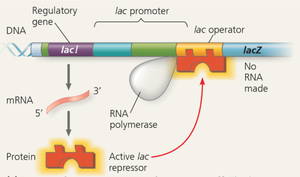
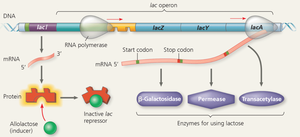
The lac operon in E. coli contains genes for enzymes that metabolize lactose. It is an inducible operon, activated in the presence of lactose.
lacI gene: Encodes the lac repressor, which is active by default and turns the operon off.
Inducer (allolactose): Binds to the repressor, inactivating it and allowing transcription of the lac operon genes.
Enzymes: β-galactosidase (lacZ), permease (lacY), and transacetylase (lacA).
Positive Gene Regulation
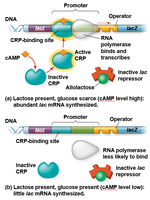
Some operons are also regulated by positive control, which enhances transcription. The lac operon is subject to positive regulation by the cyclic AMP receptor protein (CRP).
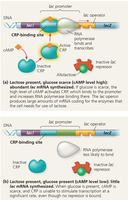
CRP: Activated by binding cyclic AMP (cAMP) when glucose is scarce.
Activated CRP: Binds to the promoter, increasing RNA polymerase affinity and accelerating transcription.
Glucose levels: When glucose is abundant, CRP is inactive, and transcription is reduced.
Summary Table: Comparison of trp and lac Operons
Feature | trp Operon | lac Operon |
|---|---|---|
Type | Repressible | Inducible |
Default State | On | Off |
Regulatory Molecule | Corepressor (tryptophan) | Inducer (allolactose) |
Pathway | Anabolic (synthesis) | Catabolic (breakdown) |
Regulation | Negative (repressor) | Negative (repressor) and positive (CRP) |
Additional info:
These notes cover the core concepts of gene regulation in prokaryotes, including the operon model, feedback inhibition, and the mechanisms of repressible and inducible operons. The lac operon is also subject to positive regulation, which is important for understanding how cells respond to multiple environmental signals. This material is directly relevant to General Biology, specifically Chapter 18: Regulation of Gene Expression.
