 Back
Regulation of Gene Expression: Mechanisms and Implications
Study Guide - Smart Notes
 Tailored notes based on your materials, expanded with key definitions, examples, and context.
Regulation of Gene Expression
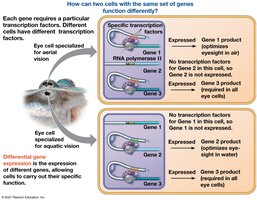
Differential Gene Expression
Differential gene expression is the process by which cells with identical genomes express different sets of genes, resulting in distinct cell types and functions. This regulation is essential for development, cellular specialization, and adaptation to environmental changes.
Key Point 1: Most cells in an organism contain the same DNA, but express different genes depending on their function.
Key Point 2: Abnormal gene expression can lead to diseases, including cancer.
Example: Eye cells specialized for aerial vision versus aquatic vision express different transcription factors to activate specific genes.
Operons: The Basic Concept
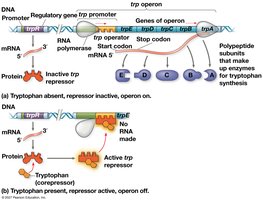
Operons are clusters of functionally related genes in prokaryotes that are coordinately controlled by a single regulatory element called the operator. The operon includes the operator, promoter, and the genes they control.
Key Point 1: The operator acts as an on-off switch for gene expression.
Key Point 2: The operon model allows efficient regulation of multiple genes involved in a common pathway.
Example: The trp operon in E. coli regulates enzymes for tryptophan synthesis.
Repressible and Inducible Operons
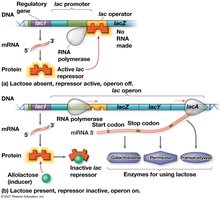
Operons can be classified as repressible or inducible based on their regulatory mechanisms. Repressible operons are usually active but can be turned off by a repressor, while inducible operons are usually inactive and can be turned on by an inducer.
Key Point 1: Repressible operon: Typically on; repressor binding shuts off transcription (e.g., trp operon).
Key Point 2: Inducible operon: Typically off; inducer inactivates repressor and allows transcription (e.g., lac operon).
Example: The lac operon is induced in the presence of lactose.
Positive Control of the lac Operon
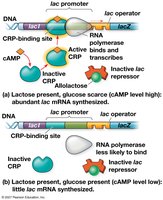
In addition to negative regulation, the lac operon is subject to positive control by the cAMP receptor protein (CRP). When glucose is scarce, cAMP levels rise, activating CRP, which enhances transcription of the lac operon.
Key Point 1: CRP binds to the promoter in the presence of cAMP, increasing transcription.
Key Point 2: When glucose is present, cAMP levels drop, CRP is inactive, and transcription is reduced.
Example: High cAMP and active CRP lead to abundant lac mRNA synthesis.
Stages of Gene Expression Regulation in Eukaryotes
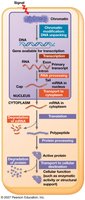
Gene expression in eukaryotic cells is regulated at multiple stages, including chromatin modification, transcription, RNA processing, translation, and protein processing/degradation.
Key Point 1: Regulation can occur before, during, or after transcription and translation.
Key Point 2: Each stage offers opportunities for fine-tuned control of gene activity.
Example: Chromatin modification, transcription initiation, RNA processing, and protein degradation are all regulatory points.
Histone Modifications and DNA Methylation
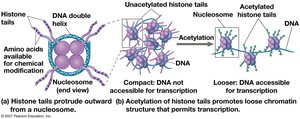
Chromatin structure affects gene accessibility. Histone acetylation loosens chromatin, making DNA accessible for transcription, while DNA methylation generally represses gene expression.
Key Point 1: Acetylation of histone tails promotes transcription by loosening chromatin.
Key Point 2: DNA methylation can cause long-term gene silencing, important in cellular differentiation and genomic imprinting.
Example: Acetylated histone tails allow transcription; methylated DNA is less transcribed.
Epigenetic Inheritance
Epigenetic inheritance refers to the transmission of traits via mechanisms other than changes in the DNA sequence, such as chromatin modifications. These changes can be passed to future generations of cells and may explain differences in disease susceptibility among genetically identical individuals.
Key Point 1: Epigenetic modifications include DNA methylation and histone modification.
Key Point 2: These modifications can affect gene expression without altering the DNA sequence.
Example: Identical twins may differ in disease risk due to epigenetic variation.
Transcription Regulation: Enhancers and Activators
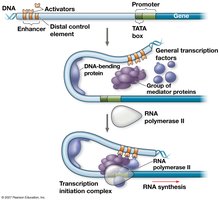
Transcription in eukaryotes is regulated by enhancers, which are DNA elements that bind activator proteins. These proteins interact with the transcription machinery to increase gene expression.
Key Point 1: Enhancers can be located far from the gene they regulate.
Key Point 2: Activators bind to enhancers and facilitate assembly of the transcription initiation complex.
Example: Enhancers and activators increase transcription of specific genes.
Cell Type–Specific Transcription
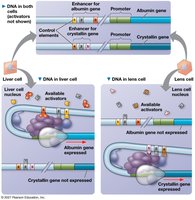
Different cell types express unique sets of genes due to the presence of specific activators and enhancers. This allows for cell specialization and function.
Key Point 1: The combination of control elements and available activators determines gene expression in each cell type.
Key Point 2: Liver and lens cells express different genes based on their unique regulatory elements.
Example: Albumin gene is expressed in liver cells, crystallin gene in lens cells.
Alternative RNA Splicing
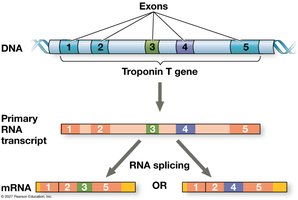
Alternative RNA splicing allows a single gene to produce multiple protein variants by including or excluding different exons during mRNA processing.
Key Point 1: Splicing can generate diverse proteins from one gene.
Key Point 2: This increases the functional complexity of the genome.
Example: The troponin T gene produces different mRNAs via alternative splicing.
Protein Processing and Degradation
After translation, proteins may undergo modifications and are selectively degraded to regulate their activity and lifespan. Ubiquitin tags proteins for degradation by proteasomes.
Key Point 1: Protein processing includes cleavage and chemical modifications.
Key Point 2: Ubiquitin-mediated degradation controls protein levels and function.
Regulation by microRNAs (miRNAs)
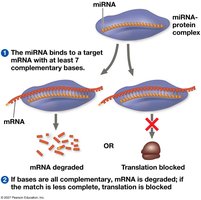
miRNAs are small RNA molecules that regulate gene expression by binding to complementary mRNA sequences, leading to mRNA degradation or inhibition of translation.
Key Point 1: miRNAs can block translation or cause mRNA degradation.
Key Point 2: They play a crucial role in post-transcriptional regulation.
Example: miRNA binding to mRNA can result in gene silencing.
Genetic Program for Embryonic Development
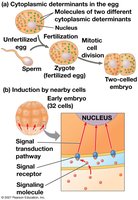
Embryonic development involves cell division, differentiation, and morphogenesis. Cell differentiation is the process by which cells become specialized, while morphogenesis shapes the organism.
Key Point 1: Developmental information comes from cytoplasmic determinants and cell signaling.
Key Point 2: Signal transduction pathways guide cell fate and differentiation.
Example: Early embryo development is influenced by cytoplasmic determinants and induction.
Determination and Differentiation of Muscle Cells
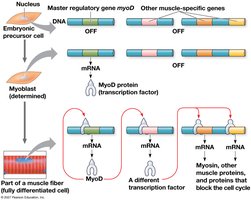
Muscle cell differentiation is regulated by master regulatory genes and transcription factors. Determination precedes differentiation, setting the cell's fate before it becomes fully specialized.
Key Point 1: The myoD gene is a master regulator for muscle cell differentiation.
Key Point 2: Transcription factors activate muscle-specific genes, leading to formation of muscle fibers.
Example: Myoblasts differentiate into muscle fibers through gene regulation.
Types of Genes Associated with Cancer
Cancer arises from mutations that disrupt normal cell growth and division. Oncogenes and tumor-suppressor genes are key players in cancer development.
Key Point 1: Oncogenes: Mutated proto-oncogenes that promote excessive cell division.
Key Point 2: Tumor-suppressor genes: Normally inhibit cell division; mutations can lead to cancer.
Example: Tumor-suppressor proteins repair DNA, control cell adhesion, and inhibit the cell cycle.
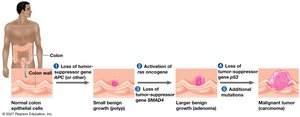
Multistep Model for Colorectal Cancer Development
Colorectal cancer develops through a series of genetic changes, including loss of tumor-suppressor genes, activation of oncogenes, and additional mutations.
Key Point 1: Cancer progression involves multiple steps and mutations.
Key Point 2: Loss of tumor-suppressor genes and activation of oncogenes are critical events.
Example: Colorectal cancer develops from normal cells to malignant carcinoma through sequential genetic changes.
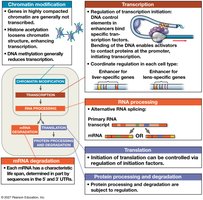
Summary of Eukaryotic Gene Expression Regulation
Gene expression in eukaryotes is regulated at many stages, including chromatin modification, transcription, RNA processing, translation, and protein degradation. Each stage provides opportunities for precise control of gene activity.
Key Point 1: Chromatin modification, transcription initiation, RNA processing, and translation are all regulatory points.
Key Point 2: mRNA degradation and protein processing further refine gene expression.
Example: Summary diagram of gene expression regulation stages.
----------------------------------------
