 Back
Regulation of Gene Expression: Mechanisms and Concepts
Study Guide - Smart Notes
 Tailored notes based on your materials, expanded with key definitions, examples, and context.
Regulation of Gene Expression
Overview
The regulation of gene expression is a fundamental process that allows cells to control which genes are active at any given time. Although all somatic cells in an organism contain the same genetic material, differences in gene expression result in the diversity of cell types and functions. This chapter explores the mechanisms by which prokaryotic and eukaryotic cells regulate gene expression, including transcriptional, post-transcriptional, and epigenetic controls.
Differential Gene Expression
Cell Type-Specific Expression
Different cell types express distinct sets of genes, despite having identical genomes. This selective expression is known as differential gene expression and is crucial for cell specialization and function.
Housekeeping genes are expressed in all cell types to maintain basic cellular functions.
Specialized genes, such as those for hemoglobin in red blood cells, myosin in muscle cells, and insulin in pancreatic cells, are expressed only in their respective cell types.
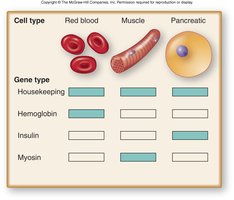
Example: Red blood cells express hemoglobin genes, muscle cells express myosin genes, and pancreatic cells express insulin genes.
Mechanisms of Gene Regulation
Control of Gene Expression in Prokaryotes and Eukaryotes
Gene expression is regulated in response to environmental changes and cellular needs. Prokaryotic cells often use operons to coordinate the expression of genes involved in the same pathway, while eukaryotic cells employ complex regulatory mechanisms at multiple stages.
Regulatory proteins (activators and repressors) bind to DNA to modulate transcription.
Prokaryotic regulation involves operons, such as the lac and trp operons.
Eukaryotic regulation includes chromatin structure modification, transcription factors, and post-transcriptional regulation.
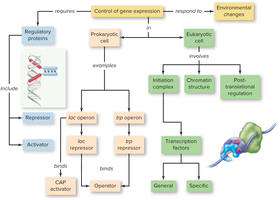
Concept: How Can Two Cells with the Same Genes Function Differently?
Role of Transcription Factors
Each gene requires specific transcription factors for expression. The presence or absence of these factors determines which genes are active in a cell, leading to cell specialization.
Specific transcription factors activate or repress gene expression.
Cells with different transcription factors express different sets of genes, resulting in distinct functions.
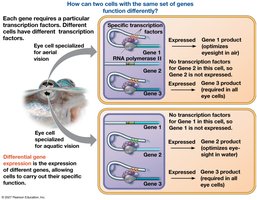
Example: Eye cells specialized for aerial vision express genes for optimal eyesight, while aquatic vision cells express different genes.
Regulation in Prokaryotes: Operon Model
Feedback Inhibition and Gene Regulation
Bacteria regulate enzyme production through feedback inhibition and gene regulation. The operon model allows coordinated expression of genes involved in the same metabolic pathway.
Feedback inhibition: The end product inhibits enzyme activity, preventing overproduction.
Gene regulation: Genes encoding pathway enzymes are regulated at the transcriptional level.
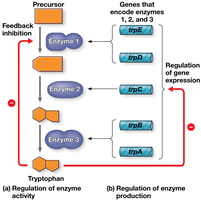
Example: The trp operon in E. coli is repressed when tryptophan levels are high, reducing enzyme production.
Operon Structure and Function
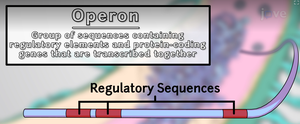
An operon is a group of genes regulated together, containing regulatory sequences and protein-coding genes transcribed as a unit.
Regulatory sequences include promoters and operators.
Operons allow efficient regulation of gene clusters.
The lac Operon
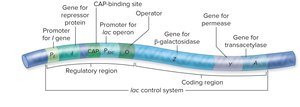
The lac operon in E. coli controls the metabolism of lactose. It includes genes for enzymes such as β-galactosidase, permease, and transacetylase, regulated by promoters, operators, and CAP-binding sites.
Inducer (allolactose): Binds to the repressor, allowing transcription of lac genes.
CAP activator: Enhances transcription when glucose is low.
Regulation in Eukaryotes
Stages of Gene Expression Regulation
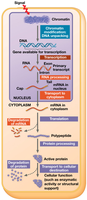
Eukaryotic gene expression is regulated at multiple stages, including chromatin modification, transcription, RNA processing, translation, and protein degradation.
Chromatin structure: Determines accessibility of DNA for transcription.
Transcription initiation: Controlled by transcription factors and regulatory elements.
Post-transcriptional regulation: Includes RNA processing, alternative splicing, and mRNA stability.
Protein processing and degradation: Modifies protein activity and lifespan.
Protein Degradation
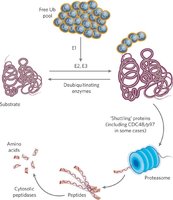
Proteins are selectively degraded to regulate their function and maintain cellular homeostasis. Proteins marked with ubiquitin are recognized and degraded by proteasomes.
Ubiquitin: Small protein that tags proteins for degradation.
Proteasome: Large protein complex that breaks down tagged proteins into peptides.
Regulation of Chromatin Structure
Chromatin Organization
Chromatin structure influences gene expression. Genes in tightly packed heterochromatin are usually not expressed, while those in loosely packed euchromatin are accessible for transcription.
Nucleosome positioning: Affects promoter accessibility.
DNA attachment sites: Influence chromatin structure and gene expression.
Histone Modifications and DNA Methylation
Chemical modifications of histones and DNA regulate chromatin structure and gene expression.
Histone acetylation: Addition of acetyl groups opens chromatin, promoting transcription.
DNA methylation: Addition of methyl groups condenses chromatin, reducing transcription.
Genomic imprinting: Methylation regulates expression of maternal or paternal alleles.
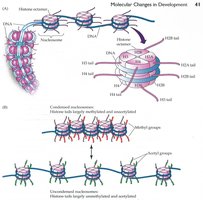
Epigenetic Inheritance
Definition and Significance
Epigenetic inheritance refers to the transmission of traits by mechanisms not directly involving the DNA sequence, such as chromatin modifications. These changes can be passed to future generations of cells and may explain differences in disease susceptibility among identical twins.
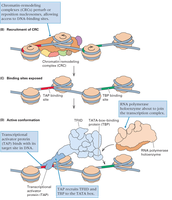
Regulation of Transcription Initiation
Transcription Factors and Control Elements
Transcription initiation is regulated by chromatin-modifying enzymes and transcription factors. Control elements in DNA serve as binding sites for these factors, enabling precise regulation of gene expression.
General transcription factors: Required for transcription of all protein-coding genes.
Specific transcription factors: Regulate expression of particular genes.
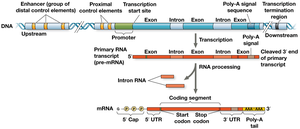
Organization of a Typical Eukaryotic Gene
Eukaryotic genes contain multiple control elements, including promoters, enhancers, and introns. These elements interact with transcription factors to regulate gene expression.
Promoter: Site where RNA polymerase binds to initiate transcription.
Enhancer: Distal control element that increases transcription.
Introns and exons: Noncoding and coding regions, respectively, processed during RNA maturation.
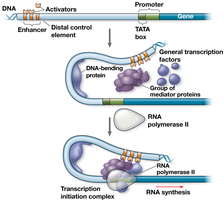
Enhancers, Activators, and Repressors
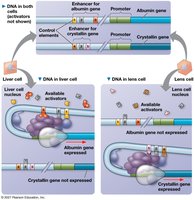
Enhancers are DNA elements that bind activators to stimulate transcription. Repressors inhibit gene expression by blocking activator binding or altering chromatin structure.
Activators: Proteins that bind enhancers and promote transcription.
Repressors: Proteins that inhibit transcription by various mechanisms.
Combinatorial Control and Cell Type-Specific Transcription
The combination of control elements and transcription factors determines which genes are expressed in each cell type. This allows for precise regulation and specialization.
Post-Transcriptional Regulation
RNA Processing and Alternative Splicing
After transcription, pre-mRNA undergoes processing, including capping, polyadenylation, and splicing. Alternative RNA splicing allows a single gene to produce multiple mRNA variants, increasing protein diversity.
Exons: Coding segments retained in mature mRNA.
Introns: Noncoding segments removed during splicing.
More than 90% of human protein-coding genes undergo alternative splicing.
Example: The troponin T gene produces different protein isoforms through alternative splicing.
Protein Processing and Degradation
Proteins are modified after translation and selectively degraded to regulate their activity and lifespan. Ubiquitin tagging and proteasome degradation are key mechanisms.
Summary Table: Prokaryotic vs. Eukaryotic Gene Regulation
Feature | Prokaryotes | Eukaryotes |
|---|---|---|
Regulatory Mechanism | Operons, feedback inhibition | Chromatin modification, transcription factors, post-transcriptional regulation |
Gene Organization | Clusters (operons) | Individual genes with control elements |
Transcription Regulation | Promoters, operators, activators, repressors | Promoters, enhancers, activators, repressors |
Post-Transcriptional Regulation | Rare | Common (splicing, mRNA stability, protein processing) |
Additional info: This table summarizes the main differences between prokaryotic and eukaryotic gene regulation mechanisms.
