 Back
Regulation of Gene Expression: Mechanisms and Concepts
Study Guide - Smart Notes
 Tailored notes based on your materials, expanded with key definitions, examples, and context.
Regulation of Gene Expression
Overview
Gene expression regulation is fundamental to cellular function and differentiation. Although all somatic cells in an organism share the same genetic content, the selective expression of genes determines cell type and function. Regulation occurs at multiple levels, from transcription to post-translational modifications.
Concepts in Gene Expression Regulation
Differential Gene Expression
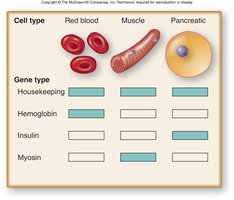
Differential gene expression refers to the phenomenon where cells with identical genomes express different sets of genes, resulting in distinct cell types and functions. This process is essential for cell specialization and organismal development.
Key Point: Most cells contain the same DNA, but express different genes.
Example: Red blood cells express hemoglobin genes, muscle cells express myosin genes, and pancreatic cells express insulin genes.
Control of Gene Expression
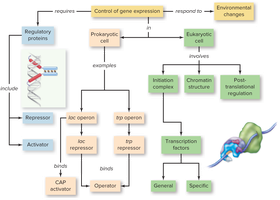
Gene expression is regulated in response to environmental changes and internal signals. Both prokaryotic and eukaryotic cells utilize regulatory proteins to modulate transcription and other stages of gene expression.
Regulatory Proteins: Include repressors and activators that bind to DNA and influence RNA polymerase activity.
Prokaryotic Regulation: Often involves operons, which are clusters of genes regulated together.
Eukaryotic Regulation: Involves chromatin structure, transcription factors, and post-transcriptional mechanisms.
Prokaryotic Gene Regulation
Operon Model
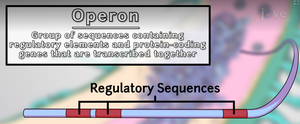
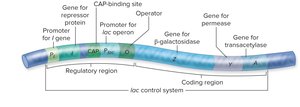
Operons are groups of genes regulated together by a single promoter and operator. This model allows bacteria to efficiently respond to environmental changes by turning on or off entire pathways.
Induction: Genes are activated in response to a substrate.
Repression: Genes are turned off when their products are not needed.
Adaptive Advantage: Grouping genes into operons enables coordinated regulation and resource efficiency.
trp and lac Operons
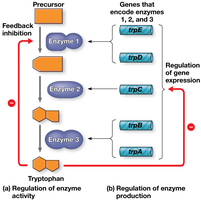
The trp operon is repressible and controls tryptophan synthesis, while the lac operon is inducible and regulates lactose metabolism. Both operons use regulatory proteins to modulate gene expression in response to environmental signals.
trp Operon: Repressed when tryptophan is abundant.
lac Operon: Induced in the presence of lactose; allolactose acts as the inducer.
Feedback Inhibition: End products inhibit enzyme activity or gene expression.
Eukaryotic Gene Regulation
Stages of Regulation
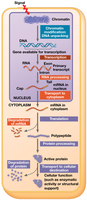
Eukaryotic gene expression is regulated at multiple stages, including chromatin modification, transcription, RNA processing, translation, and protein degradation.
Chromatin Structure: Determines accessibility of DNA for transcription.
Transcription Initiation: Controlled by transcription factors and regulatory elements.
Post-Transcriptional Regulation: Includes RNA processing, alternative splicing, and mRNA stability.
Protein Processing and Degradation: Proteins are modified and selectively degraded to regulate their activity.
Chromatin Structure and Modification
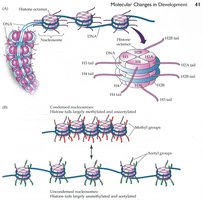
Chromatin can exist as tightly packed heterochromatin (inactive) or loosely packed euchromatin (active). Chemical modifications such as histone acetylation and DNA methylation influence chromatin structure and gene expression.
Histone Acetylation: Opens chromatin, promoting transcription.
DNA Methylation: Condenses chromatin, reducing transcription.
Epigenetic Inheritance: Chromatin modifications can be inherited without altering DNA sequence.
Transcription Initiation and Control Elements
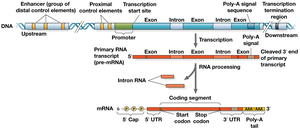
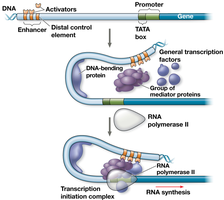
Transcription initiation is regulated by the assembly of transcription factors at the promoter. Control elements such as enhancers and promoters bind activators and repressors to modulate gene expression.
General Transcription Factors: Required for all protein-coding genes.
Specific Transcription Factors: Bind to enhancers or promoters to regulate specific genes.
Promoters: DNA sequences where RNA polymerase binds to initiate transcription.
Enhancers: Distal control elements that increase transcription efficiency.
Activators and Repressors: Proteins that stimulate or inhibit transcription.
Alternative RNA Splicing
Alternative RNA splicing allows a single gene to produce multiple protein variants by including or excluding different exons during mRNA processing. This mechanism greatly expands the diversity of proteins encoded by the genome.
Key Point: More than 90% of human protein-coding genes undergo alternative splicing.
Example: The troponin T gene produces different isoforms in muscle cells.
Protein Processing and Degradation
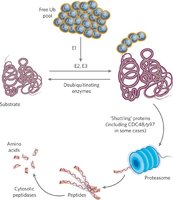
After translation, proteins undergo modifications and are selectively degraded. Ubiquitin tags proteins for destruction by proteasomes, regulating protein levels and activity within the cell.
Ubiquitin: Small protein that marks other proteins for degradation.
Proteasome: Cellular machinery that degrades tagged proteins.
Summary Table: Gene Expression Regulation in Different Cell Types
Cell Type | Housekeeping Genes | Hemoglobin Genes | Insulin Genes | Myosin Genes |
|---|---|---|---|---|
Red Blood Cell | Expressed | Expressed | Not Expressed | Not Expressed |
Muscle Cell | Expressed | Not Expressed | Not Expressed | Expressed |
Pancreatic Cell | Expressed | Not Expressed | Expressed | Not Expressed |
Additional info: Housekeeping genes are expressed in all cell types to maintain basic cellular functions, while specialized genes are expressed only in specific cell types.
Key Equations and Concepts
Feedback Inhibition:
Gene Regulation:
