 Back
Regulation of Gene Expression: Mechanisms and Control in Prokaryotes and Eukaryotes
Study Guide - Smart Notes
 Tailored notes based on your materials, expanded with key definitions, examples, and context.
Regulation of Gene Expression
Overview
Gene expression is the process by which information from a gene is used to synthesize functional gene products, such as proteins. Regulation of gene expression allows cells to respond to environmental changes and maintain homeostasis. In both prokaryotes and eukaryotes, gene expression is controlled at multiple levels, from transcription to post-translational modifications.

Bacterial Gene Regulation
Operon Model
Bacteria often regulate gene expression at the transcriptional level using operons. An operon is a cluster of functionally related genes controlled by a single promoter and operator. The operator acts as an "on-off" switch, regulated by repressor proteins and corepressors.
Operator: DNA segment that controls access of RNA polymerase to the genes.
Promoter: DNA sequence where RNA polymerase binds to initiate transcription.
Repressor: Protein that binds to the operator to block transcription.
Corepressor: Molecule that activates the repressor to shut off the operon.
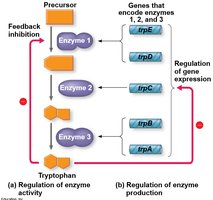
Repressible and Inducible Operons
Operons can be classified as repressible or inducible, based on their regulatory mechanisms:
Repressible operon: Usually active; can be turned off by a repressor (e.g., trp operon).
Inducible operon: Usually inactive; can be turned on by an inducer (e.g., lac operon).
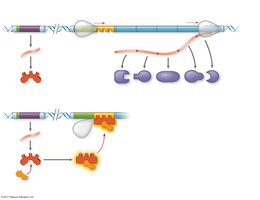
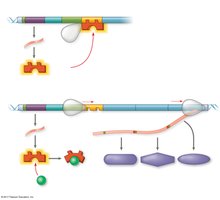
Negative and Positive Gene Regulation
Negative regulation involves repressors that turn operons off, while positive regulation involves activators that enhance transcription. For example, the lac operon is positively regulated by the cAMP-CRP complex when glucose is scarce.
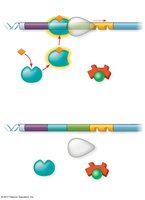
Eukaryotic Gene Regulation
Multiple Levels of Regulation
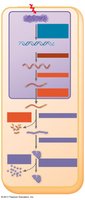
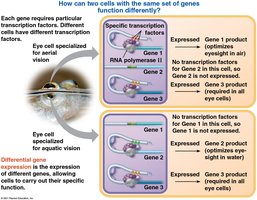
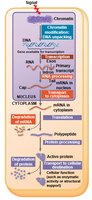
Eukaryotic gene expression is regulated at many stages, including chromatin modification, transcription, RNA processing, translation, and protein processing. Differential gene expression allows cells with the same genome to perform specialized functions.
Regulation of Chromatin Structure
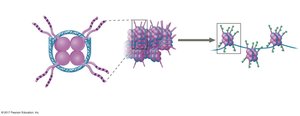
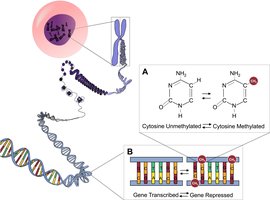
The structural organization of chromatin affects gene expression. Genes in tightly packed heterochromatin are generally not expressed. Chemical modifications, such as histone acetylation and DNA methylation, influence chromatin structure and gene activity.
Histone acetylation: Addition of acetyl groups to histone tails loosens chromatin, promoting transcription.
DNA methylation: Addition of methyl groups to DNA reduces transcription and can lead to epigenetic inheritance.
Organization of a Typical Eukaryotic Gene
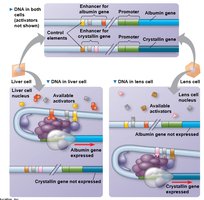
Eukaryotic genes contain multiple control elements, including promoters, enhancers, exons, and introns. These elements serve as binding sites for transcription factors that regulate gene expression.

Transcription Factors and Enhancers
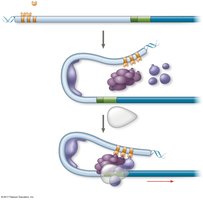
Transcription factors are proteins that bind to specific DNA sequences to regulate transcription. General transcription factors are required for all protein-coding genes, while specific transcription factors bind to enhancers or proximal control elements to activate or repress transcription.
Post-Transcriptional Regulation
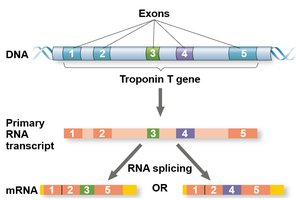
Gene expression can be regulated after transcription through mechanisms such as alternative RNA splicing, mRNA degradation, and translation initiation.
Alternative RNA splicing: Different mRNA molecules are produced from the same primary transcript, allowing for protein diversity.
mRNA degradation: The life span of mRNA affects protein synthesis; sequences in the 5' and 3' UTRs influence stability.
Translation initiation: Regulatory proteins can block or enhance translation of specific mRNAs.
Protein Processing and Degradation
After translation, proteins undergo processing and chemical modifications. Selective degradation of proteins is regulated by ubiquitin tagging and proteasome activity, controlling protein function and turnover.
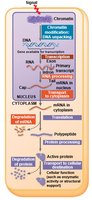
Summary Table: Levels of Gene Regulation in Eukaryotes
Level | Mechanism | Effect |
|---|---|---|
Chromatin Modification | Histone acetylation, DNA methylation | Alters DNA accessibility |
Transcription | Transcription factors, enhancers | Initiates or represses mRNA synthesis |
RNA Processing | Alternative splicing | Generates diverse mRNAs |
Translation | Regulation of initiation factors | Controls protein synthesis |
Protein Processing | Cleavage, modification, degradation | Activates or degrades proteins |
Key Terms and Concepts
Operon: Cluster of genes under control of a single promoter and operator.
Repressor: Protein that inhibits gene transcription.
Inducer: Molecule that inactivates a repressor to allow transcription.
Enhancer: DNA sequence that increases transcription when bound by activators.
Epigenetic inheritance: Transmission of gene expression patterns without altering DNA sequence.
Alternative splicing: Process by which different mRNAs are produced from the same gene.
Ubiquitin: Protein that tags other proteins for degradation.
Equations and Formulas
Gene regulation often involves feedback mechanisms. For example, feedback inhibition can be represented as:
Transcriptional regulation can be modeled as:
Examples and Applications
trp operon: Repressible operon controlling tryptophan synthesis in bacteria.
lac operon: Inducible operon regulating lactose metabolism in bacteria.
Alternative splicing: Allows a single gene to code for multiple proteins, increasing cellular complexity.
Additional info:
Epigenetic modifications such as DNA methylation and histone acetylation can be inherited through cell divisions, affecting gene expression without changing the DNA sequence.
Combinatorial control of gene activation enables complex regulation with a limited number of control elements.
