 Back
Regulation of Gene Expression: Prokaryotic and Eukaryotic Mechanisms CH. 13
Study Guide - Smart Notes
 Tailored notes based on your materials, expanded with key definitions, examples, and context.
Regulation of Gene Expression
Overview
Gene expression regulation is essential for cellular function, adaptation, and development. Both prokaryotic and eukaryotic cells employ complex mechanisms to control when and how genes are transcribed and translated into proteins.
Prokaryotic Regulation
Operon Model
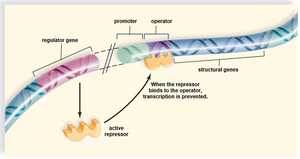
The operon model, proposed by François Jacob and Jacques Monod, explains gene regulation in prokaryotes such as bacteria. An operon is a cluster of structural and regulatory genes functioning as a single unit.
Regulatory Gene: Codes for a repressor protein that controls operon activity. Usually located outside the operon.
Promoter: DNA sequence where RNA polymerase binds to initiate transcription.
Operator: DNA sequence where the active repressor binds, blocking transcription.
Structural Genes: Code for enzymes of a metabolic pathway; transcribed together.
The trp Operon
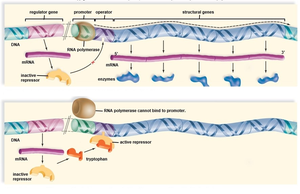
The trp operon regulates the synthesis of tryptophan.
When tryptophan is absent: The repressor is inactive and cannot bind to the operator. RNA polymerase binds to the promoter, and enzymes for tryptophan synthesis are produced.
When tryptophan is present: Tryptophan acts as a corepressor, activating the repressor. The repressor binds to the operator, blocking transcription of tryptophan-synthesizing enzymes.
The lac Operon
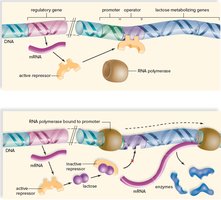
The lac operon controls the breakdown of lactose in bacteria.
When lactose is absent: The repressor binds to the operator, preventing transcription. The operon is "off."
When lactose is present: Lactose binds to the repressor, inactivating it. RNA polymerase binds to the promoter, and enzymes for lactose catabolism are produced.
Further Control of the lac Operon
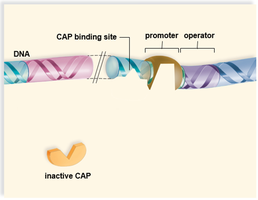
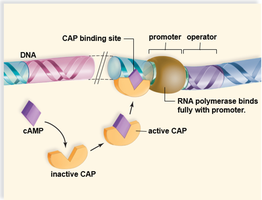
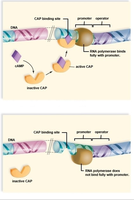
Glucose presence: E. coli prefers glucose. When glucose is present, cAMP levels are low, and CAP (catabolite activator protein) is inactive. The lac operon is not maximally expressed.
Glucose absence: cAMP accumulates and binds to CAP, activating it. Active CAP binds near the lac promoter, enhancing RNA polymerase binding and increasing expression of lac operon genes.
Eukaryotic Regulation
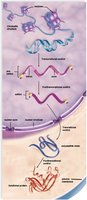
Levels of Gene Expression Control
Eukaryotic cells regulate gene expression at multiple levels:
Chromatin Structure: DNA packaging affects accessibility for transcription.
Transcriptional Control: Regulation of transcription initiation.
Posttranscriptional Control: Processing and transport of mRNA.
Translational Control: Regulation of mRNA translation into protein.
Posttranslational Control: Regulation of protein activity and degradation.
Chromatin Structure
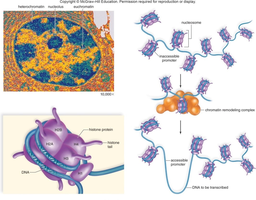
Histone Proteins: DNA is wrapped around histones, forming nucleosomes (beads on a string).
Euchromatin: Loosely packed, transcriptionally active.
Heterochromatin: Tightly packed, transcriptionally inactive.
Barr Body: In female mammals, one X chromosome is inactivated and forms a Barr body.
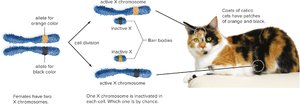
Epigenetic Inheritance
Histone modifications can lead to inheritance patterns not based on DNA sequence changes.
Epigenetic inheritance may influence growth, aging, and cancer.
Transcriptional Control
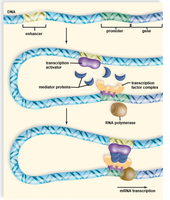
Transcription Factors: Proteins that assist RNA polymerase binding to the promoter.
Transcriptional Activators: Bind to enhancer DNA, increasing transcription.
Transcription factors must often be activated before binding DNA.
Posttranscriptional Control
Operates on the primary mRNA transcript.
Excision of introns and splicing of exons can vary, producing different mature mRNAs.
Controls speed of mRNA transport from nucleus to cytoplasm.
Example: Alternative splicing produces different hormone versions in thyroid and hypothalamus.
Small RNA (sRNA) Molecules
Noncoding DNA forms sRNA molecules involved in gene regulation.
miRNAs: Regulate translation by destroying mRNAs.
siRNAs: Form silencing complexes targeting specific mRNAs for breakdown (RNA interference).
Translational Control
Determines how efficiently mRNA is translated into protein.
Features such as the 5′ cap and poly-A tail length affect translation and mRNA stability.
Posttranslational Control
Affects protein activity after translation.
Regulates activation and degradation rate of proteins.
Proteases: Enzymes that break down proteins, confined to proteasomes or lysosomes.
Gene Mutations
Definition and Types
A gene mutation is a permanent change in the DNA base sequence.
Effects range from no impact to complete protein inactivation.
Germ-line mutations: Occur in sex cells.
Somatic mutations: Occur in body cells.
Causes of Mutations
Spontaneous mutations: Result from chemical changes or transposon movement.
Replication errors: DNA polymerase proofreads, but some errors persist.
Induced mutations: Caused by mutagens (radiation, chemicals), many of which are carcinogens.
Environmental mutagens: Include food and tobacco smoke.
Effect of Mutations on Protein Activity
Point mutations: Change a single nucleotide, altering one codon.
Frameshift mutations: Insert or delete nucleotides, disrupting the reading frame and rendering proteins nonfunctional.
Mutations Can Cause Cancer
Cancer develops through accumulating mutations.
Proto-oncogenes: Stimulate cell division; mutated forms (oncogenes) are always active.
Tumor suppressor genes: Inhibit cell division; mutations lead to uncontrolled cell cycle and tumor formation.
Summary Table: Levels of Gene Expression Control in Eukaryotes
Level | Location | Main Function |
|---|---|---|
Chromatin Structure | Nucleus | DNA accessibility for transcription |
Transcriptional Control | Nucleus | Initiation of transcription |
Posttranscriptional Control | Nucleus | mRNA processing and transport |
Translational Control | Cytoplasm | Efficiency of mRNA translation |
Posttranslational Control | Cytoplasm | Protein activation and degradation |
Additional info: This summary expands on the lecture outline by providing definitions, examples, and context for each regulatory mechanism, as well as a comparative table for eukaryotic gene expression control.
