 Back
Regulation of Gene Expression: Study Notes for General Biology
Study Guide - Smart Notes
 Tailored notes based on your materials, expanded with key definitions, examples, and context.
Regulation of Gene Expression
Introduction to Gene Expression Regulation
Gene expression regulation is a fundamental process that allows cells with identical genomes to perform different functions. This regulation is essential for cellular differentiation, development, and adaptation to environmental changes. - Differential gene expression: The expression of different genes by cells with the same genome, leading to cell specialization. - Transcription factors: Proteins that control which genes are expressed in a cell. - Abnormal gene expression: Can result in diseases such as cancer. 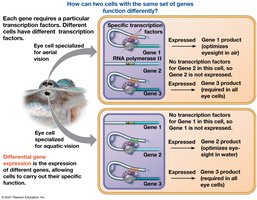
Operons: The Basic Concept
In prokaryotes, genes are often organized into operons, which allow coordinated control of gene expression. - Operon: A stretch of DNA that includes an operator, promoter, and the genes they control. - Operator: A DNA segment acting as an on-off switch for transcription. - Promoter: The site where RNA polymerase binds to initiate transcription. - Gene cluster: Functionally related genes controlled together.
Example: The trp Operon
The trp operon in E. coli regulates the synthesis of enzymes needed for tryptophan production. 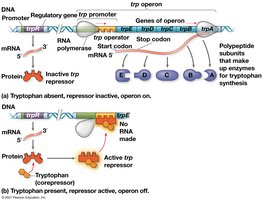
Repressible and Inducible Operons
Operons can be classified based on their regulatory mechanisms: - Repressible operon: Usually on; can be turned off by a repressor (e.g., trp operon). - Inducible operon: Usually off; can be turned on by an inducer (e.g., lac operon). - Repressor: Protein that binds to the operator to block transcription. - Inducer: Molecule that inactivates the repressor, allowing transcription.
Example: The lac Operon
The lac operon in E. coli controls the synthesis of enzymes for lactose metabolism. 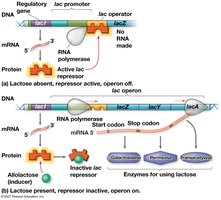
Positive Control of Gene Expression
Some operons are regulated by positive control mechanisms, which enhance transcription. - cAMP receptor protein (CRP): Activates transcription when bound to cAMP. - Glucose levels: Influence cAMP concentration and thus CRP activity. 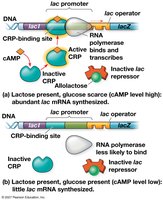
Stages of Gene Expression Regulation in Eukaryotes
Gene expression in eukaryotes is regulated at multiple stages, from chromatin modification to protein degradation. - Transcriptional regulation: Control of gene activation for transcription. - RNA processing: Includes splicing, capping, and polyadenylation. - Translation: Regulation of mRNA translation into protein. - Protein processing and degradation: Modifications and selective degradation of proteins. 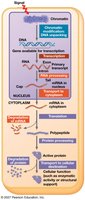
Chromatin Structure and Histone Modifications
Chromatin structure affects gene accessibility and transcription. - Histone acetylation: Addition of acetyl groups to histone tails, loosening chromatin and promoting transcription. - DNA methylation: Addition of methyl groups to DNA, often leading to reduced transcription and long-term gene silencing. - Genomic imprinting: Methylation regulates expression of maternal or paternal alleles. 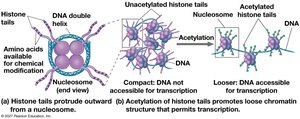
Epigenetic Inheritance
Epigenetic modifications can be inherited without altering the DNA sequence. - Epigenetic inheritance: Transmission of traits via chromatin modifications. - Example: Identical twins may differ in disease susceptibility due to epigenetic variation.
Transcriptional Regulation: Enhancers and Activators
Enhancers and transcription activators play key roles in regulating gene expression. - Enhancer: DNA sequence that increases transcription when bound by activators. - Transcription activators: Proteins that bind enhancers and facilitate transcription initiation. 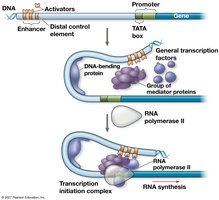
Cell Type–Specific Transcription
Different cell types express specific sets of genes due to unique combinations of transcription factors and enhancers. 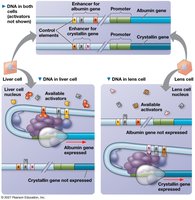
Alternative RNA Splicing
Alternative splicing allows a single gene to produce multiple protein variants. - Exons: Coding regions of a gene. - RNA splicing: Removal of introns and joining of exons in different combinations. 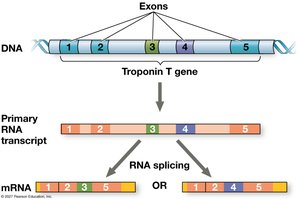
Protein Processing and Degradation
After translation, proteins undergo modifications and are selectively degraded. - Ubiquitin: Small protein attached to target proteins for degradation. - Proteasome: Protein complex that degrades ubiquitinated proteins.
Regulation by microRNAs (miRNAs)
miRNAs regulate gene expression post-transcriptionally by binding to mRNA and blocking translation or promoting degradation. 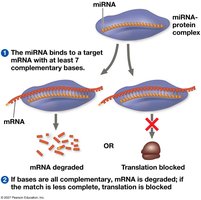
Gene Regulation in Development and Disease
Genetic Program for Embryonic Development
Embryonic development involves cell division, differentiation, and morphogenesis. - Cell differentiation: Cells become specialized in structure and function. - Morphogenesis: Physical processes that shape the organism. 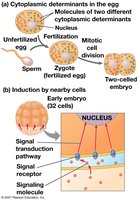
Determination and Differentiation of Muscle Cells
Muscle cell development is regulated by specific transcription factors and gene expression programs. 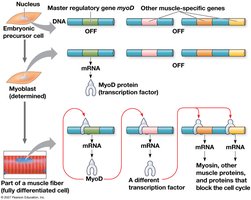
Genes Associated with Cancer
Mutations in certain genes can lead to uncontrolled cell growth and cancer. - Oncogenes: Mutated proto-oncogenes that promote cell growth and division. - Tumor-suppressor genes: Normally inhibit cell division and repair DNA; mutations can contribute to cancer. - Functions of tumor-suppressor proteins: DNA repair, cell adhesion, cell cycle inhibition.
Multistep Model of Cancer Development
Cancer often develops through a series of genetic changes affecting oncogenes and tumor-suppressor genes. 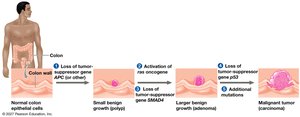
Summary of Eukaryotic Gene Expression Regulation
Eukaryotic gene expression is regulated at multiple stages, including chromatin modification, transcription, RNA processing, translation, and protein degradation. 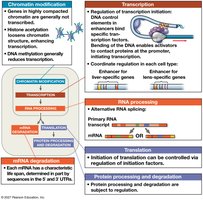
Key Regulatory Mechanisms Table
Stage | Regulatory Mechanism | Effect |
|---|---|---|
Chromatin Modification | Histone acetylation, DNA methylation | Alters DNA accessibility |
Transcription | Enhancers, activators, repressors | Controls gene activation |
RNA Processing | Alternative splicing | Generates protein diversity |
Translation | miRNAs, initiation factors | Regulates protein synthesis |
Protein Processing | Ubiquitin-mediated degradation | Controls protein lifespan |
Additional info: This table summarizes the main stages and mechanisms of gene expression regulation in eukaryotic cells. ----------------------------------------
